

Medical Payments Coverage: A Safety Net for Your Visitors
Your Visitors Deserve Protection — Here's What Guest Medical Coverage Actually Does

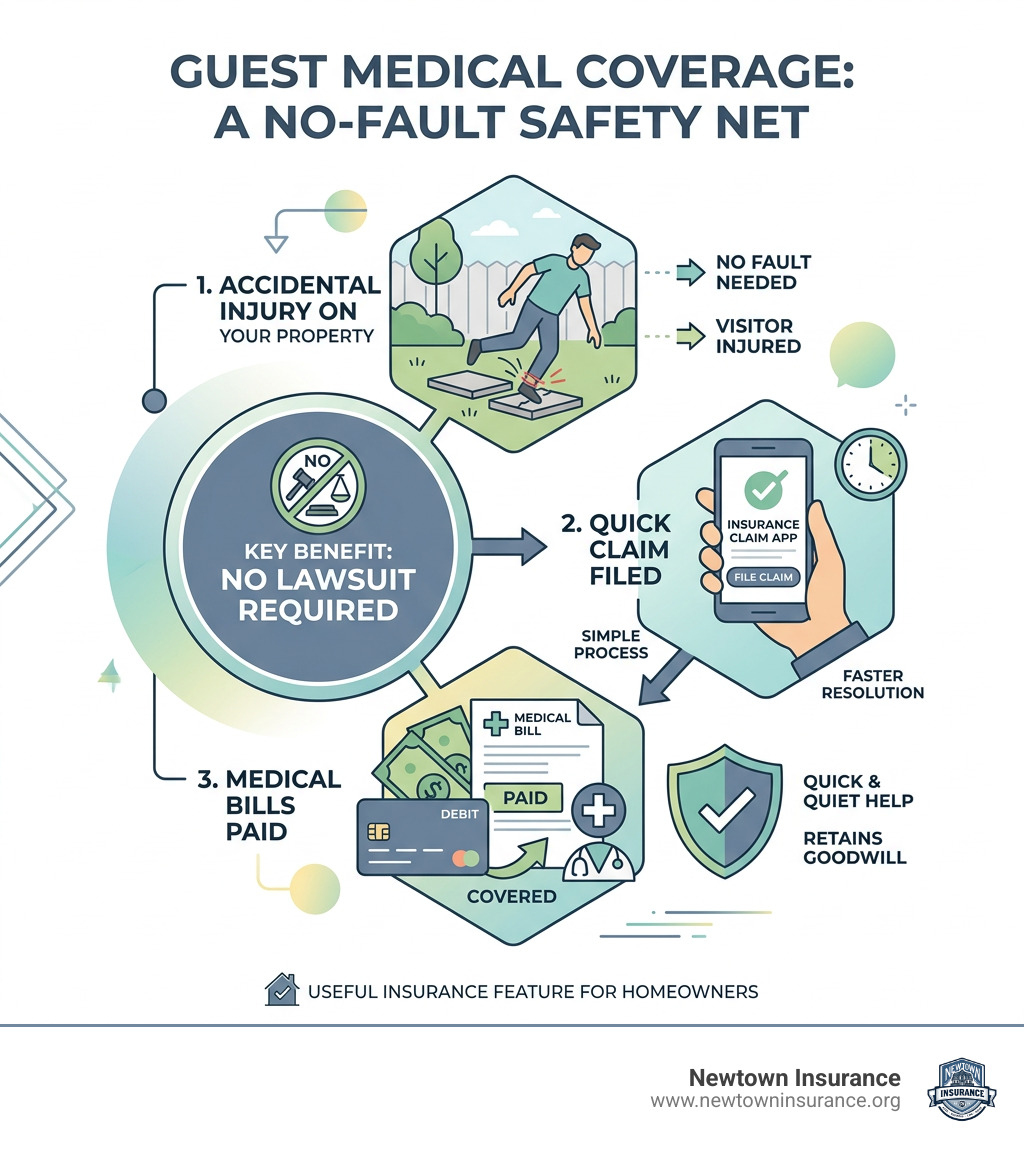
Guest medical coverage is a built-in feature of most homeowners insurance policies that pays for a visitor's medical bills if they get hurt on your property — no lawsuit required, no fault needed.
Here's a quick breakdown:
| Question | Quick Answer |
|---|---|
| What does it cover? | Medical bills for guests injured on your property |
| Who qualifies? | Non-residents — visitors, friends, delivery personnel |
| Typical limits | $1,000–$5,000 per incident (up to $25,000 with added coverage) |
| Is fault required? | No — it pays out regardless of who's responsible |
| Does it cover illness? | No — accidental injuries only |
| Does it cover residents? | No — household members are excluded |
Most homeowners don't think about this coverage until something goes wrong. A friend trips on your front steps. A delivery driver slips on your walkway. Suddenly you're dealing with a medical bill — and an awkward situation.
Guest medical coverage exists to handle exactly these moments. It's a financial safety net designed to help quickly, quietly, and without the stress of a legal battle.
I'm Shawn Beihl, a specialty insurance professional with over 15 years of experience across life, commercial P&C, health, and accident coverage — including the nuances of guest medical coverage and how it fits into a well-structured homeowners policy. In the sections below, I'll break down everything you need to know to make sure your home — and your guests — are properly protected.
What is Guest Medical Coverage in Homeowners Insurance?
In insurance, guest medical coverage is technically known as "Coverage F" or "Medical Payments to Others." Think of it as the "goodwill" portion of your homeowners policy. If a friend is over for a backyard BBQ in Newtown and accidentally trips over a loose patio stone, this coverage steps in to pay for their trip to the urgent care clinic.
The most important thing to understand is that this is no-fault insurance. Unlike other parts of your policy that require someone to be "to blame" before a check is cut, guest medical coverage triggers simply because an accident happened on your property. It is designed to handle small-scale injuries—the kind that require an X-ray, a few stitches, or an ambulance ride, but don't necessarily warrant a multi-year legal battle.
By providing immediate payouts for medical expenses, this coverage helps preserve your relationships. It prevents a minor slip-and-fall from turning into a major financial burden for your guest or a source of resentment between friends. It’s a way of saying, "I'm sorry you got hurt at my place; let me take care of the bill."

Guest Medical vs. Personal Liability: Key Differences
Many homeowners in Pennsylvania confuse guest medical coverage with personal liability coverage (Coverage E). While they both deal with injuries, they function very differently. Understanding these differences is crucial for any homeowner who wants to avoid overpaying for the wrong types of protection.
| Feature | Guest Medical (Coverage F) | Personal Liability (Coverage E) |
|---|---|---|
| Fault Required? | No | Yes (Negligence must be proven) |
| Typical Limits | $1,000 to $5,000 | $100,000 to $500,000+ |
| Legal Triggers | Accidental injury on site | Lawsuits, legal defense, settlements |
| Payout Speed | Fast (no investigation of fault) | Slow (often requires legal process) |
| Property Damage | Not covered | Covered (if you are liable) |
Personal liability is your "big guns" protection. It kicks in if someone sues you for a serious injury—for example, if a guest falls down a flight of stairs because of a broken railing you neglected to fix. In that case, you might be found negligent. Liability covers your legal fees and any court-ordered settlements, which can easily reach hundreds of thousands of dollars.
Guest medical coverage, on the other hand, is for the small stuff. It’s the $2,000 ER bill for a sprained ankle. Because it doesn't require a finding of negligence, the claim process is much faster. However, it specifically excludes property damage—so if your guest drops their expensive smartphone while tripping, guest medical won't pay for the screen repair.
What Does Guest Medical Coverage Typically Include?
When we talk about "medical expenses," we aren't just talking about the doctor's bill. Guest medical coverage is surprisingly broad in the types of services it will reimburse. If the injury occurred due to an accident on your property, the following are typically covered:
- Ambulance Fees: If the injury is serious enough to require professional transport.
- X-rays and Diagnostic Tests: To determine the extent of the injury.
- Surgical Procedures: If immediate surgery is required due to the accident.
- Hospital Stays: Room and board charges during recovery.
- Professional Nursing Care: Licensed care required during the healing process.
- Prosthetics: If the injury results in the need for a medical device.
- Dental Repair: Specifically for injuries to sound, natural teeth caused by the accident.
- Funeral Expenses: In the tragic event of a fatal accident on the property.
Eligible Expenses Under Guest Medical Coverage
The goal of this coverage is to make the injured party "whole" again regarding their out-of-pocket medical costs. Whether it’s a quick visit to a specialist or a few days of professional nursing, as long as the expense is a direct result of an accidental injury sustained on your premises, it falls under the umbrella of Coverage F.
Who is Eligible for Protection?
This is a common point of confusion. Who exactly is a "guest"? For the purposes of this insurance, a guest is anyone who does not regularly live in your household. This includes:
- Friends and extended family visiting for the holidays.
- Neighbors stopping by to say hello.
- Delivery personnel (Amazon, UPS, or the local pizza shop).
- Solicitors or mail carriers.
Who is NOT covered? You, your spouse, your children, or anyone else living in your home. If your son trips over his own skateboard in the driveway, your health insurance handles that, not your homeowners policy. Additionally, domestic employees (like a live-in nanny) are usually excluded because they should be covered under workers' compensation insurance.
Understanding Limits and Exclusions
Every insurance policy has boundaries. For guest medical coverage, those boundaries are usually defined by dollar amounts and specific types of incidents.
Common Limits for Guest Medical Coverage
Most standard homeowners policies in Pennsylvania come with a base limit of $1,000 per person. However, given that a single ER visit can easily exceed $3,000, many homeowners choose to increase this limit.
- $1,000: The bare minimum, often included by default.
- $5,000: The most common "standard" limit.
- $10,000 to $25,000: Recommended for high-traffic households or those who host frequent parties and events.
If a guest's medical bills exceed your limit—say, the bill is $7,000 but your limit is $5,000—the guest may have to look to their own health insurance for the remaining $2,000, or they might decide to file a liability claim against you if they believe you were at fault. For truly catastrophic accidents, an umbrella policy can provide an extra layer of protection that sits on top of your homeowners limits.
What is Excluded from Coverage?
While guest medical is generous, it isn't a "blank check" for any health issue. Here are the major exclusions:
- Illness: If a guest catches the flu or a virus while visiting your home, this coverage will not pay for their doctor's visit. It only covers accidental injuries.
- Pre-existing Conditions: If a guest has a chronic back problem that flares up while they are sitting on your sofa, it is generally not covered.
- Business Activities: If you run a daycare or a hair salon out of your home and a client gets hurt, your standard homeowners policy (including guest medical) likely won't cover it. You would need specific business liability insurance.
- Intentional Harm: If you (or a resident) intentionally injure a guest, insurance will not pay.
- Professional Athletics: Injuries sustained during organized, professional athletic activities on your property are typically excluded.
Frequently Asked Questions about Guest Medical Protection
Is fault or negligence required to file a claim?
No. This is the "magic" of guest medical coverage. You don't have to admit you did something wrong, and your guest doesn't have to prove you were lazy about home maintenance. If they slipped on a banana peel that they dropped, the policy can still pay out. This direct-claim process is designed to be hassle-free and keeps the lawyers out of the living room.
How does this interact with a guest's health insurance?
In many cases, guest medical coverage acts as "primary" coverage for the accident, meaning it pays out first. This is incredibly helpful for your guest because it can cover their health insurance deductible or co-pays, which can be thousands of dollars. By using your guest medical coverage, your visitor doesn't have to dip into their own savings to pay for an accident that happened at your house.
Does coverage apply to illnesses or only injuries?
Coverage is strictly for accidental injuries. A "medical emergency" like a heart attack or a stroke that happens while someone is visiting is generally not covered unless it was directly caused by an accident (like a fall). Viruses, infections, and other illnesses are excluded. The event must be "sudden and accidental."
Conclusion
At Newtown Insurance, we believe that being a good neighbor starts with having the right protection. Guest medical coverage is a small but mighty part of your homeowners policy that ensures your home remains a place of hospitality, not a source of financial stress. Whether you're hosting a graduation party or just having the neighbors over for coffee, knowing you have a "no-fault" safety net in place provides true peace of mind.
If you aren't sure what your current limits are, or if you're worried that your $1,000 limit isn't enough for today's medical costs, we’re here to help. As a Pennsylvania-based provider, we offer tailored protection and transparent pricing to ensure you have exactly what you need—and nothing you don't.
Protect your home and visitors with a policy review from Newtown Insurance. Give us a call today to see how we can help you save while staying fully protected.