The Hidden Cost of Insurance (And How to Stop Overpaying)

No hidden fee insurance means what you’re quoted is what you actually pay — no surprises buried in the fine print. Here’s a quick look at what that means in practice:
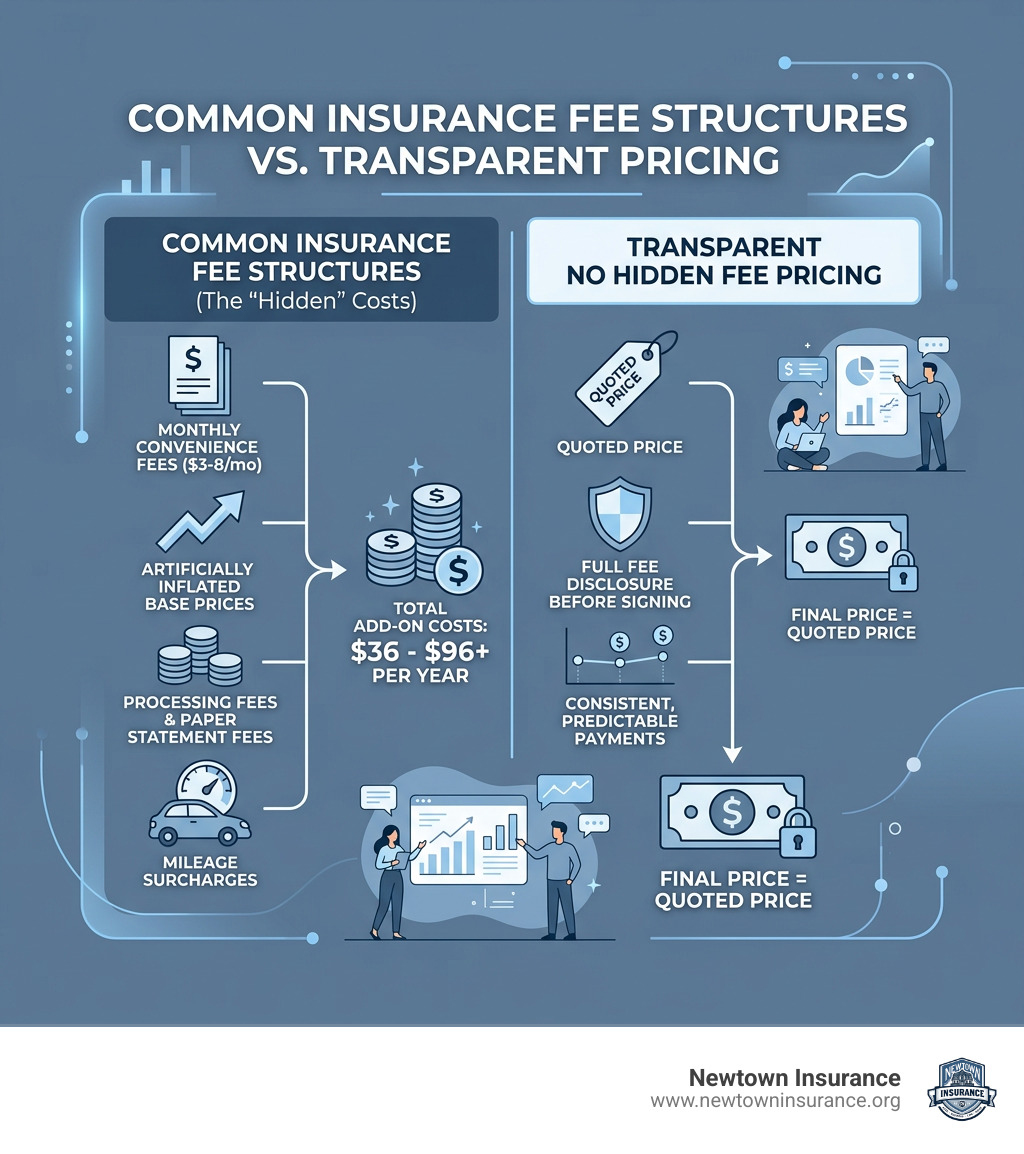
| What Transparent Insurance Looks Like | What to Watch Out For |
|---|---|
| Upfront pricing with no added surcharges | Convenience fees of $3-8/month for monthly payments |
| Quotes that don’t inflate prices before offering “discounts” | Fake discounts applied to artificially high base prices |
| Full fee disclosure before you sign | Processing fees, paper statement fees, mileage surcharges |
| Consistent pricing you can plan around | Coverage limits that quietly increase your out-of-pocket costs |
Hidden fees in insurance are exactly what they sound like — charges that don’t show up when you get your quote, but appear later in the fine print. They can range from small monthly “convenience fees” to processing charges and mileage penalties.
These costs add up fast. Monthly payment surcharges alone can cost you an extra $36 to $96 every year without you even realizing it.
And that’s before you factor in inflated base prices designed to make discounts feel like savings — even when they aren’t.
I’m Shawn Beihl, and with over 15 years in specialty insurance — including commercial P&C, life, health, and benefits management — I’ve seen how hidden fees quietly drain policyholders’ budgets, and I’m here to show you how no hidden fee insurance can change that. Read on for five practical tips you can start using today.
Tip 1: Spot the “Convenience” Trap in Monthly Payment Plans
Most of us prefer to pay for our insurance monthly rather than dropping a massive lump sum once a year. It helps with cash flow and aligns with our paychecks. However, in traditional insurance, this “convenience” comes at a literal price.
Many insurers charge what they call “convenience fees” or “installment fees” for the privilege of paying monthly. These fees typically range from $3 to $8 per month. While that might look like “pocket change” on your monthly statement, let’s do the math. Over a year, those small surcharges add up to $36–$96 in extra costs.
Think about that: you are essentially being penalized for not being able (or willing) to pay your entire premium upfront. These aren’t just administrative costs; they are pure profit for the insurance company, often buried so deep in the fine print that you don’t notice them until the first withdrawal hits your bank account.
When we talk about no hidden fee insurance, we’re looking for providers that offer payment flexibility without the “tax.” A truly transparent provider will show you the total annual cost and the monthly breakdown side-by-side, ensuring the sum of the twelve payments equals the annual total.
Common payment surcharges to watch out for include:
- Installment Fees: A flat fee added to every monthly bill.
- EFT Processing Fees: Charges for “processing” an automatic bank withdrawal.
- Late Payment Penalties: Excessive fees that kick in the moment a payment is a day late.
- Policy Change Fees: Costs associated with updating your address or adding a driver mid-term.
Tip 2: Look Beyond the “Winning Feeling” of Fake Discounts
We all love the feeling of “winning” a negotiation. Insurance companies know this, and some use it to their advantage through psychological haggling. It’s a retail sales tactic: inflate the initial quote so that when they “apply” a discount, you feel like you’ve secured a massive victory.
In reality, if the base price was artificially high to begin with, that 15% discount just brings you back down to the market average. It’s the “Black Friday” of insurance—marking prices up just to mark them down. This lack of upfront pricing makes it nearly impossible for you to know if you’re actually getting a good deal.
In Pennsylvania, transparency is becoming a bigger focus for regulators. For example, recent legislative efforts like the New federal law will help protect Pa. residents against surprise medical bills highlight a growing demand for honesty in how financial and medical services are billed. While that law focuses on healthcare, the principle is the same: you deserve to know the price before the service is rendered.
Genuine savings come from a provider’s efficiency, not their ability to “find” a discount after you complain. When you look for no hidden fee insurance, prioritize companies that give you their best, lowest price right from the start. If a company can suddenly drop their price by $400 just because you threatened to cancel, it means they were comfortably overcharging you until you spoke up.
Tip 3: Prioritize Providers with No Hidden Fee Insurance Models
The best way to avoid fees is to work with a company whose entire business model is built on transparency. Modern, tech-forward insurance providers are moving away from the “fee-heavy” model of the past. By using AI to streamline claims and reduce fraud, these companies can cut overhead costs and pass those savings directly to you without needing to “nickel and dime” you through administrative surcharges.
A key component of this is the fee cap. Transparent providers often cap their administrative fees or eliminate them entirely, relying on a flat percentage of the premium to cover their operations. This creates a trust-based relationship where the insurer doesn’t profit more just because you choose a different payment method.
You have rights when it comes to knowing what you’re paying for. Resources like the No Surprises Act and your rights provide a framework for understanding how transparency should work in complex financial sectors. In the insurance world, this means:
- Upfront Lowest Premiums: No “introductory” rates that skyrocket after six months.
- No-Negotiation Policy: Everyone gets the best rate the company can offer based on their risk profile.
- Digital-First Management: Using apps and portals to reduce the need for paper-based fees.
For those in Pennsylvania looking for this level of clarity, exploring More info about transparent insurance services can help you identify exactly what a clean, fee-free policy should look like.
Tip 4: Understand the True Cost of “No Deposit” and Micropayments
Lately, the industry has seen a rise in “no deposit” or “micropayment” insurance. While these can be life-savers for those living paycheck-to-paycheck, it is vital to understand the mechanics behind them to ensure they truly qualify as no hidden fee insurance.
In most cases, “no deposit” insurance is achieved through premium financing. Essentially, a third party (or a branch of the insurer) provides an interest-free loan to cover the down payment required by state law. This allows you to start your policy with $0 down. While this is a great tool for accessibility, you must ensure there aren’t hidden “broker fees” or “financing charges” attached to each payment.
Another risk to watch for is the coverage lapse. Micropayment models—where you pay day-to-day—can be risky. If your account runs dry for even a few hours, your coverage could lapse. In the eyes of the insurance industry, a lapse in coverage makes you a “high-risk” driver.
There is a “magic number” in insurance: 201 days. If you can maintain continuous coverage for at least 201 days, you often move from a “high-risk” category to a “preferred” category, which can drastically lower your premiums. If a “no-fee” model leads to frequent lapses because of its payment structure, it might actually cost you more in the long run by keeping your rates high.
Tip 5: Leverage Bundling and Digital-First Management
One of the most effective ways to achieve “smart savings” while maintaining transparency is through bundling. By placing your home and auto insurance with the same provider, you can often secure a “multi-line discount” of up to 15%.
Beyond the discount, bundling simplifies your financial life. Instead of tracking multiple due dates and potentially multiple sets of hidden fees, you have one point of contact. Furthermore, many providers offer a single deductible. If a storm damages both your car in the driveway and the roof of your house, a bundled policy might allow you to pay just one deductible instead of two.
To keep your costs as low as possible, embrace digital-first management. Many insurers now charge “paper statement fees” of $1 to $5 just to mail you a physical bill. By opting for paperless statements and managing your policy through an app, you eliminate these unnecessary surcharges entirely.
Policies you should consider bundling include:
- Auto + Homeowners
- Auto + Renters
- Auto + Condo
- Multi-car policies
We recommend an annual policy review. Even with a transparent provider, your life changes—you might drive less, install a security system, or pay off a car loan. Checking in once a year ensures your “no hidden fee” policy is still tailored perfectly to your current needs.
Frequently Asked Questions about Transparent Pricing
What are common hidden fees in no hidden fee insurance?
Even when a policy is marketed as “transparent,” you should double-check for:
- Convenience fees: Small charges for monthly billing.
- Cancellation fees: Penalties for ending a policy before the term is up.
- Paper statement fees: Charges for receiving mail instead of digital alerts.
- Late fees: Surcharges that may exceed the actual cost of the missed interest.
- SR-22 filing fees: Extra costs for filing high-risk certificates with the state.
How do I identify a genuine no hidden fee insurance provider?
A genuine provider will offer:
- Upfront Quotes: The price you see is the price you pay.
- Fee Disclosure: A clear, easy-to-read list of any and all administrative costs.
- No-Negotiation Policy: They don’t play “price match” games because their first price is their best price.
- Transparent Fee Caps: If they do charge fees, they are capped at a reasonable, disclosed amount.
Are hidden fees more prevalent in car or home insurance?
Hidden fees are generally more prevalent in car insurance. This is because car insurance policies are updated more frequently (new cars, new drivers, address changes) and have more “moving parts” like mileage surcharges or installment interest. Home insurance tends to be more stable, but you should still watch out for processing fees and surcharges for “specialty” items like jewelry or art that weren’t clearly explained upfront.
Conclusion
At Newtown Insurance, we believe that residents of Pennsylvania deserve better than the “fine print” games of the past. Our mission is to provide no hidden fee insurance through a combination of tailored protection, smart savings, and absolute transparency.
We are a local provider that puts the customer first, ensuring you never overpay for “convenience” or “admin” costs that don’t add value to your protection. If you’re tired of the surcharges and ready for a straightforward relationship with your insurer, it’s time to make the switch.
Ready to see the difference transparency makes? Start Now and get a quote that actually means what it says.