What Pennsylvania Employers Need to Know About Workers’ Compensation Insurance

Workers compensation insurance PA is mandatory for nearly every employer in the state — even if you only have one part-time employee.
Here’s a quick overview of the key facts:
| Topic | Key Detail |
|---|---|
| Who needs it? | All PA employers with 1 or more employees (full-time, part-time, or family members) |
| What does it cover? | Medical bills, lost wages, death benefits, and occupational diseases |
| Wage replacement rate | ~66.67% of pre-injury average weekly wage |
| How to get it | Private carrier, State Workers’ Insurance Fund (SWIF), or approved self-insurance |
| Penalty for skipping it | Fines up to $15,000 and up to 7 years in prison |
| Reporting deadline | Employees have 120 days to report an injury |
Pennsylvania’s workers’ compensation system has been in place since 1915. It’s a no-fault system, meaning injured employees don’t have to prove their employer did anything wrong to receive benefits. In return, employers get protection from most personal injury lawsuits filed by employees.
For many Pennsylvania business owners — especially small businesses — understanding this coverage can feel overwhelming. The rules around who qualifies, what’s covered, and how much it costs aren’t always obvious. This guide breaks it all down in plain language.
I’m Shawn Beihl, a specialty insurance adviser with over 15 years of experience across commercial P&C, disability, and benefits management, including workers compensation insurance PA — helping businesses identify risk and control costs. In the sections ahead, I’ll walk you through everything you need to know to stay compliant and protect your team.
Understanding Workers Compensation Insurance PA Requirements

In the Commonwealth, the rules are quite clear: if you employ people, you almost certainly need workers compensation insurance PA. This isn’t just a friendly suggestion from the state; it’s a legal mandate that dates back to the Pennsylvania Workmen’s Compensation Act of 1915.
The system was designed as a “grand bargain.” Employees gave up the right to sue their employers for negligence in exchange for guaranteed medical care and wage loss benefits, regardless of who was at fault for the accident. For us as employers, this provides what is known as the exclusive remedy doctrine. This means that in most cases, the workers’ comp system is the only way an employee can recover damages, shielding our businesses from potentially bankrupting personal injury lawsuits.
Who Needs Workers Compensation Insurance PA?
Whether you are running a tech startup in Newtown or a local coffee shop, the law applies to you if you have one or more employees. This includes:
- Full-time employees
- Part-time employees
- Seasonal workers
- Family members employed by the business
For a long time, many small business owners felt left out of the loop. However, the 2011 Reform Bill signed by Governor Corbett was a game-changer. It expanded access and made it easier for small businesses, including sole proprietors, partners, and LLC members, to secure the protection they need. You can find more Official PA Workers’ Comp Act Details through the Department of Labor & Industry (DLI).
Common Exemptions from Workers Compensation Insurance PA
While the net is cast wide, there are a few specific groups that may be exempt from the standard PA workers’ comp rules:
- Federal Employees: These workers are covered under federal programs rather than state law.
- Casual Labor: Workers whose employment is occasional and not in the regular course of the employer’s business.
- Domestic Servants: Coverage for nannies or housekeepers is generally optional, though highly recommended.
- Agricultural Workers: Farmers are exempt if they employ a worker for fewer than 30 days a year or pay that worker less than $1,200 in a calendar year.
- Religious Exemptions: Members of certain religious sects whose tenets oppose insurance benefits may apply for an exemption.
- Executive Officers: In some cases, corporate officers can waive their own coverage if they meet specific ownership criteria.
Benefits and Coverage Under Pennsylvania Law
When a claim is filed, workers compensation insurance PA kicks in to cover several types of benefits. The goal is to get the worker back on their feet (literally and financially) without putting the business out of operation.
Medical and Wage Loss Specifics
The most immediate benefit is medical coverage. This includes all “reasonable and necessary” care, such as ER visits, surgeries, hospital stays, and prescriptions. It even covers orthopedic appliances like braces or crutches.
One unique rule in Pennsylvania is the 90-day doctor rule. If an employer provides a list of at least six designated healthcare providers, the employee must treat with one of those providers for the first 90 days of their injury. After that, they are free to choose their own doctor.
For wage loss, the math is fairly straightforward:
- The Rate: Generally, employees receive 66.67% (two-thirds) of their average weekly wage.
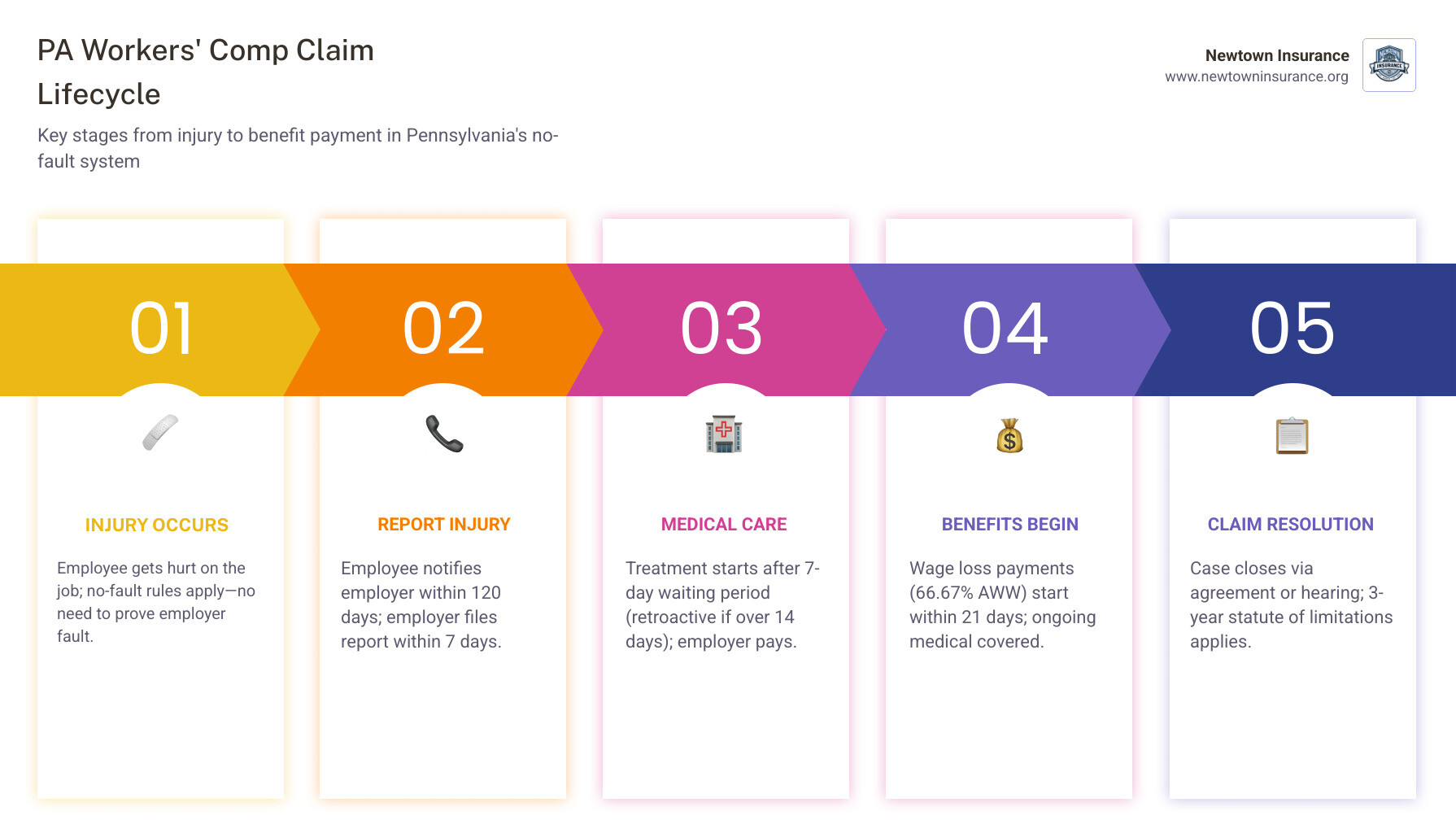
- The Waiting Period: No benefits are paid for the first 7 days of disability.
- The Retroactive Rule: If the disability lasts more than 14 days, the employee is then paid retroactively for that first week.
- Caps: These payments are subject to a maximum cap based on the PA Statewide Average Weekly Wage (SAWW).
Pennsylvania Death Benefits and Funeral Expenses
In the tragic event of a workplace fatality, the law provides support for the deceased’s family.
- Funeral Expenses: The policy pays up to $7,000 for burial costs.
- Dependent Benefits: A widow or widower without children typically receives 51% of the deceased’s average weekly wage. If there are children, that percentage can increase up to 66.67%.
- Extended Family: If there is no surviving spouse or child, dependent parents or siblings may be eligible for benefits under specific Death benefit distribution rules.
How to Obtain Coverage and Manage Costs
At Newtown Insurance, we believe you shouldn’t have to overpay for compliance. There are three primary ways to secure workers compensation insurance PA:
- Private Insurance Carriers: Most businesses buy a policy through an agent or broker. This is often the most flexible and cost-effective route for low-to-medium risk businesses.
- State Workers’ Insurance Fund (SWIF): Created in 1915, SWIF is the “insurer of last resort.” It provides coverage for businesses that might be turned away by private carriers due to high-risk industries (like roofing or logging) or a poor claims history.
- Self-Insurance: Very large, financially stable companies can essentially “insure themselves” by setting aside funds to pay claims directly.
Factors That Affect Your Premium
Your cost is typically calculated using this formula: (Payroll / 100) x Class Code Rate x Experience Modifier.
- Class Codes: Every job has a code based on risk. A desk clerk costs much less to insure than a steelworker.
- Payroll: Since premiums are based on every $100 of payroll, your total headcount directly impacts the cost.
- Experience Modification Factor: This is your “safety score.” If you have fewer accidents than average for your industry, your “mod” goes down, and so does your premium.
The Path to Self-Insurance in PA
Self-insurance isn’t for everyone. To qualify, a business must typically have been in operation for at least three consecutive years and demonstrate immense financial strength. The application process involves submitting audited financials and maintaining an adequate accident and illness prevention program. Most self-insured entities in PA use the PA Code Self-Insurance Regulations as their guide and manage their filings through the WCAIS system.
Penalties for Non-Compliance and Reporting Timelines
Skipping out on workers compensation insurance PA is a gamble you will eventually lose. The state takes this very seriously because an uninsured injury often ends up being paid for by the Uninsured Employers Guaranty Fund — and the state will come knocking to get that money back from you.
Criminal Penalties:
- Misdemeanor: Failure to insure can result in a $2,500 fine and up to one year in jail.
- Felony: If the state proves the failure was intentional, the fine jumps to $15,000 per violation, and you could face up to seven years in prison.
Civil Penalties:
Beyond the fines, you lose your “exclusive remedy” protection. This means an injured worker can sue you in civil court, where there are no caps on “pain and suffering” damages. For more details on the risks, see the Employer Penalty Documentation.
Critical Deadlines for Employers and Employees
Timing is everything in a workers’ comp claim.
- 120 Days: The maximum time an employee has to report an injury to their employer. If they miss this, they may lose their right to benefits.
- 7 Days: Once an employer is notified of an injury that results in lost time, they have 7 days to file a report with their insurer.
- 21 Days: The employer/insurer must either start paying benefits or issue a formal denial within 21 days of being notified.
- 3 Years: The statute of limitations for filing a formal claim petition if a case is denied.
For a full list of rights, we recommend keeping the Injured Worker Rights Pamphlet on hand.
Frequently Asked Questions about PA Workers’ Comp
What does workers’ comp NOT cover in Pennsylvania?
While the system is broad, it isn’t a “catch-all” for every bad day at the office. It does NOT cover:
- Injuries caused by the employee’s intoxication or illegal drug use.
- Self-inflicted injuries.
- Injuries resulting from illegal acts or fighting (unless the employee was a victim of a work-related assault).
- Pain and Suffering: Unlike civil lawsuits, workers’ comp only pays for economic losses (medical and wages).
- Job Security: Workers’ comp provides money, but it does not technically guarantee your specific job will be waiting for you, though other laws like the FMLA might.
When does my coverage actually begin?
For the employee, coverage begins on Day 1, Minute 1 of the job. There is no “probationary period” for workers’ comp.
For the employer, coverage typically begins the day after the insurance carrier receives your completed application and premium check. If you are using SWIF, they are very strict about this — coverage is never retroactive.
How are wage loss benefits calculated?
Benefits are based on the “Average Weekly Wage” (AWW) earned during the year prior to the injury.
If you earn $900 a week, your benefit would typically be $600 (66.67%). However, if you are still able to work but in a lower-paying role due to your injury, you may receive “partial disability” benefits to help bridge the gap. Benefits are suspended if an employee is incarcerated.
Conclusion
Navigating workers compensation insurance PA doesn’t have to be a headache. At Newtown Insurance, we specialize in helping Pennsylvania businesses find tailored protection that fits their specific industry and budget. Our goal is to provide smart savings and transparent pricing so you can focus on growing your business while we handle the risk.
Whether you’re a new business owner or looking to review your current experience modifier, our customer-first support team is here to help. For more information on how we can protect your Newtown business, visit our services content page or reach out for a consultation. Stay safe, stay covered, and let’s keep Pennsylvania working.