

The Ultimate Guide to Affordable Business Insurance
Why Affordable Business Insurance Is Essential for Small Business Owners

Affordable business insurance helps protect your company from financial losses caused by accidents, lawsuits, property damage, and more — without breaking the bank. Here's a quick summary of what you need to know:
- Cost range: Most small businesses pay between $500 and $5,000 per year
- Starting price: Basic general liability can start as low as $19/month
- What it covers: Third-party injuries, property damage, professional errors, business interruption, and more
- Is it required? Not always by law, but often required by contracts, licenses, or clients
- How to save: Bundle policies, raise deductibles, compare quotes, and ask about loyalty discounts
Running a small business already comes with plenty of financial pressure. As one industry expert put it, "any financial loss can be a serious threat" — especially in tough economic times. The right insurance policy doesn't have to be expensive. It just has to fit your business.
I'm Shawn Beihl, and with over 15 years of specialty insurance experience — including commercial property and casualty coverage — I've helped countless business owners find affordable business insurance that actually matches their risks. In the sections below, I'll walk you through everything you need to make a smart, confident decision.
How Much Does Affordable Business Insurance Cost?
When you are trying to balance the books in Newtown, Pennsylvania, the first question is always: "What’s the damage going to be to my bottom line?" We understand that every dollar counts. The truth is that affordable business insurance isn't a one-size-fits-all price tag. Instead, it’s a spectrum based on how much risk your specific venture carries.
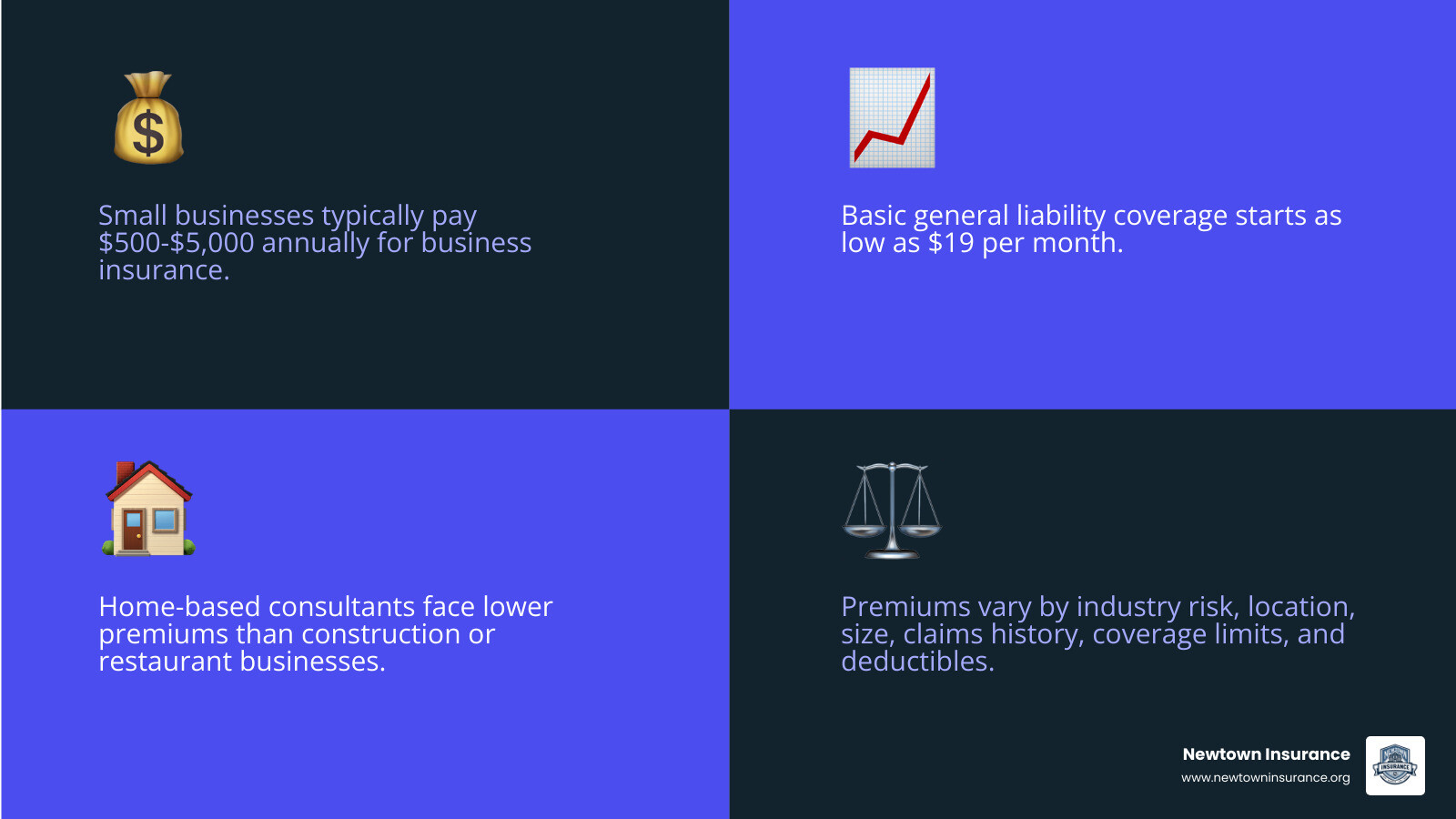
Typically, small businesses can expect to pay anywhere from $500 to $5,000 annually for their business insurance policies. If that range seems wide, it’s because a solo consultant working from a home office in Bucks County has vastly different needs than a local construction crew or a bustling restaurant on State Street.
For many low-risk businesses, you can find basic general liability plans starting at around $500 annually. If you prefer to look at it on a monthly basis, some providers offer coverage for as little as $19 to $21 per month. However, as your business grows—adding employees, physical storefronts, or specialized equipment—your premiums will naturally scale to match that increased exposure.

Factors Influencing Your Affordable Business Insurance Premiums
Why does your neighbor’s landscaping business pay more than your graphic design studio? It all comes down to the "ingredients" that insurers use to bake your premium. Here are the primary factors we look at:
- Industry Type: This is the biggest driver. A business that uses heavy machinery or handles hazardous materials is statistically more likely to file a claim than an office-based professional.
- Business Size and Operations: The more revenue you generate and the more employees you have, the larger your "target" for potential lawsuits or accidents.
- Location: Operating in Pennsylvania means your rates are influenced by local state laws, weather patterns, and even the crime rates in your specific zip code.
- Claims History: Think of this like your driving record. If you’ve had multiple claims in the past three to five years, insurers view you as higher risk, which can drive up costs.
- Coverage Limits and Deductibles: If you want $2 million in coverage instead of $1 million, you’ll pay more. Conversely, choosing a higher deductible (the amount you pay out of pocket before insurance kicks in) can significantly lower your monthly premium.
Real-World Examples of Coverage Costs
To give you a better idea of how affordable business insurance works in practice, let’s look at some common scenarios:
- The "Slip-and-Fall": Imagine a customer visits your retail shop in Newtown, trips over a loose rug, and breaks their wrist. Without insurance, you could be looking at thousands in medical bills and legal fees. A General Liability policy, which might cost you less than $50 a month, would typically cover these costs.
- Property Damage: A fire breaks out in the kitchen of your small cafe. Beyond the physical damage to the building, your expensive espresso machines and inventory are destroyed. Commercial Property insurance helps fund the repairs and replacement so you don't have to close your doors for good.
- Professional Errors: You’re a consultant and you give a client advice that leads to a significant financial loss for them. They sue you for negligence. Professional Liability (also known as Errors & Omissions) is designed to cover your legal defense and any resulting settlements.
Essential Coverage Types and Legal Requirements
Navigating insurance jargon can feel like reading a foreign language. But when you’re looking for affordable business insurance, it helps to know which "blocks" you actually need to build your safety net.
Basic Liability vs. Comprehensive Affordable Business Insurance Packages
Most small business owners start with General Liability Insurance. This is the "must-have" coverage that protects you against third-party injuries (like the slip-and-fall mentioned earlier), damage to someone else's property, and even advertising injuries like libel or slander.
However, many businesses find that a Business Owner’s Policy (BOP) is the most cost-effective route. A BOP bundles General Liability with Commercial Property insurance and often includes Business Interruption coverage. Bundling these together is almost always cheaper than buying them separately. It’s the "value meal" of the insurance world—you get the protection you need for your equipment, inventory, and liability in one neat, discounted package.
Who Needs Coverage and Is It Mandatory?
One of the most frequent questions we hear is: "Do I really need this?"
If you are a sole proprietor or a home-based business, the answer is a resounding yes. Many people mistakenly believe their homeowners insurance will cover their business activities. In reality, most homeowners policies have very low limits for business equipment and almost zero liability coverage for business-related accidents. If a delivery driver trips on your porch while dropping off a business package, your homeowners policy might deny the claim.
Is it mandatory in Pennsylvania? While Pennsylvania law doesn't require every business to carry General Liability, it does have strict rules for other types:
- Workers’ Compensation: If you have even one employee (including part-time workers), PA law generally requires you to carry Workers' Comp to cover on-the-job injuries.
- Commercial Auto: If you use a vehicle primarily for business, your personal auto insurance won't cover accidents that happen while you're working. Pennsylvania requires specific commercial limits for business vehicles.
- Contractual Obligations: Even if the law doesn't require it, your landlord or your clients probably will. Most commercial leases in Newtown require proof of liability insurance before you can move in.
Strategies to Save Money on Your Business Insurance
You want protection, but you also want to keep your expenses lean. Here is how we help our clients find the most affordable business insurance without cutting corners on quality.
Risk Mitigation: The Best Way to Lower Rates
Insurers love businesses that take safety seriously. By implementing simple safety protocols—like installing security cameras, using high-quality locks, keeping walkways clear of debris, and having formal employee training manuals—you can often qualify for lower premiums. Think of it as "proving" to the insurance company that you are a low-risk partner.
Smart Policy Adjustments
- Higher Deductibles: If you have enough cash in the bank to cover a $1,000 or $2,500 "emergency," raising your deductible can drop your monthly premium significantly.
- Annual Payments: Many insurance companies charge a small "convenience fee" for monthly billing. Paying your entire annual premium upfront can often save you 5% to 10% right off the bat.
- Multi-Product Discounts: Just like bundling your home and auto, bundling different types of business coverage (like a BOP + Commercial Auto) can lead to substantial "multi-policy" discounts.
How to Get Affordable Business Insurance Quotes Quickly
Gone are the days of waiting weeks for a paper quote to arrive in the mail. Today, you can gather the information you need in minutes. To get the most accurate and affordable business insurance quotes, have the following ready:
- Your legal business name and address.
- A brief description of what you do daily.
- Your estimated annual revenue.
- The number of employees you have.
- Details about any previous insurance claims.
Using online tools or working with a local broker allows you to compare different carriers side-by-side. This ensures you aren't just taking the first price offered, but the one that truly offers the best value for your specific industry.
Frequently Asked Questions about Business Insurance
Is business insurance tax deductible?
Yes! According to IRS regulations, the premiums you pay for business insurance are generally considered "ordinary and necessary" business expenses. This means you can typically write off the cost of your General Liability, Professional Liability, Workers’ Comp, and Property insurance on your federal tax return. This effectively lowers the "real" cost of your policy by reducing your taxable income.
Does my homeowners insurance cover my home-based business?
Usually, no. As we touched on earlier, homeowners insurance is designed for personal living, not commercial enterprise. While some policies might offer a small amount of coverage (e.g., $2,500) for business equipment like a laptop, they rarely provide the liability protection you need if a client sues you or if you are held liable for a data breach. If you run a business out of your home in Newtown, you need a dedicated business policy or at least a specific "home-based business" endorsement.
What about insurance taxes in Pennsylvania?
Unlike some regions that have complex provincial sales taxes (like the 8% PST seen in Ontario, Canada), Pennsylvania has its own set of tax rules for insurance. It is important to work with a local provider who understands the PA Department of Revenue requirements. Generally, your quoted premium will include any applicable state taxes or surcharges, so there are no surprises when you get your bill.
Conclusion
At Newtown Insurance, we live and work in the same community you do. We know that small businesses are the heartbeat of Pennsylvania, and our goal is to keep that heart beating strong by providing protection that fits your budget. We pride ourselves on offering tailored protection, smart savings, and transparent pricing.
You’ve worked too hard to build your business to let one accident take it all away. Whether you are a sole proprietor just starting out or an established local shop looking to save on your current premiums, we are here to help you navigate the process with customer-first support.
Don't leave your future to chance. Get a quote for our services today and see how easy it is to find affordable business insurance that gives you the peace of mind you deserve.