
Why Funeral Expense Coverage Matters More Than You Think

Funeral expense coverage is a type of life insurance designed to pay for end-of-life costs — like funeral services, burial, and related debts — so your family isn’t left with the bill.
Here’s what you need to know at a glance:
- What it covers: Funeral and burial costs, medical bills, legal fees, and other final expenses
- Who it’s for: Most policies are available to adults ages 50-85, with no medical exam required
- How much it pays: Typically between $5,000 and $50,000
- What it costs: Premiums can start around $62/month depending on age and coverage amount
- Key benefit: The death benefit is paid directly to your beneficiary and can be used for any expense
Most of us spend years planning for retirement. Planning for what happens after we’re gone? That’s a conversation most people put off — until it’s too late.
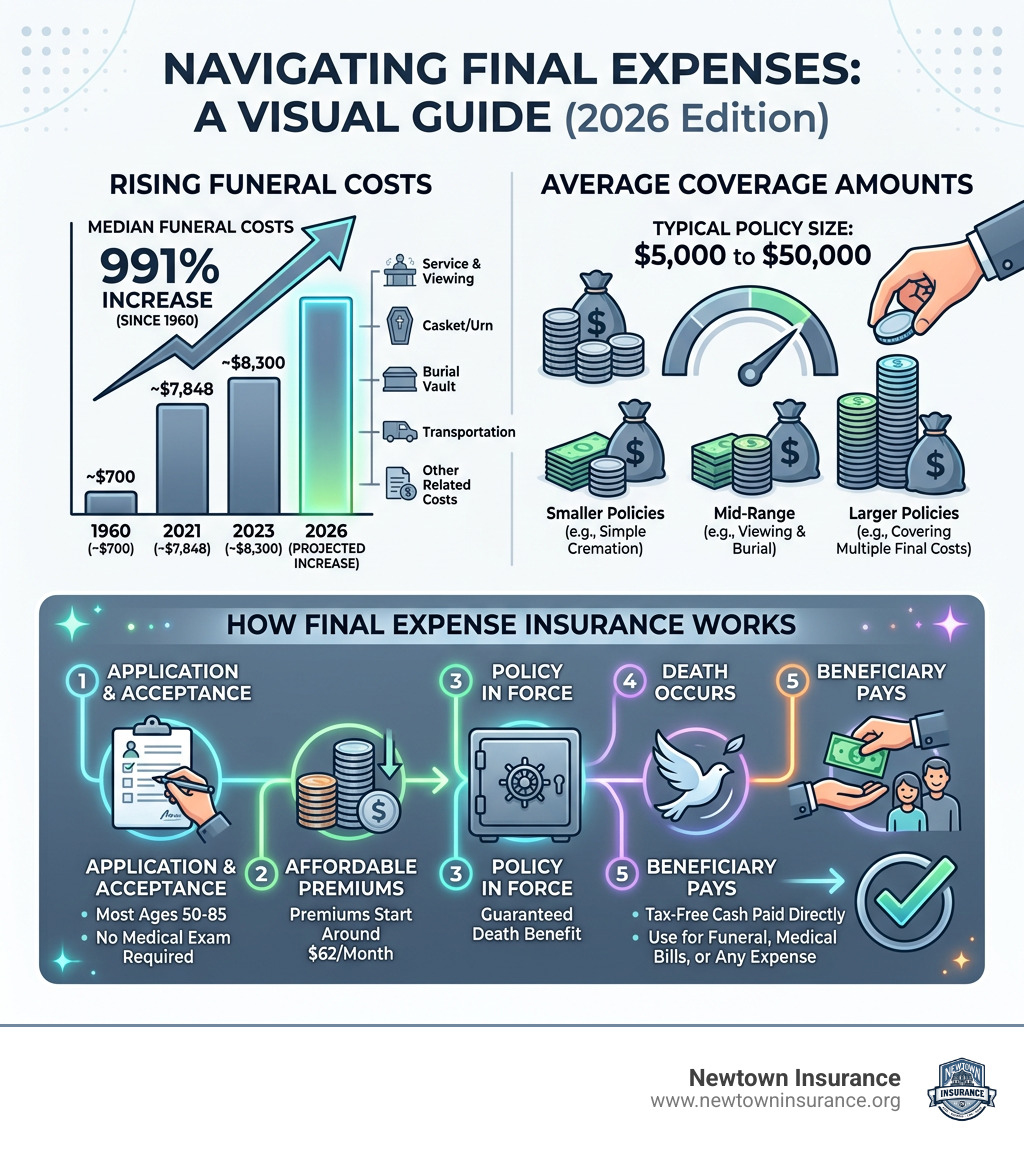
The numbers make a strong case for not waiting. According to the National Funeral Directors Association, the national median cost of a funeral with viewing and burial reached approximately $8,300 in 2023. That’s a staggering 991% increase from the $700 average in 1960. And Social Security’s one-time death benefit? Just $255 — barely enough to cover a grave marker.
Without a plan in place, those costs fall directly on the people you love most.
At Newtown Insurance, with over 15 years of specialty insurance experience — including life insurance and benefits management — we’ve helped countless families navigate the often-overlooked world of funeral expense coverage. In this guide, we’ll walk you through everything you need to make a confident, informed decision.
Understanding the Reality of Modern Funeral Costs
When we talk about “final expenses,” we aren’t just talking about a service and a bouquet of flowers. The reality of modern death care involves a long list of itemized costs that can catch grieving families off guard.
According to National Funeral Directors Association statistics, the median cost for an adult funeral with a viewing and burial was approximately $7,848 in 2021. However, when you add in a burial vault—which most cemeteries require to prevent the ground from buckling—that median price jumps to $9,420. By 2023, the average cost of a traditional funeral reached roughly $8,300.
To put this in perspective, funeral costs have skyrocketed by 991% over the last four decades. In 1960, a funeral cost about $700. By 1985, it was $2,737. Today, you are looking at nearly ten times the 1960 price.

Breaking Down the Bill
Why is it so expensive? Here are some of the typical costs your family might face:
- The Basic Service Fee: This is a non-declinable fee that covers the funeral home’s overhead. It currently averages around $2,300.
- Caskets: Depending on the material and style, casket prices can easily exceed $2,000 to $2,500.
- Burial Vaults: These protect the casket from the weight of the earth and heavy maintenance equipment, costing an average of $1,572.
- Opening and Closing the Grave: This labor fee typically ranges from $300 to $1,000.
- Cremation: While cremation expenses are often touted as the “budget” option, they are only about 28% less than a traditional burial when you include a viewing and service.
- Incidentals: Grave markers ($200–$400 for basic styles), obituaries, and flowers add up quickly.
Against these thousands of dollars in costs, the federal government offers a Social Security death benefit of just $255. It is a drop in the bucket, leaving a massive financial gap that funeral expense coverage is designed to fill.
What is Final Expense Insurance?
Final expense insurance (often called burial insurance or end-of-life insurance) is a type of permanent whole life insurance. Unlike term life insurance, which expires after a set number of years, this coverage stays with you for the rest of your life as long as you pay the premiums.
These policies are specifically designed for seniors, typically ranging from age 50 to 85. One of the biggest draws is the simplified application process. Most plans do not require a medical exam; instead, you simply answer a few health questions.
How Funeral Expense Coverage Works
When you pass away, the insurance company pays a cash death benefit to your chosen beneficiary. This money is usually paid out within days, providing the liquidity needed to pay a funeral home upfront.
The beauty of this coverage is its flexibility. While it is intended for a funeral, the beneficiary can use the funds for any “financial loose ends,” such as:
- Unpaid medical bills or hospice costs.
- Credit card debt or small personal loans.
- Legal fees and probate costs (which can take months or years to settle).
- Utility bills or mortgage payments for the family home.
Level vs. Modified Benefit Plans
Not all policies pay out the same way. Depending on your health when you apply, you will likely fall into one of two categories:
| Feature | Level Benefit Plan | Modified (Graded) Benefit Plan |
|---|---|---|
| Who it’s for | Applicants in relatively good health. | Applicants with serious pre-existing conditions. |
| Payout Timing | Full death benefit available from day one. | Limited payout during the first 2-3 years. |
| Accidental Death | Full benefit paid immediately. | Full benefit paid immediately. |
| Natural Death (Year 1-2) | Full benefit paid. | Refund of premiums + interest (often 10-30%). |
| Cost | Generally lower premiums. | Generally higher premiums due to risk. |
Comparing Funeral Expense Coverage to Traditional Life Insurance
At Newtown Insurance, we often help Pennsylvania residents distinguish between different types of protection. Traditional term life insurance is great for income replacement while you’re working, but it eventually expires. If you outlive the term, you’re left with no coverage for your funeral.
Standard whole life insurance offers high coverage amounts (hundreds of thousands of dollars) but requires rigorous medical exams and can be prohibitively expensive for seniors.
Funeral expense coverage hits the “sweet spot” for many. It offers a permanent solution with smaller, more affordable coverage amounts (usually $5,000 to $50,000) that match the actual costs of a funeral rather than trying to replace a 40-year salary.
Choosing the Right Funeral Expense Coverage Plan
Choosing a plan involves more than just looking at the monthly price. You need to understand the “fine print” regarding how and when the money is paid.
Simplified Issue vs. Guaranteed Issue
As noted in Investopedia’s guide to final expense, there are two primary ways to qualify:
- Simplified Issue: You answer a health questionnaire. If you don’t have major chronic illnesses, you can qualify for a “Level” plan with immediate full coverage.
- Guaranteed Issue: There are no health questions at all. You cannot be turned down. However, these almost always come with a waiting period (graded benefit).
Understanding Waiting Periods and Exclusions
If you have a graded benefit policy, the company usually won’t pay the full face value if you die of natural causes within the first two years. Instead, they might refund all the premiums you paid plus 10% to 30% interest. This protects the insurance company from “deathbed” applications. However, if death is accidental (like a car crash), the full benefit is almost always paid from day one.
Other common exclusions include a suicide clause. In most states, including Pennsylvania, if the policyholder dies by suicide within the first two years of the policy, the death benefit is not paid; instead, the premiums are refunded to the beneficiary.
Available Riders
You can often customize your policy with “riders” or add-ons:
- Accidental Death Rider: Pays an additional sum if you die in an accident.
- Children’s Term Rider: Provides a small amount of coverage for grandchildren or children.
- Accelerated Death Benefit: Allows you to access a portion of the money while you are still alive if you are diagnosed with a terminal illness.
Determining Your Coverage Needs and Alternatives
How much coverage do you actually need? To find your number, start with the current median funeral cost (roughly $8,300–$9,500) and then add a “cushion” for inflation and other debts. Most people find that a policy between $10,000 and $15,000 is sufficient to cover a standard service and leave a little extra for the family.
Are There Alternatives?
While burial insurance is a popular choice, it isn’t the only way to prepare:
- Savings Accounts: You could set aside $10,000 in a dedicated account. The risk? You might pass away before you finish saving, or the bank could freeze the account during probate, leaving your family unable to access the cash for weeks.
- Pre-need Plans: These are contracts made directly with a funeral home. You lock in today’s prices and pay them directly. The downside is that if the funeral home goes out of business or you move to another state, the plan may not be portable.
- Traditional Life Insurance: If you are younger and in great health, a standard whole life policy might offer better long-term value.
At Newtown Insurance, we emphasize transparent pricing and tailored protection. We believe in helping our Pennsylvania neighbors find the plan that fits their specific budget without overpaying for “fluff” they don’t need.
Frequently Asked Questions about Funeral Insurance
Do I need a medical exam for funeral expense coverage?
In almost all cases, no. These policies are designed to be accessible. You will either answer a few questions about your health history (Simplified Issue) or answer no questions at all (Guaranteed Issue). No blood draws, no needles, and no doctor visits are required.
What is a graded death benefit or waiting period?
This is a “probationary period” for the policy, usually lasting the first 24 months. If you die of natural causes during this time, your family receives a refund of your premiums plus interest. After the 24-month mark, the full death benefit is paid regardless of the cause of death.
Can the payout be used for things other than a funeral?
Yes. The insurance company writes a check directly to your beneficiary, not the funeral home. Your loved ones can use that money for whatever is most urgent—whether that is the funeral bill, a lingering credit card balance, or even travel expenses for family members coming to the service.
Conclusion
Planning for the end of life isn’t about being morbid; it’s about being responsible. It’s about ensuring that the last memory your family has of you isn’t the stress of a $10,000 bill they can’t afford to pay.
With the cost of funerals rising nearly 1,000% over the last few decades, relying on a $255 Social Security check or “hoping for the best” isn’t a strategy. Whether you choose a level benefit plan or a guaranteed issue policy, having funeral expense coverage provides a guaranteed safety net.
At Newtown Insurance, we are proud to serve the Newtown, Pennsylvania community with smart savings and customer-first support. We can help you navigate these options to find a plan that protects your assets and your family’s peace of mind.
Protect your family’s future with our comprehensive services