Why Insurance Savings Tips Can Save You Hundreds This Year

Insurance savings tips can make a real difference in what you pay every year — and most people are leaving money on the table without knowing it.
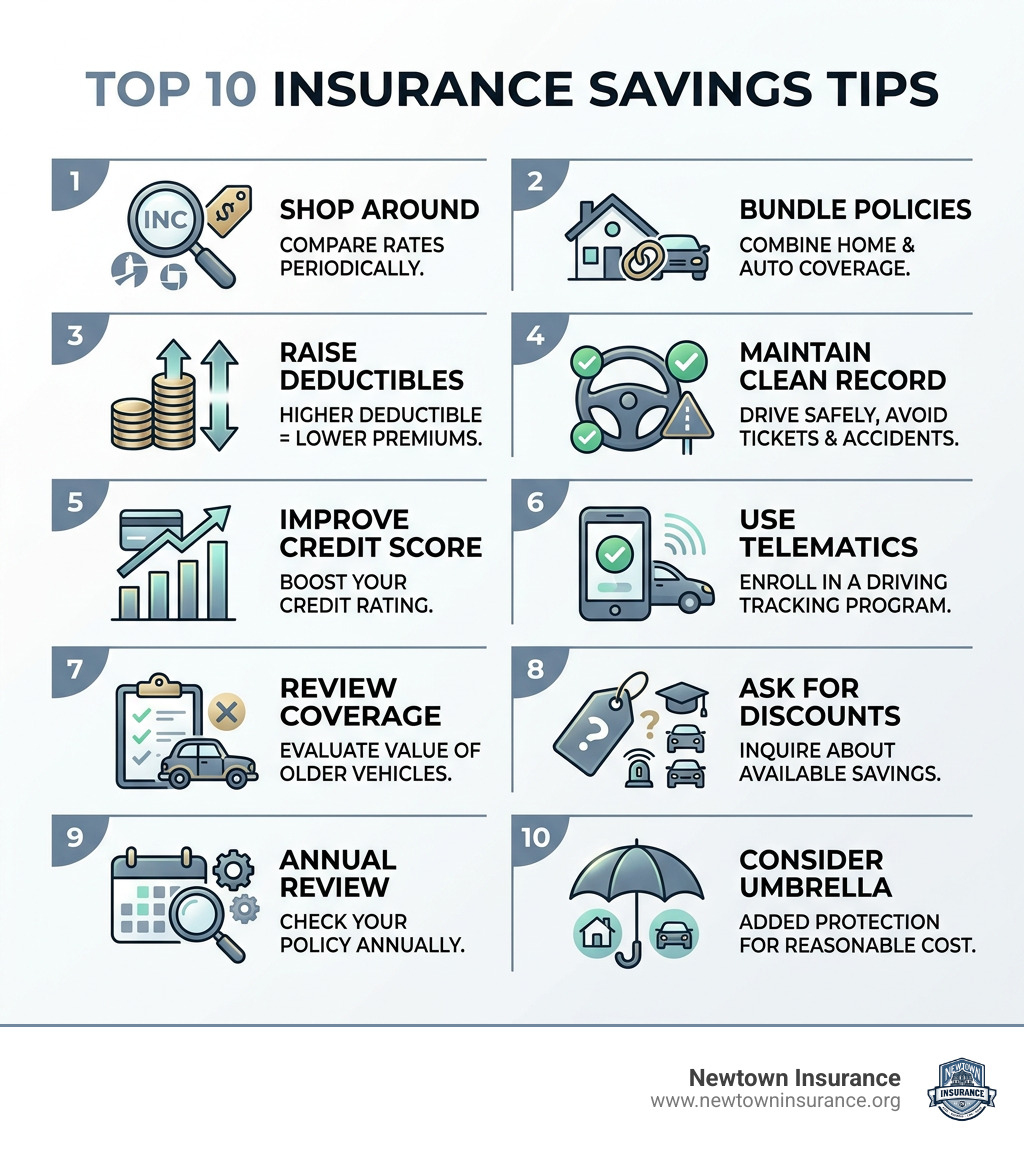
Here are the top 10 ways to lower your insurance premiums:
- Shop around — switching insurers saves a median of $461 per year
- Bundle home and auto — save an average of 15% on both policies
- Raise your deductible — a higher deductible means lower monthly premiums
- Keep a clean driving record — DUIs raise rates by 90%; speeding tickets by 39%
- Improve your credit score — bad credit can cost you 76% more
- Enroll in a telematics program — save 10%+ just for signing up
- Drop unnecessary coverage on older vehicles — if the car isn’t worth it, don’t pay for it
- Ask about discounts — good student, multi-vehicle, anti-theft, and more
- Review your policy annually — life changes mean your coverage should too
- Consider an umbrella policy — $1M in extra protection for as little as $250–$300 per year
Insurance costs have climbed steadily in recent years, driven by inflation, more expensive vehicle technology, and rising repair costs. For many Pennsylvania households, that means paying more without getting more — often because of hidden inefficiencies in their current policy, not because their risk actually went up.
The good news? Most of the savings are well within reach. You don’t need to sacrifice coverage to spend less. You just need to know where to look.
I’m Shawn Beihl, and with over 15 years of experience across life, commercial P&C, health, and disability insurance, I’ve helped countless clients discover smarter insurance savings tips without cutting corners on protection. Let’s walk through the strategies that actually move the needle.
Mastering Insurance Savings Tips for Your Household
When we talk about insurance savings tips, the conversation often starts and ends with finding the lowest possible price. However, true mastery of your insurance budget involves balancing the cost of your premium with the level of protection you actually need. In Pennsylvania, we see many drivers opting for the bare minimum to save a few dollars, but this often leads to financial disaster if an accident occurs.
The state minimums for liability are frequently inadequate. For instance, if you carry low limits and cause a multi-vehicle accident with several injuries, those medical bills can quickly exceed your coverage, leaving your personal assets—like your home or savings—vulnerable to lawsuits.
Experts suggest that the “smart” way to save isn’t by cutting your coverage to the bone, but by optimizing how you buy it. This is where the 100/300/100 rule comes into play. This refers to $100,000 for bodily injury per person, $300,000 per accident, and $100,000 for property damage. While this sounds like a lot, the premium difference between the state minimum and these higher limits is often surprisingly small.
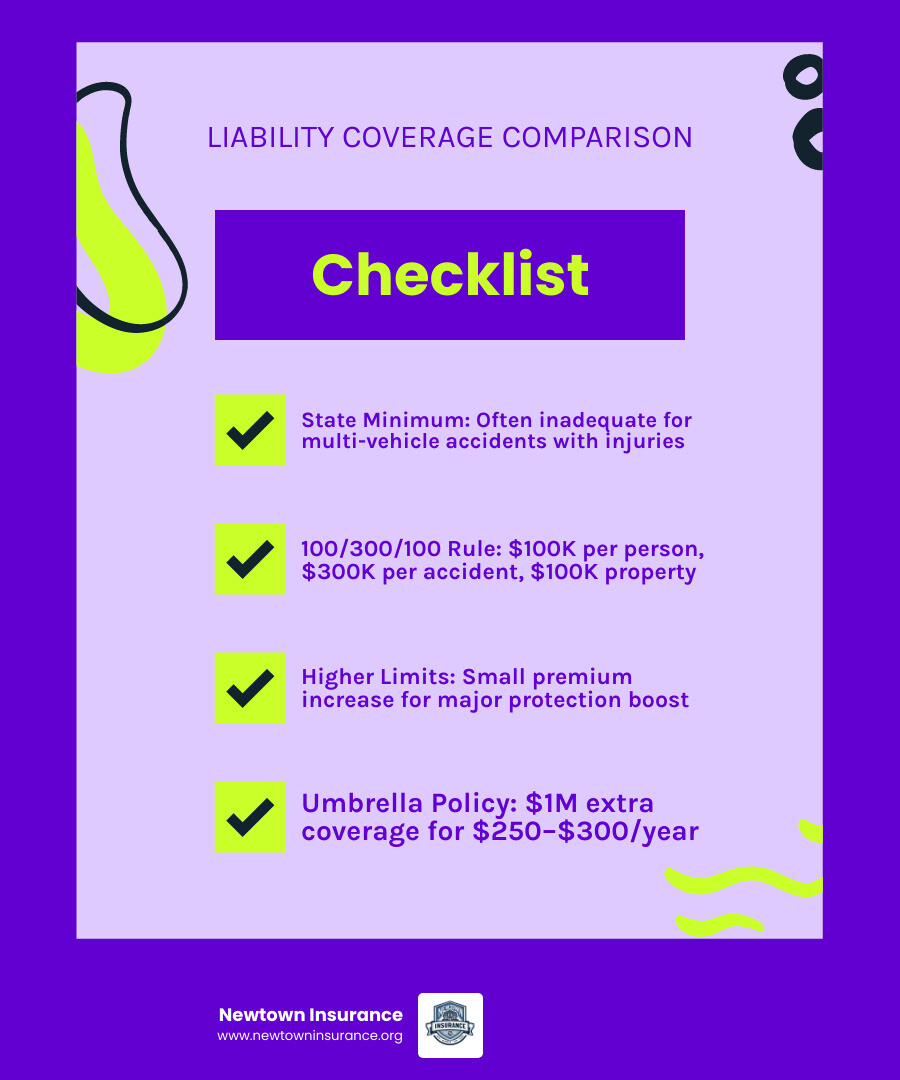
For those with significant assets to protect, we often recommend an umbrella policy. This acts as an extra layer of liability protection that sits on top of your auto and homeowners policies. A $1 million umbrella policy typically costs between $250 and $300 per year. It is one of the most cost-effective insurance savings tips for long-term financial protection because it prevents a single bad day on the road from wiping out your entire net worth. You can find more expert advice on adequate coverage limits to help you decide what is right for your family.
Home and Auto Insurance Savings Tips Through Bundling
One of the most effective and easiest insurance savings tips is bundling. This simply means purchasing your homeowners (or renters) insurance and your auto insurance from the same provider. On average, bundling can save you 15% across both policies.
Beyond the raw data, bundling offers “quality of life” benefits. You only have one company to deal with, one login for your accounts, and often just one renewal date to remember. From our perspective at Newtown Insurance, bundling also makes it easier to identify gaps in your coverage because we can see the whole picture of your household’s risk. If you want to dive deeper into how this works, you can check out more info about insurance services on our site.
Strategic Deductible Adjustments
Your deductible is the amount you pay out-of-pocket before your insurance kicks in. One of the most direct insurance savings tips is to increase this amount. For example, moving from a $500 deductible to a $1,000 deductible can significantly lower your monthly or annual premium.
However, this is a risk management play. We only recommend this if you have an emergency fund ready to cover that $1,000 if something happens tomorrow. If you are a safe driver with a long history of no claims, “betting on yourself” by taking a higher deductible is a great way to reduce fixed monthly costs. The savings over several years of claim-free driving often far exceed the extra $500 you would pay in the event of a single accident.
How Your Habits and History Drive Costs
Your daily habits and your history behind the wheel are the primary drivers of your insurance rates. Insurance is essentially a giant math problem based on risk; the more “risky” your history looks, the more you will pay.
A clean driving record is your best asset. When you avoid accidents and moving violations, you prove to the insurer that you are a low-risk client. Conversely, a single DUI can raise your rates by an average of 90%. Speeding tickets are also costly, often resulting in a 39% rate increase. In Pennsylvania, these surcharges can stay on your policy for several years, making that one heavy-footed afternoon a very expensive mistake in the long run.
Top Car Insurance Savings Tips for Safe Drivers
If you are a safe driver, you should be rewarded for it. Modern technology has introduced a new way to save: telematics, also known as usage-based insurance (UBI). These programs use a mobile app or a small device plugged into your car to monitor your actual driving habits—things like how hard you brake, how fast you accelerate, and how many miles you drive.
Many carriers offer a 10% discount just for signing up for these programs. If the data shows you are a safe, low-mileage driver, those discounts can climb even higher. This is one of the most personalized insurance savings tips available today. For more insights on how technology is changing the industry, browse our latest insurance blog updates.
The Impact of Credit Scores and Claims
It surprises many of our neighbors in Newtown to learn that their credit score can impact their car insurance premium more than their driving record in some cases. Nationally, drivers with poor credit pay an average of 76% more for car insurance than those with excellent credit. Insurers have found a statistical correlation between credit management and claim frequency. Improving your credit score is a long-term insurance savings tip that pays dividends across your entire financial life.
Another habit to consider is how you handle small claims. While it’s tempting to use your insurance for every dent and scratch, filing small claims can lead to premium increases that outweigh the payout you receive. If a repair costs $600 and your deductible is $500, it is almost always better to pay the $100 out of your own pocket rather than losing your “claim-free reward” and seeing your rates spike for the next three years. If you’re ready to see where you stand, you can start your insurance review now.
Optimizing Your Vehicle and Coverage Selection
The vehicle you choose to drive has a massive impact on your premium. Before you head to the dealership, we always suggest checking the insurance costs for the models you are considering. Factors like repair costs, safety ratings, and theft rates all play a role.
Vehicles with high safety marks—which you can verify using the IIHS Safety Ratings Tool—often cost less to insure because they protect passengers better during a crash. Additionally, installing anti-theft devices or using winter tires can qualify you for further discounts. In regions like ours where winter weather is a factor, showing your insurer that you’ve taken steps to prevent accidents (like installing specialized tires) can sometimes lead to a lower rate.
Evaluating Coverage for Older Vehicles
As your car ages, its market value drops. Eventually, you reach a point where paying for collision and comprehensive coverage might not make financial sense. A common “rule of thumb” is the 10x premium rule: if your annual premium for collision and comprehensive coverage is more than 10% of the car’s total value, it might be time to drop those options.
For example, if your 12-year-old car is worth $2,000 and you are paying $300 a year just for the physical damage portion of your insurance, you are essentially “buying” your car back from the insurance company every few years. In this scenario, you might be better off “self-insuring” for physical damage—saving that premium money in a dedicated account—while maintaining your required liability coverage.
Discounts for Students, Seniors, and Groups
There are dozens of “niche” discounts that people often miss. At Newtown Insurance, we make it a point to ask about these because they add up quickly:
- Good Student Discount: If you have a high school or college student on your policy with a “B” average or higher, most insurers offer a significant discount.
- Away-at-School Discount: If your student is at a college more than 100 miles away and doesn’t have a car with them, you can save a bundle.
- Defensive Driving: Seniors who take a certified defensive driving course can often lock in lower rates for three years.
- Professional Affiliations: Being a member of certain alumni associations, professional groups, or even certain employers can trigger group discounts.
- Multi-Vehicle: Insuring more than one car on the same policy is a standard way to trigger a “multi-car” discount.
Proactive Shopping and Policy Management
The most important of all insurance savings tips is to stay proactive. The insurance market changes constantly. New discounts are introduced, and companies change how they weigh different risk factors.
Research shows that respondents who switched insurers saw a median annual savings of $461. This doesn’t mean you should switch every six months—loyalty has its own rewards—but it does mean you should perform an annual review. Working with independent agents (like us!) allows you to compare quotes from multiple regional and national carriers at once, ensuring you aren’t overpaying for a policy that was “the best deal” five years ago but isn’t anymore. To get to know the people behind your protection, learn more about our team.
Frequently Asked Questions about Insurance Savings
Should I always choose the cheapest insurance quote?
Not necessarily. The “cheapest” quote often comes with trade-offs, such as lower liability limits, higher deductibles, or a company with a poor reputation for handling claims. We recommend looking for the best value—the right balance of high-quality coverage and a competitive price. Saving $10 a month isn’t worth it if the company disappears when you actually need to file a claim.
How often should I shop around for new rates?
We recommend a full policy review at least once a year. You should also check your rates whenever you have a major life change, such as getting married, buying a home, moving to a new ZIP code, or adding a teen driver to your policy.
Does my vehicle choice really affect my premium that much?
Absolutely. A luxury SUV with expensive sensors in the bumpers will cost much more to insure than a standard sedan with high safety ratings. Always call your agent for a quick quote before you sign the papers on a new vehicle purchase.
Conclusion
At Newtown Insurance, we believe that residents of Pennsylvania deserve more than just a generic policy. We focus on providing tailored protection, smart savings, and transparent pricing. Our goal isn’t just to sell you a policy; it’s to provide customer-first support that helps you navigate these insurance savings tips so you can stop overpaying and start feeling secure.
Whether you are looking to bundle your home and auto or you want to see if your safe driving habits can earn you a discount, we are here to help. Start saving on your insurance today by letting us take a second look at your current coverage. We’re local, we’re experienced, and we’re ready to help you keep more of your hard-earned money.