Why Your Auto Insurance Bill Is Probably Higher Than It Should Be
Tips for saving money on insurance can make a real difference — and most drivers are leaving money on the table without knowing it.
Here are the most effective ways to lower your auto insurance costs:
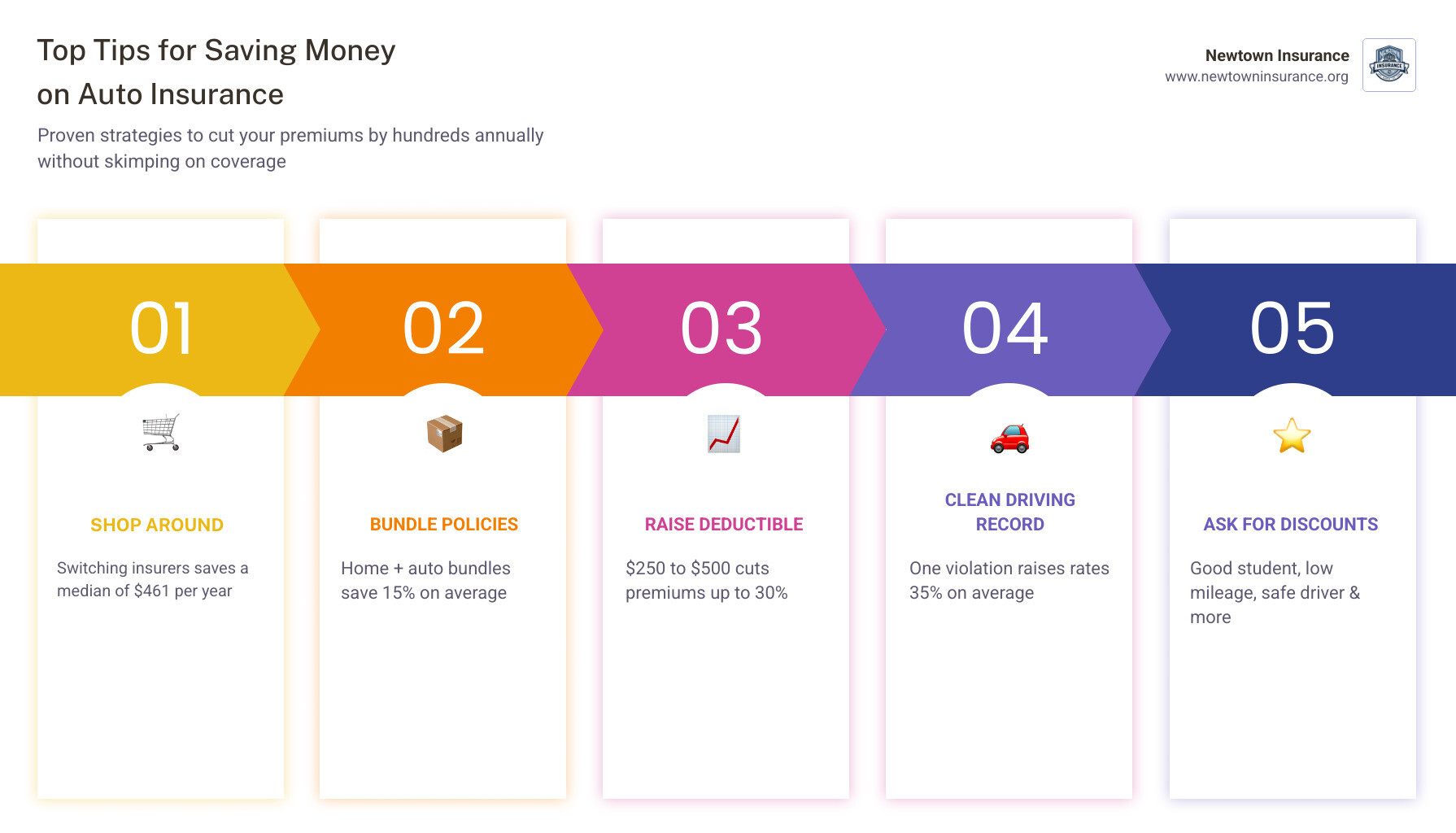
- Shop around — Switching insurers saves a median of $461 per year
- Bundle policies — Combining home and auto saves an average of 15% on both
- Raise your deductible — Going from $250 to $500 can cut premiums by up to 30%
- Maintain a clean driving record — One violation raises rates by 35% on average
- Improve your credit score — Drivers with bad credit pay 76% more on average
- Ask about discounts — Good driver, good student, defensive driving, low mileage, and more
- Drop unnecessary coverage — Consider removing collision/comprehensive on older low-value cars
- Pay in full — Paying your 6-month premium upfront can save around 10%
Auto insurance is one of those bills that quietly grows year after year. Many Pennsylvania drivers assume their rate is just what it is — a fixed cost of owning a car. But that’s rarely true.
The reality? Insurance companies price policies based on risk models. And there are many factors within your control that directly affect what you pay. A few smart moves can add up to hundreds of dollars in annual savings — without sacrificing the protection you need.
I’m Shawn Beihl, a specialty insurance professional with over 15 years of experience across life, commercial P&C, health, and benefits management — and sharing tips for saving money on insurance while keeping you properly covered is exactly what I do. Let’s walk through the strategies that actually work.
The Power of Comparison: Shopping and Bundling Strategies
If you haven’t looked at other insurance options in the last two years, you are almost certainly overpaying. Insurance companies are constantly adjusting their algorithms. A company that was the “cheapest” for you three years ago might now be among the most expensive because their “appetite” for your specific demographic or vehicle type has changed.
According to a 2024 survey by Consumer Reports involving over 40,000 Americans, those who took the time to switch insurers saw a median annual savings of $461. That is not pocket change; that is a car payment or a very nice weekend getaway in the Poconos.
How shopping around reduces insurance costs
When we talk about tips for saving money on insurance, shopping around is the undisputed heavyweight champion. Different insurers weigh factors like your age, location in Newtown, and driving history differently. One company might penalize a single speeding ticket heavily, while another might barely nudge your rate.
To get the most out of shopping:
- Use Independent Agents: Unlike “captive” agents who only sell one brand, independent agents can shop multiple carriers to find the best fit for your specific needs.
- New Customer Discounts: Many companies offer aggressive “introductory” rates to lure you away from your current provider.
- Annual Policy Review: Make it a habit to check rates every 12 months. Even if you don’t switch, knowing the market rate gives you leverage.
Maximizing multi-policy and multi-car discounts
One of the easiest ways to trigger a massive price drop is through “bundling.” When you give an insurance company more of your business—say, your auto, homeowners, and umbrella policies—they view you as a higher-value, more loyal customer.
On average, bundling your home and auto policies can save you 15% on both premiums. If you have multiple vehicles in your household, ensuring they are all on the same policy can trigger multi-car discounts that are often more substantial than any individual “safe driver” perk. Furthermore, maintaining continuous coverage history is vital; insurance companies see a “lapse” in coverage as a major red flag, often resulting in much higher rates when you try to re-apply.
Strategic Policy Adjustments: Deductibles and Coverage Limits
Most people set their insurance “limits” once and never look at them again. This is a mistake. As your life changes—as your car gets older or your net worth grows—your policy needs to evolve.
One of the most immediate tips for saving money on insurance is adjusting your deductible. The deductible is the amount you pay out-of-pocket before the insurance company kicks in. By raising your deductible from $250 to $500, you could reduce your comprehensive and collision premiums by up to 30%. If you can afford to go to $1,000, the savings are even more dramatic. However, we always advise our Pennsylvania clients: only raise your deductible to an amount you can actually afford to pay tomorrow if an accident happens.
For more deep dives into these strategies, check out these insurance savings tips.
Tips for saving money on insurance by optimizing coverage
While we want to save money, we never want to be “under-insured.” Many people stick to “state minimums” to save a few bucks, but this is a dangerous game. In some states, minimum liability might be as low as $30,000 per person. Imagine causing a multi-car pileup where three people have $50,000 in medical bills each. If your policy only covers $20,000 or $30,000 per person, you are personally on the hook for the remaining $60,000+.
Experts generally recommend a liability limit of at least 100/300/100 ($100,000 per person, $300,000 per accident, and $100,000 for property damage). It sounds like a lot, but the premium difference between the bare minimum and these safer limits is often surprisingly small.
Additionally, if your car is older, apply the “10x Rule.” If your annual premium for collision and comprehensive coverage is more than 10% of the car’s total value (which you can check on Kelley Blue Book), it might be time to drop those optional coverages and just stick with liability.
The role of umbrella policies in financial protection
It might sound counterintuitive to suggest buying more insurance to save money, but an umbrella policy is the ultimate “sleep well at night” tool. An umbrella policy provides an extra $1 million or more of liability protection that sits on top of your auto and home policies.
A $1 million umbrella policy typically costs only $250 to $300 per year. To qualify, insurers usually require you to have certain “underlying” limits on your auto policy (like the 100/300/100 mentioned above). By bundling these through one provider, you often get a package discount that makes this massive amount of protection very affordable.
Essential Tips for Saving Money on Insurance Through Smart Vehicle Choices
The car you drive is one of the biggest factors in your premium. Before you sign those papers at the dealership, call your agent. Some cars are “theft magnets,” while others have incredibly expensive sensors in the bumpers that make even a minor “fender bender” cost $5,000 to repair.
We recommend using the IIHS Top Safety Pick tool to see how your prospective vehicle stacks up. Safer cars generally mean lower medical payment premiums. Conversely, high-performance sports cars often come with hefty “surcharges” because, statistically, they are involved in more high-speed accidents. You can also research market values and insurance-friendly models on TrueCar.
Tips for saving money on insurance with lifestyle changes
Your daily habits can also drive down costs. If you’ve recently started working from home or moved closer to your office in Newtown, tell your insurer. Many companies offer “low mileage” discounts if you drive fewer than 7,500 or 5,000 miles per year. There are even “pay-per-mile” options for those who rarely use their vehicles.
Another pro tip: avoid filing small claims. If you have a $500 deductible and the repair costs $700, it might be tempting to file a claim to save that $200. Don’t do it. Filing a claim can lead to a “surcharge” that raises your rates for the next three to five years, costing you far more than $200 in the long run.
For those looking for clarity in their billing, learn more about no-hidden-fee insurance.
How credit scores and driving records impact your rate
In Pennsylvania and most other states, your “insurance score” (which is heavily derived from your credit score) is a major pricing factor. Statistics show that people who manage their finances responsibly tend to be more responsible drivers. In fact, drivers with poor credit can pay up to 76% more than those with excellent credit.
Your driving record is equally impactful:
- One Violation: Can increase rates by 35% on average.
- Speeding Ticket: Can lead to a 39% jump.
- DUI: Can cause rates to skyrocket by an average of 90%.
Behavioral Savings: Defensive Driving and Telematics
If you are a safe driver, you should be rewarded for it. Many insurers now offer “Usage-Based Insurance” (UBI) or telematics programs. These involve installing a small device in your car or using a smartphone app to monitor your driving habits—things like how hard you brake, how fast you accelerate, and what time of day you drive.
While there are privacy concerns for some, safe drivers can see significant rewards. You can read more about the technical side of Telematics and usage-based insurance on Wikipedia.
Qualifying for common auto insurance discounts
Don’t wait for your insurance company to offer you discounts—ask for them! Many are “hidden” unless you speak up. Common ones include:
- Good Student Discount: For students with a “B” average or higher.
- Mature Driver Savings: For those over a certain age who complete a refresher course.
- Defensive Driving Courses: Taking a course from the National Safety Council can yield a discount of up to 20%.
- Administrative Discounts: Signing up for automatic payments and paperless billing often shaves a few dollars off every month.
Frequently Asked Questions about Auto Insurance Savings
How much liability coverage do experts actually recommend?
While Pennsylvania law requires a minimum, experts strongly suggest 100/300/100 limits. If you own a home or have significant savings, you should also consider a $1 million umbrella policy. State minimums are often “woefully inadequate” and can leave your personal assets—like your home or future wages—vulnerable to lawsuits following a major accident.
When should I consider dropping collision and comprehensive coverage?
A good rule of thumb is the “10x rule”: if the annual cost of the coverage is more than 10% of the car’s book value, it’s likely not worth it. For example, if your car is worth $3,000 and the collision coverage costs $400 a year, you’re paying a huge percentage of the car’s value for a relatively small potential payout (minus your deductible).
What are the pros and cons of usage-based telematics programs?
Pros: Significant discounts for safe, low-mileage drivers and real-time feedback on your driving.
Cons: Privacy concerns regarding data tracking, and in some cases, aggressive driving behavior (like hard braking to avoid a yellow light) could actually lead to a rate increase rather than a discount, depending on the carrier’s rules.
Conclusion
Saving money on insurance doesn’t have to mean cutting corners on your protection. By shopping around, bundling your policies, and making strategic adjustments to your deductibles, you can keep your hard-earned money in your pocket where it belongs.
At Newtown Insurance, we pride ourselves on providing tailored protection for our Pennsylvania neighbors. We believe in transparent pricing and smart savings that don’t leave you exposed. Whether you’re looking to trim your current bill or you’re shopping for a new vehicle, we’re here to help you navigate the complexities of insurance with a customer-first approach.
Ready to see how much you could save? Start saving on your insurance today and get a quote that fits your life and your budget.