What Loss of Use Coverage Actually Pays For (And Why It Matters)

Loss of use coverage is the part of your insurance policy that pays for your temporary living expenses when your home or car becomes unusable after a covered incident.
Here’s a quick snapshot of what it covers:
| Situation | What Loss of Use Covers |
|---|---|
| Home damaged by fire | Hotel stays, restaurant meals, pet boarding, storage |
| Mandatory evacuation order | Temporary housing for up to 14 days |
| Car in the shop after accident | Rental car, rideshare, or public transit costs |
| Rented-out unit becomes uninhabitable | Lost rental income (fair rental value) |
Think of it as a financial safety net. If something forces you out of your home — or leaves you without your car — this coverage helps you maintain your normal standard of living without draining your savings.
It goes by a few names depending on your policy:
- Additional Living Expenses (ALE) — the most common term in home and renters insurance
- Coverage D — how it appears on your policy’s declaration page
- Rental reimbursement — the auto insurance version
Without it, even a few weeks in a hotel can cost thousands of dollars out of pocket. In cities like Boston, that’s up to $320 per night — and that’s before meals, laundry, or boarding your dog.
At Newtown Insurance, our team has over 15 years of experience in specialty insurance — including property and casualty coverage. We’ve helped countless policyholders understand exactly how loss of use coverage protects them when life gets disrupted. In this guide, we’ll break down everything you need to know so you’re never caught off guard.
What is Loss of Use Coverage?
At its core, Loss of use coverage is designed to keep your life moving when your property stands still. Whether it’s a fire that makes your kitchen unusable or a car accident that leaves you hitching rides to work, this coverage steps in to handle the “extra” costs of being displaced.
The most important thing to remember is that this coverage is triggered by a “covered peril.” In the insurance world, a peril is simply an event like a fire, windstorm, or lightning strike. If your home is damaged by one of these and becomes uninhabitable, your insurance company helps foot the bill for your new, temporary life.
Loss of Use Coverage in Home and Renters Insurance
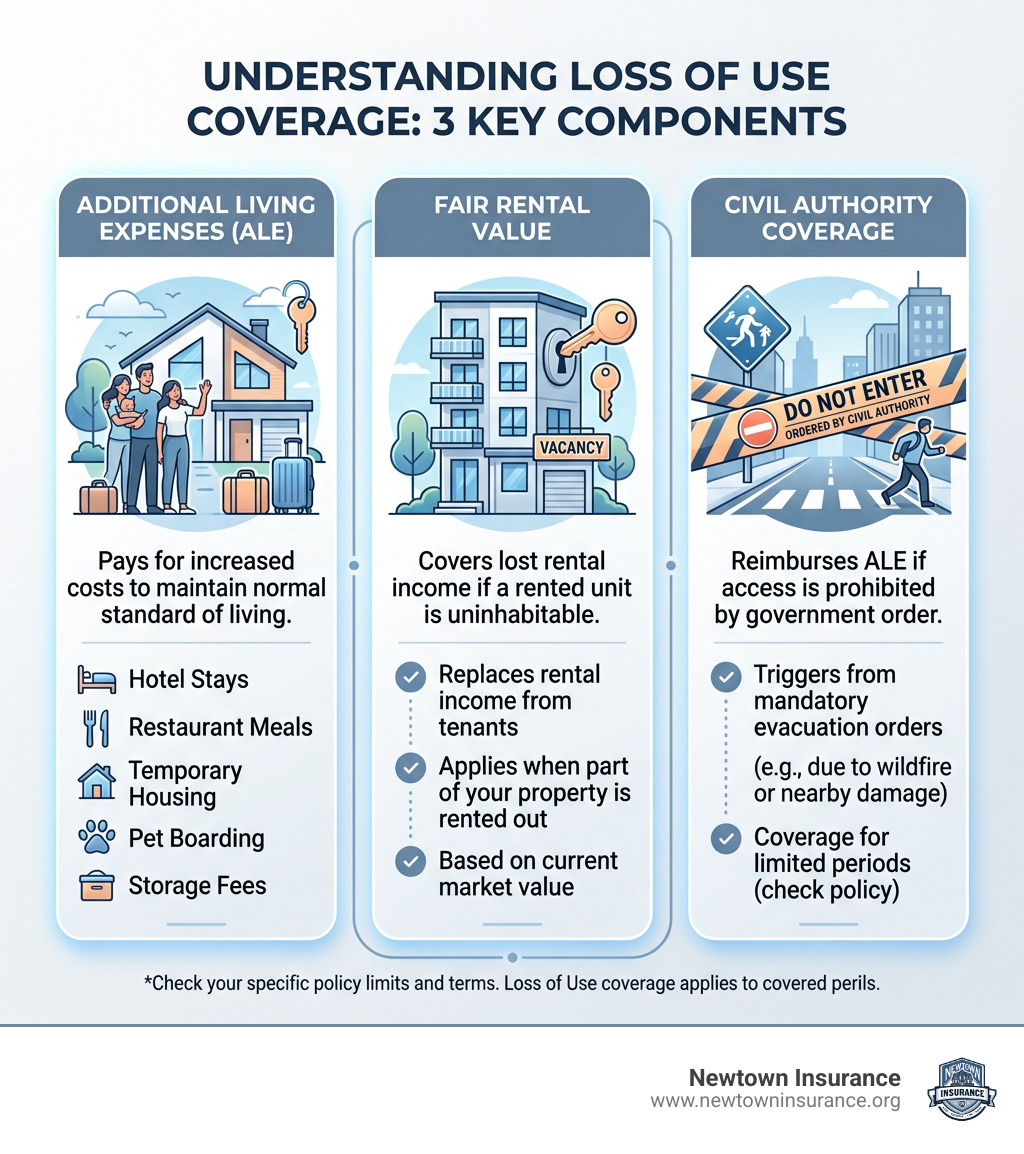
In homeowners and renters policies, Loss of use coverage is often referred to as “Coverage D.” It isn’t just one single benefit; it’s actually a bundle of three distinct protections:
- Additional Living Expenses (ALE): This is the heavy hitter. It covers the increase in your living expenses. If you usually spend $200 a week on groceries but now have to spend $500 a week eating at restaurants because your hotel doesn’t have a kitchen, ALE reimburses that $300 difference.
- Fair Rental Value: If you rent out a room in your house or own a multi-family property in Newtown, and a fire makes that unit unrentable, this part of the policy replaces the lost rental income.
- Civil Authority: This is a unique protection. It kicks in if a government authority (like the local fire department or police) prohibits you from accessing your home due to damage in your neighborhood, even if your specific house isn’t damaged.
Whether you have a standard homeowners policy, renters insurance, condo insurance, or mobile home insurance, this coverage is typically “baked in.” However, the limits vary wildly depending on the type of policy you hold. For a deeper dive into the basics, check out this guide on what is loss of use coverage?
Loss of Use Coverage in Auto Insurance
In auto insurance, Loss of use coverage is more commonly known as “rental reimbursement.” Unlike home insurance, where it’s usually included, rental reimbursement is often an optional add-on.
To carry this coverage, most Pennsylvania insurers require you to have both collision and comprehensive coverage first. If your car is in the shop for a week after a fender bender on State Street, this coverage pays for:
- A rental car (usually of a “like kind and quality” to your own).
- Public transportation costs if you don’t want to drive.
- Rideshare fees like Uber or Lyft.
It’s important to note that this doesn’t apply to routine maintenance. If your car is in the shop for an oil change or new tires, you’re on your own for the rental!
How it Works: Expenses, Limits, and Legal Rates
Understanding how much you’re entitled to can be the difference between a stress-free recovery and a mounting pile of debt. Loss of use coverage doesn’t just hand you a blank check; it works on a reimbursement basis or through daily limits.
| Feature | Homeowners/Renters (Coverage D) | Auto (Rental Reimbursement) |
|---|---|---|
| Typical Limit | 20% to 30% of Dwelling Coverage | $30–$50 per day / $900–$1,500 total |
| Common Duration | 12 to 24 months | Max 30 days or until repaired |
| Deductible | None (applies to the main claim) | None (applies to the main claim) |
| Key Expenses | Hotels, Food, Pet Boarding, Laundry | Rental Cars, Taxis, Public Transit |
When you are displaced from your home, the costs add up fast. Beyond the obvious hotel bill, you can claim:
- Pet Boarding: If your hotel doesn’t allow your furry friends.
- Storage Rentals: If you need to move your furniture out while the drywall is being replaced.
- Laundry: Since you likely won’t have your own washer and dryer.
- Increased Commute: If your temporary housing is further from work, you can claim the extra gas and parking fees.
That costs vary by location. If you are traveling or displaced to a nearby major city, you might face some of the most expensive US cities for hotel stays, where rates can easily exceed $300 a night.
International and Legal Benchmarks
While we focus on Pennsylvania, it’s interesting to see how these rates are quantified globally, as it often influences how legal teams view “reasonable” costs. In the UK, daily loss of use rates for general damages are often assessed at £15 to £20 per day. In Thailand, rates are more structured, with private cars receiving a minimum of THB 500 per day (about $14 USD). These benchmarks help insurance adjusters determine what a “fair” daily rate looks like when a specific rental receipt isn’t provided.
Calculating Your Coverage Limits
For homeowners, your limit is usually a percentage of your “Coverage A” (Dwelling Coverage). If your home is insured for $300,000 and you have a 20% limit, you have $60,000 available for Loss of use coverage.
For renters, it’s often a flat amount (like $5,000) or a percentage of your personal property coverage.
Pro-Tip: Check if your policy has a “time-based restriction.” Some policies might give you a high dollar limit but cut you off after 12 months, even if the repairs aren’t finished. In Newtown, where construction permits and contractor schedules can sometimes lag, having a 24-month cap provides much better peace of mind. You can often increase these limits for a very small addition to your annual premium—sometimes as little as $20 to $50 a year.
Filing a Claim and Getting Reimbursed
Filing a Loss of use coverage claim requires a bit of homework. Because this is a reimbursement-based system, the burden of proof is on you to show what you spent.
The Importance of Record Keeping
The golden rule of loss of use is: Save every receipt.
- Did you buy a sandwich because you couldn’t cook at home? Save the receipt.
- Did you pay for a laundromat? Save the receipt.
- Did you pay for a dog sitter? Save the receipt.
Insurance adjusters will compare these costs to your “normal” expenses. If you usually spend $100 a week on groceries and spend $250 while displaced, they will reimburse the $150 difference. For more details on how property claims are handled, you can see more info about home insurance services.
Step-by-Step Claim Process
- Notify Your Insurer Immediately: As soon as the incident happens, call us or your carrier. Don’t wait until you’ve checked into a hotel.
- Document the Damage: Take photos of the uninhabitable areas. If the kitchen is scorched, that’s your proof that you can’t cook at home.
- Get Adjuster Approval: Before signing a long-term lease for a temporary apartment, get your adjuster’s “okay” on the monthly rent.
- Submit Receipts Regularly: Don’t wait until the end of a six-month repair to submit your expenses. Send them in monthly to keep your cash flow steady.
- Final Settlement: Once you move back in, your adjuster will do a final tally of all “Additional Living Expenses” and issue the final payment.
Frequently Asked Questions about Loss of Use
Do I have to pay a separate deductible for loss of use?
No. In almost all cases, there is no separate deductible for Loss of use coverage. However, you can only access this coverage if you have an open claim for a covered peril (like a fire or windstorm). You will still have to pay your primary policy deductible for the home repairs, but the ALE payments usually start from dollar one once the claim is approved.
What happens if the government prohibits access to my home?
This falls under “Civil Authority” coverage. If a neighborhood disaster—like a massive gas leak or a neighbor’s house being dangerously unstable after a fire—causes the authorities to cordone off your street, your insurance may cover your hotel stay. Typically, this is limited to 14 days of coverage and requires that the damage causing the evacuation be a peril covered by your policy.
How is loss of use quantified in legal claims?
If you are involved in a car accident that wasn’t your fault, you can claim “loss of use” damages from the at-fault party’s insurance. This is different from your own “rental reimbursement” coverage. Legally, you are entitled to the “reasonable” cost of a rental vehicle for the time your car is out of commission.
Attorneys often look at loss of use meaning and legal damages to determine these rates. They may use “Basic Hire Rates” (the standard rate for a similar car) to calculate what you are owed, even if you didn’t actually rent a car. This is known as “tortfeasor liability”—the person at fault is responsible for the fact that you lost the use of your property.
Conclusion
Loss of use coverage is truly the “unsung hero” of your insurance policy. While everyone focuses on the cost of rebuilding a roof or replacing a car, it’s the daily costs of living that can truly derail your life during a crisis.
At Newtown Insurance, we believe in more than just selling a policy; we believe in tailored protection that fits your life in Pennsylvania. Whether you’re in the heart of Newtown or the surrounding areas, we focus on smart savings and transparent pricing to ensure you aren’t overpaying for the wrong coverage.
Don’t wait for a disaster to find out if your limits are too low. Our customer-first support team is here to help you review your “Coverage D” and ensure you have the peace of mind you deserve.
Ready to secure your safety net? Start Now and let us help you find the perfect balance of protection and value.