

The Reddit-Approved Guide to the Best Car Insurance Discounts
Why Most Drivers Overpay for Car Insurance (And How to Stop)

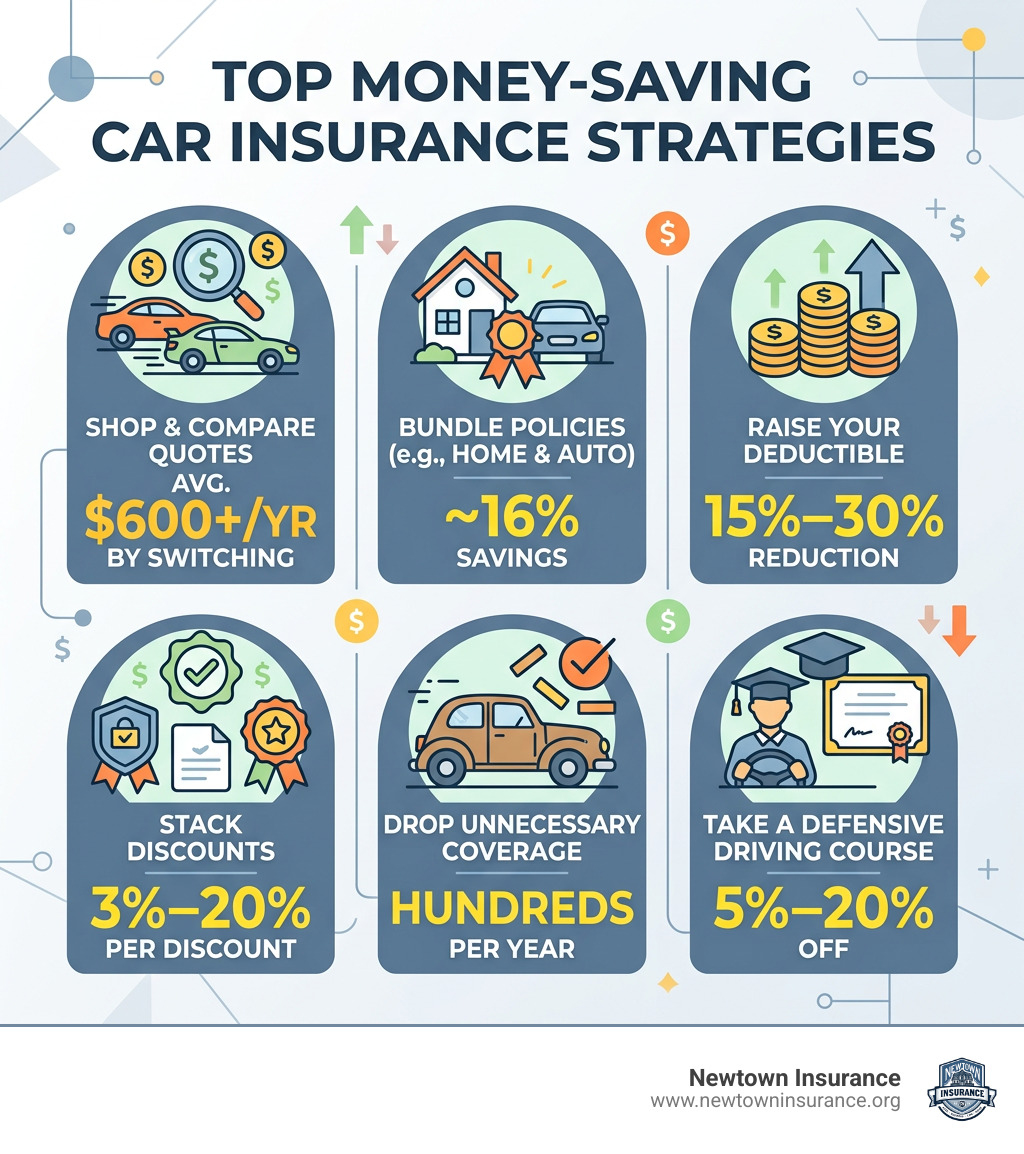
Moneysaving car insurance strategies can realistically cut your annual premium by $300–$800 without sacrificing the protection you need. Here's a quick look at the most effective ways to lower your rate:
| Strategy | Potential Savings |
|---|---|
| Shop and compare quotes annually | Varies; avg. $600+/yr by switching |
| Bundle home and auto policies | ~16% on average |
| Raise your deductible | 15%–30% reduction |
| Stack discounts (safe driver, paperless, loyalty) | 3%–20% per discount |
| Drop unnecessary coverage on older cars | Hundreds per year |
| Take a defensive driving course | 5%–20% off |
The average American spends over $2,000 a year on car insurance. That's a big line item — and for many Pennsylvania drivers, a chunk of that spend is simply unnecessary. Rates shift constantly based on your life, your driving record, and even the insurance market itself. A policy that was competitive two years ago may not be today.
The good news? A few smart, targeted adjustments can make a real difference — no coverage gaps required.
I'm Shawn Beihl, a specialty insurance professional with over 15 years of experience across life, commercial P&C, health, and disability coverage, and I've spent much of that time helping people find genuinely moneysaving car insurance strategies that hold up long-term. In the sections below, I'll walk you through exactly how to do that.
Master the Art of Bundling and Stacking Discounts
If you are looking for the "low-hanging fruit" of moneysaving car insurance, bundling is your best friend. In the insurance world, we call this a multi-policy discount. It is the practice of purchasing your auto insurance and homeowners (or renters) insurance from the same provider.
The national average savings for bundling home and auto policies sits at approximately 16 percent. However, depending on where you live, those numbers can fluctuate. While some states see lower returns, others can see savings as high as 22 percent. For our neighbors here in Pennsylvania, bundling remains one of the most consistent ways to keep more money in your pocket.
Beyond just the initial discount, bundling simplifies your life. You have one login, one agent to call, and often a single deductible if a disaster (like a falling tree or a major storm) damages both your home and your car. You can explore more about insurance services to see how different policy types can be woven together for maximum protection.
Life Changes and Loyalty
Your life isn't static, and your insurance shouldn't be either. Major life milestones are often triggers for significant discounts.
- Marriage: Statistically, married drivers are seen as lower risk, often resulting in lower premiums.
- Homeownership: Even if you don't bundle, simply owning a home can signal stability to an insurer, potentially lowering your auto rate.
- Loyalty Rewards: While we always recommend shopping around, some carriers offer "tenure" discounts. However, be careful—sometimes a "loyalty" discount is smaller than the savings you'd get by switching to a more competitive carrier.
- Paperless Billing: It sounds small, but going green can save you 3% to 5%. It reduces administrative costs for the company, and they pass those cents back to you.
Maximizing Moneysaving Car Insurance Through Occupational and Student Discounts
Many drivers leave money on the table because they simply don't ask. The old saying, "You never know if you don’t ask," is the golden rule of insurance discounts.
The Good Student Discount If you have a young driver on your policy, you know how expensive it can be. Most insurers offer a "Good Student" discount for full-time students (high school or college) who maintain a 3.0 GPA or higher (B average). The logic is simple: students who are responsible with their studies are statistically more responsible behind the wheel.
Occupational and Affinity Groups Are you a teacher, a first responder, or a member of the military? Many companies offer specialized discounts for specific professions or members of certain alumni associations and credit unions. Military members, in particular, often have access to some of the most competitive moneysaving car insurance rates in the industry.
The Early Shopper Discount Timing is everything. Some insurance companies will give you a discount of up to 10% just for signing a new policy at least 7 to 14 days before your current one expires. They like proactive customers! If you're ready to see what's available, you can start your savings journey today.
Strategic Coverage Adjustments for Moneysaving Car Insurance
One of the most impactful ways to lower your premium is to look at your deductibles. Your deductible is the amount you pay out of pocket before your insurance kicks in.
The Deductible Math
Raising your deductible from $250 to $500, or from $500 to $1,000, can reduce your physical damage coverage costs by 15% to 30%. However, you shouldn't do this blindly. You need to calculate the "payback period."
For example, if raising your deductible saves you $100 a year, but increases your out-of-pocket risk by $500, you need to go five years without a claim to break even. If the savings are $250 a year, you break even in just two years. As noted by Consumer Reports, being a safe driver makes this risk much more manageable.
| Deductible Level | Estimated Annual Premium | Potential Annual Savings |
|---|---|---|
| $250 Deductible | $2,000 | $0 (Baseline) |
| $500 Deductible | $1,700 | $300 |
| $1,000 Deductible | $1,450 | $550 |
The "10x Rule" for Older Cars
If you are driving an older vehicle that is long since paid off, you might be over-insuring it. Comprehensive and collision coverage (often called "full coverage") pays to repair or replace your car. But if your car is only worth $3,000 and your annual premium for that specific coverage is $800, you are paying nearly 27% of the car's value every year just to protect it.
A good rule of thumb is the "10x Rule": if the annual cost of your comprehensive and collision coverage is more than 10% of the car's actual cash value, it might be time to drop those coverages and stick to liability only.
Why Exceeding State Minimums is a Moneysaving Car Insurance Move
It sounds counterintuitive, but buying more insurance can actually save you from financial ruin. Every state has minimum liability requirements. In many cases, these minimums are woefully inadequate.
If you carry the bare minimum and cause a multi-car accident with injuries, the medical bills can easily exceed $100,000. If your policy only covers $25,000, you are personally on the hook for the remaining $75,000. That is not moneysaving car insurance; that is a financial disaster.
We generally recommend a minimum of 100/300/100 ($100,000 per person for bodily injury, $300,000 per accident, and $100,000 for property damage).
The Umbrella Policy For those with significant assets to protect, a $1 million umbrella policy is a smart addition. It sits on top of your auto and home insurance, providing an extra layer of protection. Surprisingly, a $1 million umbrella policy typically only adds $250 to $300 to your annual premiums. It requires you to have certain base limits on your auto policy, but it offers incredible peace of mind.
Leveraging Technology and Habits for Long-Term Savings
The way you drive has a massive impact on what you pay. Modern technology now allows insurance companies to reward you for your actual habits, rather than just your demographic data.
Usage-Based Insurance (Telematics)
Usage-based insurance (UBI) programs use a plug-in device or a smartphone app to track your driving. They look at how many miles you drive, how hard you brake, and what time of day you're on the road. If you are a low-mileage driver or a very safe driver, you can see significant discounts. This is particularly useful for people who work from home and no longer have a daily commute.
Defensive Driving Courses
In Pennsylvania, taking an approved defensive driving course can earn you a discount of anywhere from 5% to 20%. These courses are often available online and only take a few hours. It’s a small investment of time for a multi-year reduction in your premium.
The Impact of Claims and Credit
Your history matters. Every claim you file becomes part of your permanent record for three to five years.
- Avoid Small Claims: If you have a $500 deductible and a $700 repair, pay it out of pocket. Filing that claim might only net you $200 today, but it could raise your rates by hundreds of dollars over the next three years.
- Credit Score: In most states, including Pennsylvania, your credit score affects your insurance rate. Insurers have found that people who manage their credit well tend to file fewer claims. Improving your score can lead to lower premiums over time.
The Pro-Level Shopping Strategy: Standardize and Compare
If you want to find true moneysaving car insurance, you have to shop around. But you have to do it correctly. Many people make the mistake of just looking at the final price without checking the coverage.
Step 1: Pull Your Declarations Page
Your "Dec Page" is the summary of your current policy. It lists your exact limits and deductibles. Use this as your baseline.
Step 2: Standardize Your Quotes
When you ask for quotes from different companies, ensure you are asking for the exact same coverage. If Company A quotes you a $500 deductible and Company B quotes you a $1,000 deductible, Company B will look cheaper, but they aren't necessarily offering a better deal. According to the Wall Street Journal, standardizing your quotes is the only way to get an "apples-to-apples" comparison.
Step 3: Use an Independent Agency
Working with an independent agency, like Newtown Insurance, gives you an edge. Unlike "captive" agents who only sell for one company, we have relationships with dozens of carriers. We can do the shopping for you, comparing multiple quotes to find the one that fits your budget and protection needs.
Frequently Asked Questions about Car Insurance Savings
How often should I shop for new quotes?
We recommend doing an annual review. Even if you are happy with your current carrier, the market changes. A quick check-up once a year ensures you aren't missing out on new discounts or better rates. You should also shop whenever you have a major life event, such as moving, getting married, or buying a new car.
Will filing a small claim raise my rates?
Almost certainly. Most experts suggest a $1,500 threshold. If the damage is less than $1,500 and you can afford to pay it out of pocket, you should probably avoid filing a claim. The "surcharge" (rate increase) that follows a claim often lasts three to five years and can end up costing you much more than the original repair was worth.
Does my credit score really affect my premium?
Yes. Actuarial data shows a strong correlation between financial responsibility and driving safety. While it might seem unfair, a higher credit score generally leads to lower insurance premiums. If you’ve recently improved your credit score, it’s a great time to ask for a re-rate or shop for a new policy.
Conclusion
Finding moneysaving car insurance doesn't have to be a chore. By bundling your policies, adjusting your deductibles based on actual math, and staying on top of your driving habits, you can significantly reduce your annual spend.
At Newtown Insurance, we specialize in providing Pennsylvania drivers with tailored protection and transparent pricing. We believe in smart savings that don't compromise your safety. If you're ready to stop overpaying and start saving, we're here to help.
Start Your Quotes Today and let us find the best discounts for your unique situation.