You Don’t Have to Hand Over Your Phone Number to Shop for Health Insurance

If you’ve been wondering how to get health insurance quotes without personal information, the short answer is: you can get meaningful estimates using just a few basic details — no name, phone number, email, or Social Security Number required upfront.
Here’s how to get started quickly:
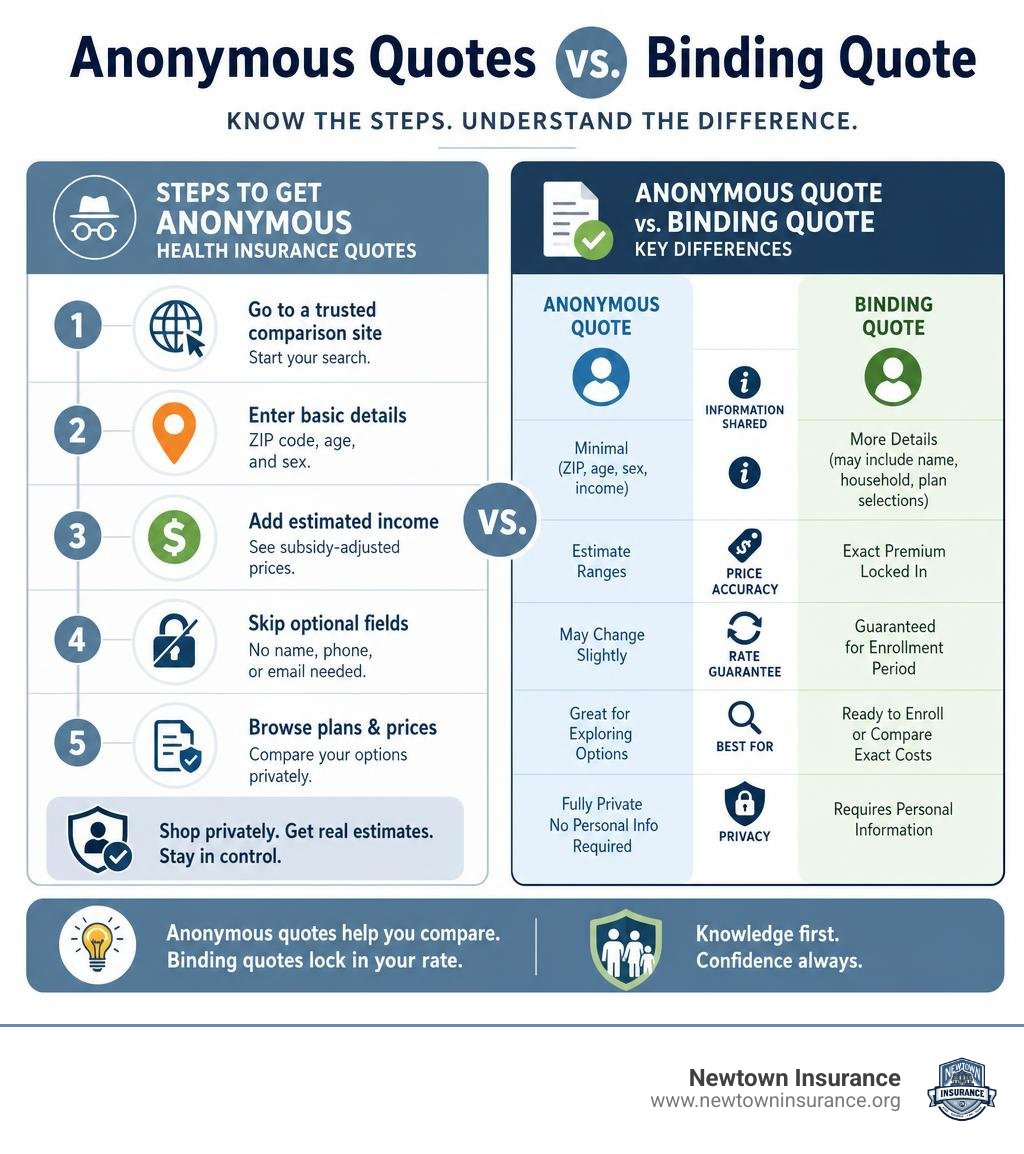
- Go to HealthCare.gov or a multi-carrier comparison site
- Enter your ZIP code, age, and sex — that’s often enough for a preliminary quote
- Add your estimated income if you want to see subsidy-adjusted prices
- Skip any optional fields asking for name, phone, or email
- Browse plans and prices before deciding whether to share more
On HealthCare.gov, the average monthly premium runs about $619 before subsidies — but drops to around $113 after premium tax credits. More than 40% of 2026 marketplace members pay $10 or less per month.
Shopping this way gives you real pricing power before you commit to anything — or talk to anyone.
The catch? The less information you share, the broader your estimate will be. Anonymous quotes are useful for comparing ballpark costs, but they’re not the same as a final, locked-in rate. That gap matters, and it’s worth understanding before you start.
This is where most people get tripped up: they either share too much too soon (and get flooded with calls), or they share too little (and get quotes that don’t reflect their real costs). There’s a smarter middle path.
I’m Shawn Beihl from Newtown Insurance, and with over 15 years in specialty insurance — including health, life, and benefits management — I’ve helped countless Pennsylvania residents figure out how to get health insurance quotes without personal information while still getting accurate, useful numbers. In the sections below, I’ll walk you through exactly how to do it.
Why Insurers Ask for Your Data vs. Your Right to Privacy
To understand how to navigate the quoting process privately, it helps to understand why health insurance companies ask for so much data in the first place. Unlike other types of coverage, health insurance pricing is heavily regulated. Under the Affordable Care Act (ACA), insurers are strictly limited in what they can use to set your premiums. They cannot charge you more or deny you coverage based on pre-existing conditions, gender, or medical history.
However, they are allowed to look at a few core factors to perform a basic risk assessment:
- Age: Older individuals generally have higher healthcare utilization, so premiums scale with age.
- ZIP Code: Local healthcare costs, state-level regulations, and regional provider networks heavily influence base pricing.
- Tobacco Use: In most states, insurers can charge tobacco users up to 50% more in premiums.
Beyond these rating factors, websites ask for your name, phone number, and email address for marketing purposes. Once a lead-generation site captures your contact info, it is often sold to multiple brokers, triggering an avalanche of high-pressure sales calls and endless spam emails.

Protecting your personal data is not just about avoiding annoying phone calls; it is about maintaining control over your digital footprint. As discussed in our Insurance Quotes No Personal Info Guide, you have a right to explore your financial options without immediately entering a marketing funnel.
If you want a deeper look at what is truly required to get a price versus what is simply requested for marketing, you can read our comprehensive analysis on Can You Get Health Insurance Quote Without Giving Personal Information. Knowing the difference allows you to confidently bypass optional fields on comparison sites, such as those highlighted in the guide to Compare Health Insurance Quotes – NerdWallet , which explains how to map out your coverage needs before sharing identifying details.
The Trade-Offs of Learning How to Get Health Insurance Quotes Without Personal Information
While keeping your identity under wraps protects your inbox, it does introduce a clear trade-off: anonymity directly impacts quote accuracy.
When you request a health insurance quote without providing verified personal details, the system generates a preliminary premium estimate. This estimate is built on broad demographic averages for your ZIP code. In the auto insurance sector, data shows that anonymous estimates typically fall within a 15% to 30% variance of the final binding price. For health insurance, that variance can be even wider, primarily because of government subsidies.
Under the ACA, your actual out-of-pocket premium is determined by your household income relative to the Federal Poverty Level (FPL). If you browse completely anonymously and omit your household income, the portal will show you the full-price retail premium. For example, while the average retail premium is $619, your actual cost could be under $10 if you qualify for premium tax credits. To get an accurate quote, you must provide realistic income estimates, even if you keep your name and phone number hidden.
How to Get Health Insurance Quotes Without Personal Information
The secret to getting anonymous quotes is utilizing public platforms and direct carrier portals that allow for guest browsing. Federal and state marketplaces are designed to let consumers shop the catalog before creating an account.
By using Finder.Healthcare.gov – the Health Insurance Marketplace , you can access the plan selection tool without logging in. The system will ask for your ZIP code, the ages of the people in your household, and whether anyone uses tobacco. Because these portals are run by government entities, they do not sell your data to private brokers, making them safe environments for exploratory shopping.
Actionable Steps: How to Get Health Insurance Quotes Without Personal Information
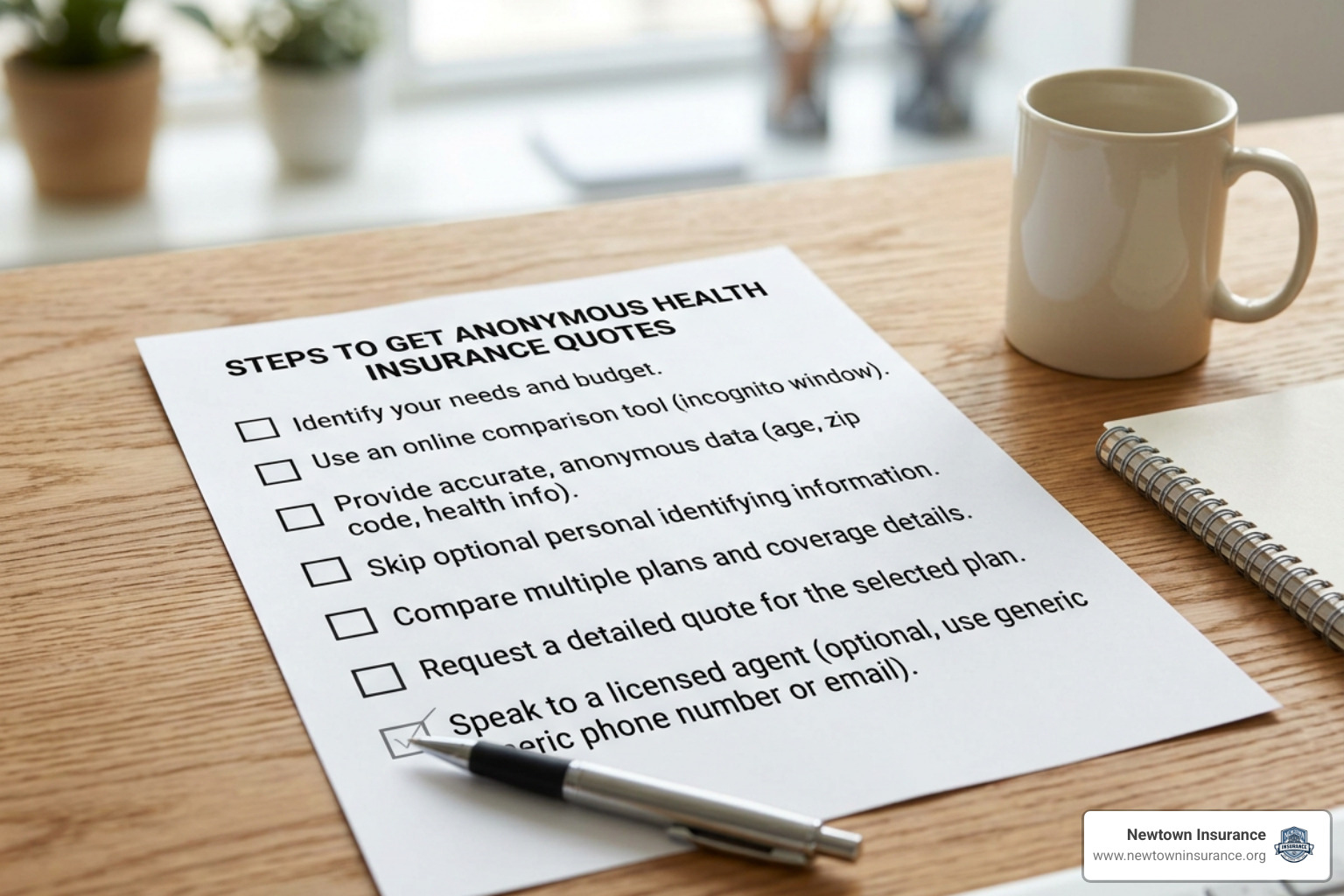
If you want to shop across both public marketplaces and private plans while keeping your identity secure, follow this step-by-step strategy:
- Use Incognito Mode: Open a private browsing window to prevent tracking cookies from following you across different insurance sites.
- Practice Data Minimization: Only fill out fields marked with an asterisk (*). If a field for a phone number or email does not have a red asterisk, leave it completely blank.
- Review the Privacy Policy: Before typing any information into a private comparison tool, scroll to the bottom of the page and check their privacy policy. Look for terms like “we do not sell your personal information” or “opt-out of third-party sharing.”
- Look for SSL Encryption: Ensure the website address starts with
https://and displays a padlock icon in the browser bar, indicating your connection is secure. - Use a Dedicated “Spam” Email: Create a free, separate email address (e.g., via Gmail or ProtonMail) specifically for shopping. This keeps your primary inbox clean and allows you to walk away from the quotes whenever you want. You can use this dummy email on sites like eHealth: Get Medicare & Health Insurance Quotes to browse private marketplace options safely.
How to Compare Health Insurance Quotes Without Phone Numbers or Emails
The biggest hurdle in online shopping is the dreaded “required” phone number field. Many private comparison sites will block you from seeing your quotes until you provide a valid 10-digit number.
To bypass this without giving away your real cell number, you can use a temporary Voice over IP (VoIP) number through services like Google Voice, TextNow, or a temporary burner app. This allows you to receive any automated verification texts required to view the quotes, but you can keep the app muted to completely avoid unsolicited sales calls.
This privacy-first approach is highly effective across all insurance sectors. For instance, if you are also shopping for other types of protection, you can apply these same techniques using our Car Insurance Quote No Personal Info Guide and the updated Car Insurance Quote Without Info Guide 2026. The core methodology remains the same: use secondary contact channels and dummy data until you are ready to buy.
Comparing Plan Types and Marketplaces Anonymously
When shopping for coverage, you will encounter three main categories of health plans: ACA Marketplace plans, short-term health insurance, and supplemental coverage. Each category handles user privacy and anonymous quoting differently.
| Plan Type | Anonymity Level | Information Required for Quote | Underwriting Rules | Best For |
|---|---|---|---|---|
| ACA Marketplace Plans | High (on public exchanges) | ZIP code, age, sex, estimated income | Guaranteed issue; no medical questions | Long-term comprehensive coverage; subsidy seekers |
| Short-Term Plans | Low to Medium | ZIP code, age, gender, basic health history | Medical underwriting; pre-existing conditions excluded | Temporary coverage gaps; healthy individuals |
| Supplemental Coverage | High | ZIP code, age | Simplified underwriting; cash payout focus | Filling deductibles; extra accident/illness protection |
If you are looking for private carrier options in Pennsylvania, you can explore direct portals like those provided for Individual and family health insurance plans – Capital Blue Cross to compare local plan benefits alongside public options.
State-Based vs. Federal Marketplaces
The privacy of your quoting experience can also depend on whether your state uses the federal HealthCare.gov portal or runs its own state-based exchange.
Pennsylvania operates its own state-based marketplace called Pennie. State-based exchanges are built to comply with strict state-level privacy laws, meaning they are highly secure and do not share or sell your data to third-party marketing firms. When you shop on Pennie, you can safely input your ZIP code, household size, and income to see exact subsidy calculations without worrying about spam.
For residents looking to understand how Pennsylvania manages consumer data and healthcare options, the Health Insurance – Commonwealth of Pennsylvania portal provides excellent resources on state-specific consumer protections, local plan rules, and privacy rights.
Moving from Anonymous Quotes to Secure Enrollment
Eventually, the research phase ends, and you must select a plan. To transition from an anonymous estimate to a binding policy, you will have to provide your full personal information, including your legal name, physical address, Social Security Number, and payment details.
When you are ready to make this move, ensure you are submitting your data through a verified, secure portal. Avoid emailing sensitive documents or reading your SSN over the phone to unverified agents. Instead, use secure client portals that utilize end-to-end encryption.
If you are curious about how the quoting process changes once you provide your verified details, read our guide on Personalized Insurance Quotes to understand how underwriters lock in your final premiums. You can also explore similar processes in other categories, such as our guide on Life Insurance Quote No Personal Info Guide 2026 or learn How To Get A Personalized Quote For Life Insurance to see how different insurance products transition from anonymous estimates to fully underwritten, secure policies.
Frequently Asked Questions about Anonymous Health Insurance Quotes
Can I get an accurate health insurance quote without my Social Security Number (SSN)?
Yes. You do not need to provide your Social Security Number to get a health insurance quote. On both public and private quoting platforms, your SSN is completely unnecessary during the shopping and comparison phase. You will only be required to provide your SSN when you are ready to officially submit an application for enrollment, as the government uses it to verify your identity, citizenship status, and tax subsidy eligibility.
How do I avoid spam calls when shopping for health insurance online?
The most effective way to avoid spam calls is to avoid using lead-generation websites that promise “multiple free quotes” from various carriers. These sites make money by selling your contact details to dozens of aggressive brokers. Instead, use official government sites like HealthCare.gov (or Pennie in Pennsylvania) or work directly with a trusted local agency. If you must use a private comparison tool, enter a temporary VoIP phone number and a dedicated shopping email address.
Do anonymous health insurance quotes include government subsidies?
Anonymous quotes will only include government subsidies if you provide your estimated household income and household size. Because premium tax credits are calculated strictly based on your income relative to the Federal Poverty Level, a quoting tool cannot guess your subsidy eligibility without this financial data. You can safely enter your estimated annual income without providing your name or SSN to see an accurate, subsidy-adjusted price.
Conclusion
Shopping for health insurance does not have to mean sacrificing your personal privacy. By leveraging public marketplaces, using data minimization techniques, and protecting your primary contact channels with temporary emails and VoIP numbers, you can easily compare plans and find the best rates on your own terms.
At Newtown Insurance, we believe in a customer-first approach. We are here to provide Pennsylvania residents with tailored protection, smart savings, and transparent pricing — without the high-pressure sales tactics or endless spam calls. When you are ready to transition from anonymous browsing to a secure, customized plan that fits your budget, we are ready to help.
Get a personalized quote today and let our team build a secure, reliable health coverage plan designed specifically for you.