

Incognito Mode: Getting Insurance Quotes Without Giving Your Life Story
Why Shoppers Search for Insurance Quotes Without Personal Info

Getting insurance quotes without personal info is possible — but there's an important catch: what you get is an estimate, not a real quote.
Here's a quick breakdown of what you can and can't do:
| What You Want | What's Actually Possible |
|---|---|
| A quote with zero personal info | Not possible — insurers need some data to price risk |
| A rough estimate with minimal info | Yes — ZIP code + vehicle details is often enough to start |
| An accurate, bindable quote | Requires full personal details (name, DOB, license, VIN) |
| Buying a policy anonymously | No — identity verification is always required |
So if you're just trying to get a ballpark figure before handing over your life story, you're in the right place.
Many Pennsylvania drivers feel uneasy sharing personal details online before they've even seen a rate. That hesitation is completely reasonable — especially with concerns about spam calls, data selling, and hard credit pulls. The good news: you can do meaningful comparison shopping with far less information than most quote forms imply.
I'm Shawn Beihl of Newtown Insurance, and with over 15 years in specialty insurance I've helped countless clients navigate the process of getting insurance quotes without personal info before committing to a full application. In the sections ahead, I'll walk you through exactly how far anonymity can take you — and where you'll eventually need to share the real details.
Can You Really Get insurance quotes without personal info?
Yes, but only in the loose, everyday sense of the word "quote."
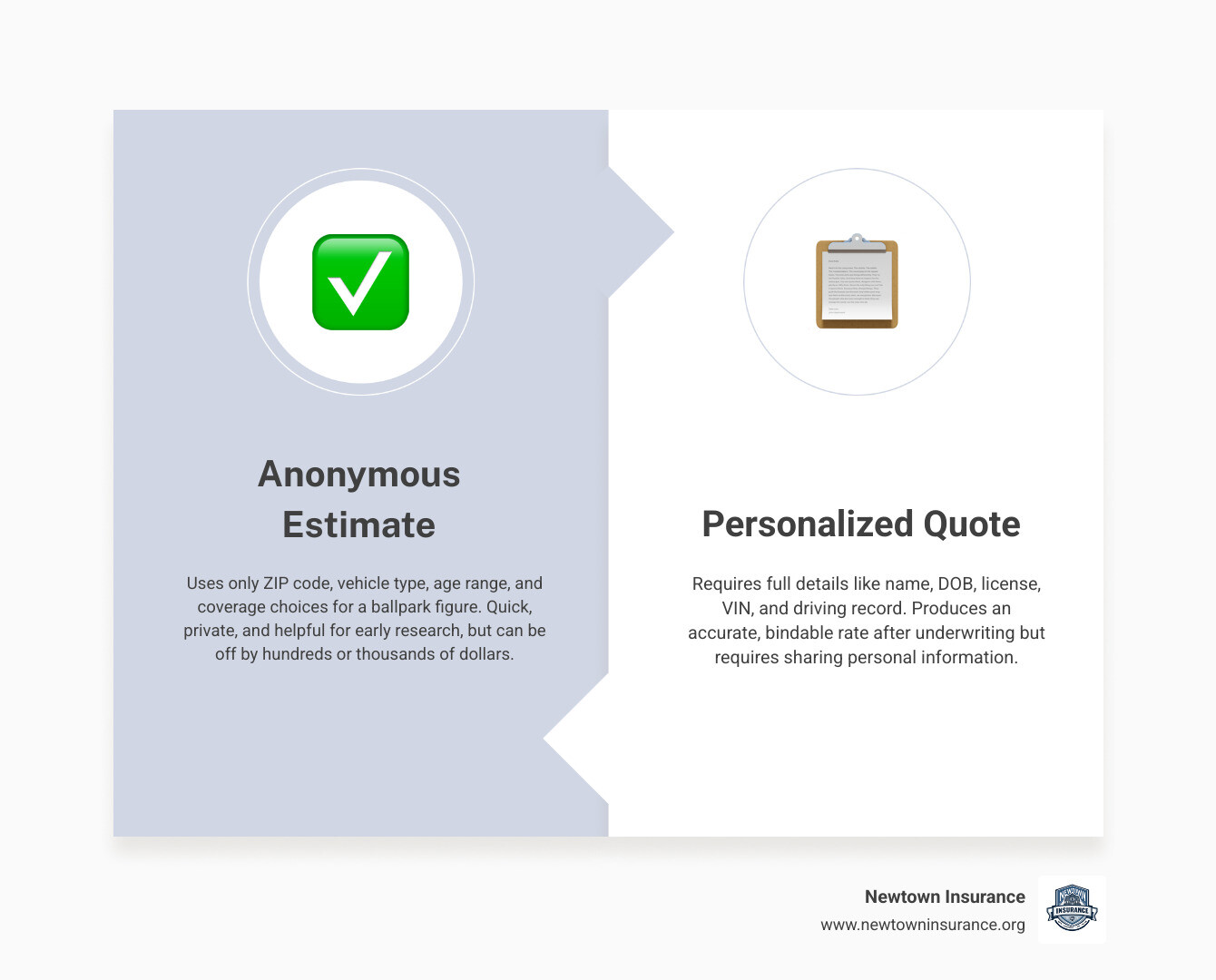
If we are being precise, completely anonymous auto insurance quotes usually do not exist. What most people can get is a rough estimate using limited information such as a ZIP code, vehicle type, driver age range, and basic coverage choice. That can still be useful, but it is not the same as a fully underwritten rate.
What “anonymous” actually means in insurance
In insurance shopping, "anonymous" usually means:
- no full name yet
- no phone number yet
- no Social Security number yet
- maybe no exact street address yet
- sometimes no driver's license number or VIN at the first step
That kind of estimate can help us compare broad price ranges without triggering a full application process. Think of it as browsing the menu before ordering dinner. Helpful? Yes. Final bill? Not even close.
Why completely anonymous quotes usually don’t exist
Insurance pricing is based on risk, and risk is personal. Insurers generally need to know things like:
- who is driving
- where the car is garaged
- what vehicle is being insured
- how much coverage is being selected
- whether the driver has accidents, tickets, lapses, or other rating factors
They also need verified information before issuing proof of insurance or binding a policy. That is why true anonymity tends to end when the process moves from "shopping" to "buying."
For a deeper look at how minimal-info shopping works, see our car insurance quote no personal info guide.
When an estimate is useful and when it isn’t
A minimal-info estimate is useful when we want to:
- get a general price range
- compare carriers early
- understand whether full coverage is in budget
- narrow the list before sharing real details
It is not enough when we need to:
- know the exact premium
- compare discounts accurately
- add multiple drivers
- insure a high-value or unusual vehicle
- buy coverage the same day
If we are still in research mode, an estimate is often fine. If we are ready to purchase, we need a real quote. We cover that transition in more detail in our car insurance quote no personal info guide.
What insurers need before they can give an accurate rate
The more personalized the rate, the more personalized the data has to be. That is not insurers being nosy for sport. It is how pricing works.
The basic information most quote tools ask for
Most online tools begin with a short list like this:
- ZIP code
- age or date of birth
- vehicle year
- make and model
- basic driving history
- desired coverage level
- annual mileage

Even this short list matters a lot. Research shows the cheapest insurer can change dramatically depending on age and credit profile. In 43% of ZIP codes, the company with the cheapest rate for a 20-year-old is not the cheapest for a 35-year-old. In 48% of ZIP codes, the cheapest company for a driver with poor credit is different from the cheapest for a driver with good credit.
The details often required later in the process
Once we want a more accurate quote, insurers often ask for:
- full name
- full birth date
- street address
- driver's license number
- VIN
- prior insurance information
- all household drivers of driving age
- sometimes Social Security number
Not every insurer asks for all of this upfront. Some save the more sensitive fields for later. But by the time we get to a bindable quote, identity and vehicle verification are standard.
Why age, ZIP code, driving record, and credit matter so much
These details affect claim risk and expected cost.
- Age helps predict loss frequency and severity. Younger drivers usually pay more.
- ZIP code reflects local accident patterns, repair costs, theft rates, weather exposure, and litigation trends.
- Driving record shows past behavior, which is one of the strongest indicators of future claims.
- Credit-based insurance scores, where allowed, are commonly used because they correlate with claim patterns.
Coverage history also matters. A lapse in insurance can signal higher risk, while a long, stable history may help.
For readers who want a neutral overview of how auto insurance is priced and regulated, it can help to understand the broader system before comparing Pennsylvania-specific options.
How state laws affect quote questions and pricing factors
State law shapes both coverage requirements and what rating factors can be used.
In Pennsylvania, drivers must meet state minimum auto insurance requirements, and insurers must rate policies within Pennsylvania rules. State law also affects optional coverages, tort choices, and how claims are handled. While some other states restrict the use of certain factors like credit or gender, what matters for our readers here is Pennsylvania law.
If you want Pennsylvania-specific guidance rather than generic internet advice, visit our Pennsylvania Insurance Requirements and Quotes.
How accurate are insurance quotes without personal info?
Short answer: sometimes close, sometimes wildly off.
Anonymous estimates can be directionally useful, but they are not dependable enough for final decisions.
Why anonymous estimates can be off by a lot
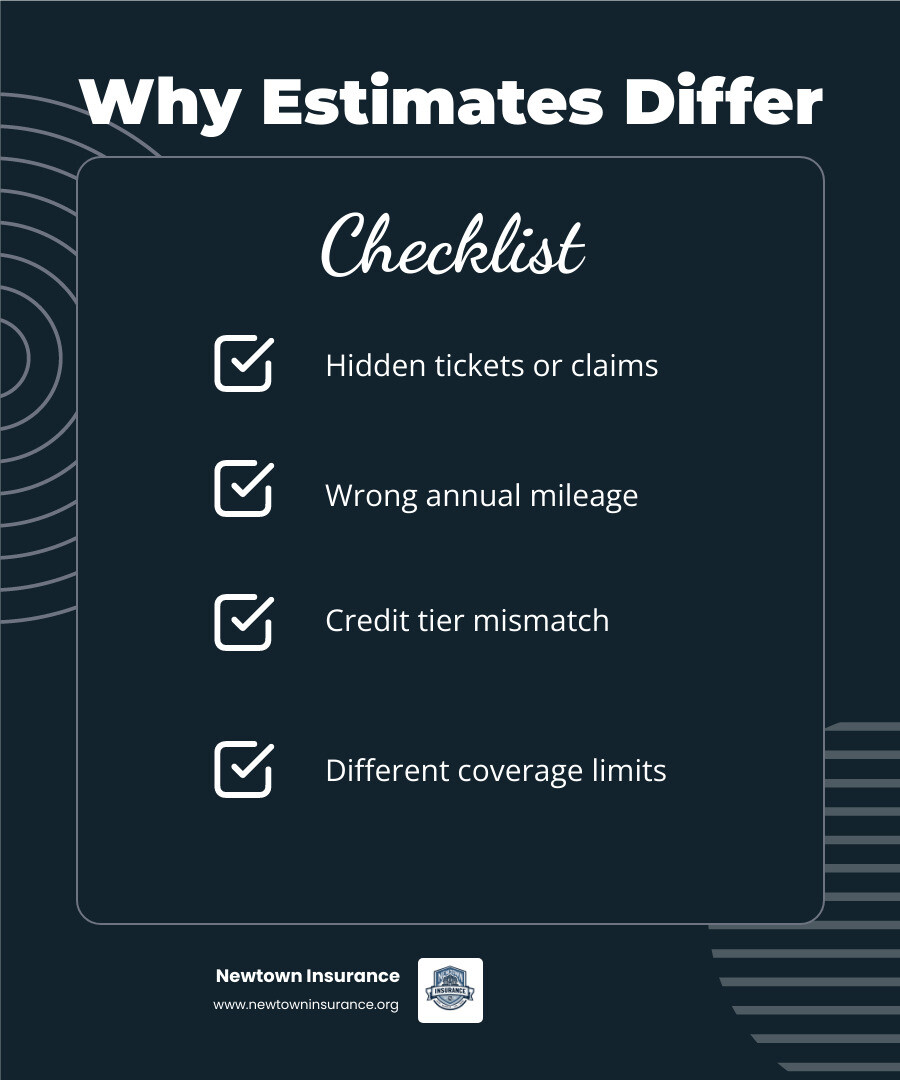
A minimal-info estimate often uses assumptions. If those assumptions are wrong, the estimate can drift fast. Common trouble spots include:
- hidden tickets or accidents
- claims history
- annual mileage
- credit tier
- prior insurance lapses
- garaging location differences
- missing VIN details
- wrong coverage limits or deductibles
A person who drives 5,000 miles a year may get a very different price than someone driving 18,000. A driver with a spotless record may see a pretty close estimate, while someone with a recent claim may see a number that changes a lot after verification.
The data behind quote variation
National data helps show why these estimates move around so much:
- Drivers could overpay by an average of $4,914 per year by not comparing rates.
- The national average cost is about $2,685 per year for full coverage and about $800 for minimum coverage.
- In 43% of ZIP codes, the cheapest insurer for a 20-year-old is not the cheapest for a 35-year-old.
- In 48% of ZIP codes, the cheapest insurer for poor credit is not the same as the cheapest for good credit.
Here is a simple comparison:
| Quote Type | Info Used | Accuracy | Best Use |
|---|---|---|---|
| Anonymous estimate | ZIP code, vehicle basics, broad profile | Low to moderate | Early research |
| Minimal-info quote | DOB, address, driving history, coverage choices | Moderate to high | Narrowing options |
| Personalized quote | Verified personal and vehicle details | High | Purchase decision |
Who gets the closest ballpark estimate
Anonymous estimates are usually closest for drivers who have:
- a clean driving record
- one standard vehicle
- no lapse in coverage
- typical mileage
- straightforward coverage needs
If nothing about the profile is unusual, the ballpark number may be reasonably useful.
Who should skip straight to personalized quotes
We usually recommend going straight to a personalized quote if we are dealing with:
- teen or very young drivers
- poor credit
- recent accidents or claims
- DUI or SR-22 needs
- luxury or performance vehicles
- multi-car or multi-driver households
- recent lapse in coverage
These situations create bigger pricing swings, so rough estimates are less reliable.
Smart ways to shop privately before sharing full details
Privacy-first shopping is absolutely possible. The trick is to use a staged approach rather than trying to stay anonymous forever.
How to get insurance quotes without personal info in two steps
Our favorite method is simple:
- Start with estimate tools
- Use ZIP-only or minimal-input tools.
- Enter vehicle basics and broad coverage preferences.
- Compare ranges, not exact dollars.
- Share full details only with finalists
- Pick the 2 to 3 options that look most promising.
- Then complete full quote requests for accurate pricing.
- Compare those final numbers side by side.

This approach reduces unnecessary data sharing while still getting us to an accurate answer.
For more on comparing options efficiently, read our compare insurance quotes complete guide.
How to protect your privacy online while comparing quotes
A few practical habits go a long way:
- use a secondary email for quote shopping
- consider a VoIP or temporary number if a phone field is required
- uncheck marketing consent boxes
- look for HTTPS and a secure padlock
- use a password manager
- enable two-factor authentication where available
- avoid quote forms on public Wi-Fi unless using a VPN
- read the privacy policy before submitting
In plain English: if a site feels like it wants your phone number more than it wants to show a rate, be cautious.
Red flags that a quote site may sell your data
Watch for these warning signs:
- phone number marked "required" before any pricing appears
- vague privacy policy
- broad consent language about "partners"
- lots of pop-ups and urgency
- no clear explanation of how quotes are generated
- lead-form style pages that ask for contact info before vehicle info
That does not prove bad intent, but it should slow us down.
Alternatives to full quotes for rough pricing
If we just want a ballpark, alternatives include:
- state average premium studies
- broad insurer rate analyses
- coverage calculators
- speaking with a local agent for benchmark ranges
- using minimal-input online estimators
Privacy-friendly tactics include:
- start with ZIP code only
- avoid SSN until necessary
- skip VIN early if allowed
- use real but minimal information
- narrow choices before filling out full forms
For a full comparison strategy, see our compare insurance quotes complete guide.
Pros, cons, and the point where anonymity ends
Anonymous shopping has real advantages, but it also has limits.
Benefits of getting estimates first
Starting with estimates can help us:
- reduce spam calls and emails
- avoid sales pressure too early
- compare broad price ranges quickly
- figure out whether minimum or full coverage fits the budget
- narrow the field before doing full applications
That matters because many drivers worry they are overpaying. One research source found that 39% of visitors to an anonymous quote page felt they were paying too much for car insurance.
Drawbacks of holding back information
There are tradeoffs:
- lower accuracy
- possible missed discounts
- premium changes later
- more back-and-forth before purchase
- wasted time if the estimate was too optimistic
In other words, privacy can save hassle early, but too much secrecy can slow down the final decision.
Can you buy a policy anonymously?
No. A policy cannot be purchased anonymously.
Before coverage can be bound, insurers generally need to verify:
- legal name
- date of birth
- address
- vehicle details
- license information
- ownership or insurable interest
- payment details
They may also need signatures and confirmations required by Pennsylvania law. If a company issues ID cards and proof of insurance, it must know who it is insuring. That is the point where "incognito mode" ends.
For a closer look at what happens between quote and purchase, read our guide to personalized insurance quotes.
The minimum information usually needed to bind coverage
For most auto policies, binding coverage usually requires:
- named insured
- garaging address
- vehicle ownership details
- VIN
- driver's license information
- prior coverage details
- selected limits and deductibles
- payment information
- signed or confirmed application details
Once this stage begins, accuracy matters more than privacy shortcuts. Incorrect information can delay issuance or change the premium.
Frequently Asked Questions about insurance quotes without personal info
Can I get insurance quotes without personal info and avoid a credit hit?
Usually yes. Quote requests are generally handled as soft inquiries, not hard pulls, so they typically do not affect credit scores. That said, insurers may use a credit-based insurance score where allowed by law. In Pennsylvania, that can be part of rating, but a standard quote request is not the same as applying for a loan.
Which quote requests can I usually skip at first—SSN, VIN, or driver’s license?
Often, yes at the estimate stage.
Many quote tools can start without:
- Social Security number
- VIN
- driver's license number
But those fields may become necessary later for verification and accurate pricing. If the goal is just a rough estimate, we can often delay them. If the goal is to buy today, we should expect to provide them.
What happens if I use fake information to get a quote?
Usually, we get a bad estimate.
Using a fake name may not matter much for a rough calculator, but a fake address, wrong age, or made-up driving history can produce a meaningless price. Worse, if incorrect information carries into the application stage, it can lead to:
- premium changes
- delays
- denial of the policy
- cancellation after issue
- problems at claim time
Better strategy: share less, but keep what we do share accurate.
Conclusion: Start private, then get precise
The smartest approach to insurance quotes without personal info is not to chase perfect anonymity. It is to control the process.
We recommend starting with privacy-friendly estimates, using only the minimum information needed to compare options. Then, once we have a shortlist, we can move to accurate personalized quotes with confidence.
That approach gives Pennsylvania drivers the best of both worlds:
- less spam
- less pressure
- smarter comparison
- more accurate final pricing
At Newtown Insurance, we believe insurance shopping should feel transparent, not intrusive. If you are ready to move from ballpark estimate to real numbers, explore our Pennsylvania insurance services or learn more about personalized insurance quotes.
If you are also researching other types of coverage with similar privacy concerns, our related guides may help:
- car insurance quote no personal info guide
- life insurance quote no personal info guide 2026
- can you get health insurance quote without giving personal information
Because yes, we all like privacy. We just also like accurate prices. Ideally before our inbox turns into a digital haunted house.