What Is Home Insurance and Why Does It Matter?

Home insurance information is something every homeowner — and renter — should understand before something goes wrong.
Here is a quick overview of what home insurance is and what it does:
| Key Question | Quick Answer |
|---|---|
| What is it? | A policy that protects your home, belongings, and finances from unexpected losses |
| What does it cover? | Your home’s structure, personal property, liability, and temporary living costs |
| Is it required? | Not by law, but mortgage lenders almost always require it |
| What does it cost? | The national average is around $1,300 per year |
| What doesn’t it cover? | Floods, earthquakes, and damage from neglect typically require separate coverage |
Your home is likely your biggest financial asset. A fire, a burst pipe, or a lawsuit from a visitor who gets hurt on your property could cost you tens — or even hundreds — of thousands of dollars. Home insurance is the financial safety net that keeps one bad day from becoming a financial disaster.
Yet many homeowners carry policies they don’t fully understand. They may be overpaying, underinsured by as much as 17%, or unaware of major gaps in their coverage.
I’m Shawn Beihl, a specialty insurance adviser with over 15 years of experience in property and casualty insurance, and I’ve spent my career helping people make sense of complex home insurance information so they can protect what matters most. In the sections below, I’ll walk you through everything you need to know — from policy types and coverage limits to claims, costs, and common pitfalls.
Understanding the Basics of Home Insurance Information
At its core, a homeowners insurance policy is a “package deal.” It combines property insurance (for your stuff and your house) with liability insurance (for your legal responsibility to others). Think of it as a multi-layered shield. If a lightning strike toasts your roof, the property side kicks in. If your dog decides the mail carrier’s leg looks like a chew toy, the liability side steps up to cover the legal and medical bills.
The primary purpose is simple: indemnity. That’s a fancy insurance word for “making you whole again.” The goal is to return you to the same financial position you were in before the disaster happened. We want to make sure that if the unthinkable occurs, you aren’t left staring at a pile of ashes with a mortgage still due.
Speaking of mortgages, while we often think of insurance as a choice, for most of us, it’s a requirement. If you’re financing your home in Newtown or anywhere else in Pennsylvania, your lender is going to insist on seeing proof of insurance. Why? Because the house is their collateral. If the house burns down, they want to know the insurance company will pay off the loan.
If you let your policy lapse, you might encounter “force-placed insurance,” also known as Collateral Protection Insurance (CPI). Trust us, you don’t want this. Lenders purchase this to protect their interest, not yours. It’s often much more expensive than a standard policy and provides significantly less protection for your personal belongings. To avoid this headache, it’s best to stay informed and keep your policy active. For a deeper dive into how these policies work, check out this Consumer Guide: Homeowners Insurance.
Is Homeowners Insurance Legally Required?
Technically, no. Unlike car insurance, there is no Pennsylvania state law that says you must have home insurance. If you bought your home with cash or have fully paid off your mortgage, you could legally go without it.
However, we wouldn’t recommend it. Even without a lender looking over your shoulder, the risk is simply too high. Could you afford to rebuild your home out of pocket tomorrow? Most of us couldn’t. Furthermore, many homeowners pay their premiums through an escrow account. This is where your mortgage servicer collects a portion of your insurance and property taxes each month as part of your mortgage payment, then pays the bills on your behalf when they’re due. This ensures your equity is always protected.

What Does a Standard Policy Actually Cover?
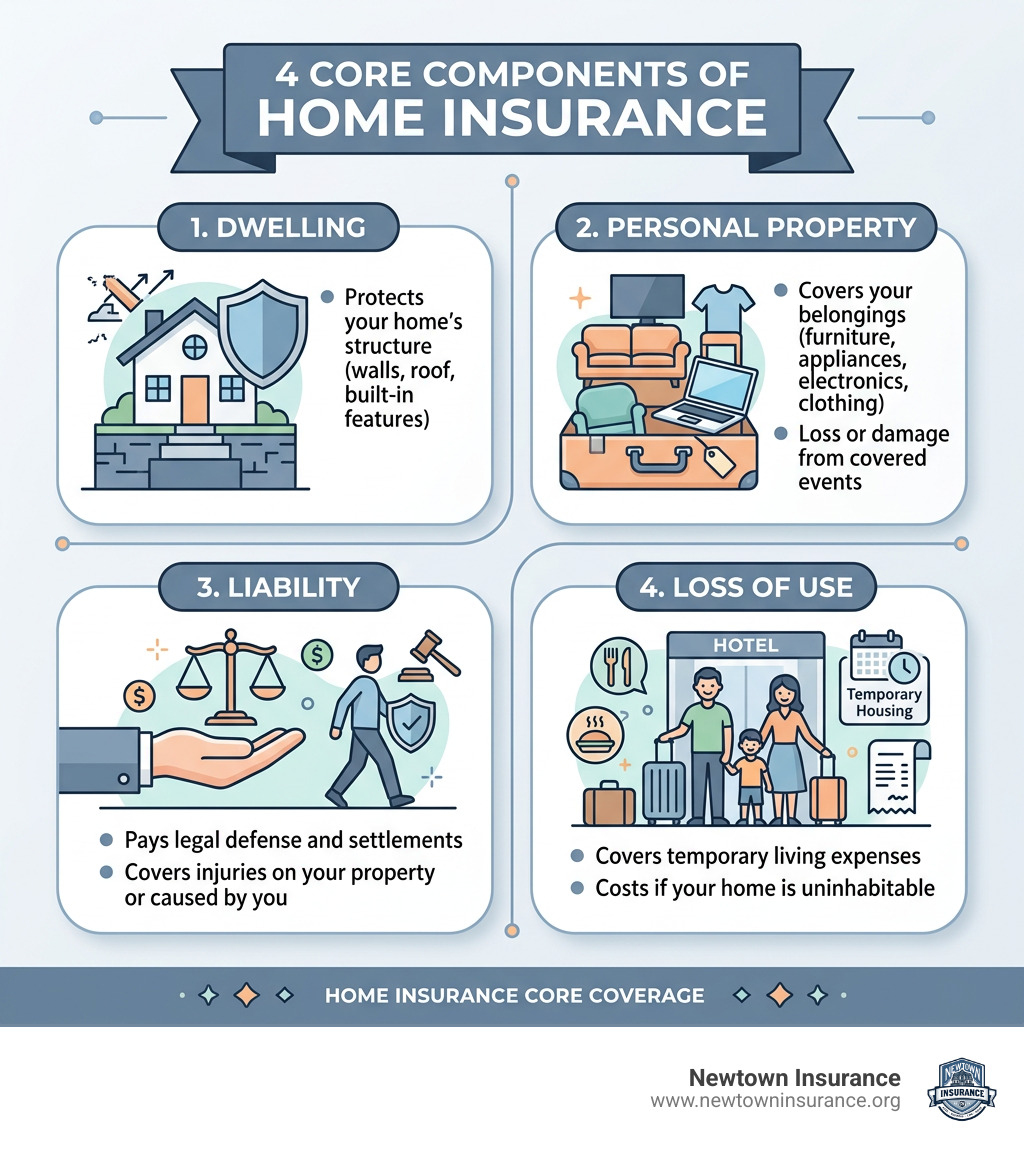
A standard policy (typically an HO-3) is broken down into several key coverage parts. Understanding these is the foundation of mastering home insurance information.
- Dwelling Coverage (Coverage A): This protects the structure of your home itself — the walls, roof, floors, and attached structures like a garage.
- Other Structures (Coverage B): This covers things on your property that aren’t attached to the house, like a fence, a detached shed, or even a gazebo. Usually, this limit is set at 10% of your dwelling coverage.
- Personal Property (Coverage C): This is for your “stuff” — furniture, clothes, electronics, and appliances. Interestingly, this coverage often follows you. If your laptop is stolen from your car while you’re on vacation, your homeowners policy might actually cover it!
- Loss of Use (Coverage D): If a fire makes your home uninhabitable, this pays for your additional living expenses (ALE). This includes hotel stays and restaurant meals while your home is being repaired. You can learn more about this vital protection in our post on loss-of-use-coverage.
- Personal Liability (Coverage E): This protects you if someone sues you for bodily injury or property damage. Standard limits usually start at $100,000, but in today’s litigious world, we often suggest higher limits or an umbrella policy.
- Medical Payments (Coverage F): This is for smaller, “no-fault” medical bills if a guest is injured on your property, regardless of who is to blame.
Common Perils and the HO-3 Special Form
In insurance, a “peril” is just a cause of loss. The most common policy type for owner-occupied homes is the HO-3 “Special Form.”
The HO-3 is unique because it uses two different ways to define what is covered:
- Open Perils for the Dwelling: This means your house is covered for everything except for a specific list of exclusions (like floods or earthquakes). If it’s not on the “no-no” list, it’s covered.
- Named Perils for Personal Property: Your belongings are typically covered only for 16 specific disasters listed in the policy. These include fire, lightning, windstorm, hail, explosion, riot, aircraft, vehicles, smoke, vandalism, theft, falling objects, weight of ice/snow, accidental discharge of water/steam, sudden cracking of systems, and freezing.
Essential Home Insurance Information for Renters and Condos
Not everyone lives in a detached single-family home. If you rent an apartment or own a condo, your needs are different.
- HO-4 (Renters Insurance): Your landlord has insurance for the building, but that policy does not cover your furniture, clothes, or electronics. An HO-4 policy covers your belongings and provides liability protection. It’s incredibly affordable — often less than the cost of a few pizzas a month.
- HO-6 (Condo Insurance): This is “walls-in” coverage. The condo association usually covers the exterior and common areas, but you are responsible for the interior of your unit, including flooring, cabinetry, and your personal belongings.
For our friends who might be researching across borders, you might find Home insurance information for tenants helpful for general concepts, though specific Pennsylvania regulations will vary.
Navigating Policy Types and Reimbursement Methods
Not all policies are created equal. Depending on your home type, you might see different “HO” numbers:
- HO-1 & HO-2: Basic and Broad forms. These are less common today as they offer more limited protection than the HO-3.
- HO-5: The “Comprehensive” form. This is the gold standard, offering “open perils” coverage for both your home and your personal belongings.
- HO-8: Modified coverage for older homes where the cost to rebuild is much higher than the market value.
Understanding Payouts and Recoverable Depreciation
When you file a claim, how much will you actually get? This is where many people get a surprise. There are two main ways insurers calculate payouts:
| Method | How it Works | The Result |
|---|---|---|
| Actual Cash Value (ACV) | Replacement cost minus depreciation (age/wear) | You get less money for older items. |
| Replacement Cost Value (RCV) | The cost to buy the item new today | You get enough to actually replace the item. |
Expert Tip: Always opt for Replacement Cost coverage if possible. If a 10-year-old TV is destroyed, ACV might only give you $50. Replacement Cost will give you enough to buy a brand-new TV of similar quality.
Sometimes, insurers use “recoverable depreciation.” They give you the ACV check first, then send you a second check for the remaining balance once you prove you actually replaced the item. For a deeper look at these mechanics, visit What Is Homeowners Insurance and How Does It Work?.
Common Exclusions and Supplemental Coverage
Standard policies are great, but they aren’t all-encompassing. There are a few “big ones” that are almost always excluded:
- Flooding: This is the most common misunderstanding. Standard home insurance covers a burst pipe inside the house, but it does not cover water that comes from the ground up (storm surge, overflowing rivers). For that, you need a separate policy through the National Flood Insurance Program or a private insurer.
- Earthquakes: Usually requires a separate rider or policy.
- Maintenance Issues: Insurance is for “sudden and accidental” events. It won’t pay to fix a roof that is leaking because it’s 30 years old and worn out.
- Sewer Backup: This is often an optional add-on, but highly recommended for Pennsylvania homes with basements!
Factors That Influence Your Premiums and Costs
Why does your neighbor pay less than you? Several factors go into the “secret sauce” of insurance pricing. In Pennsylvania, the average premium is around $1,300, but your specific homeowners-insurance-pa-cost will depend on:
- Rebuild Cost: Not the market value, but what it would cost in labor and materials to build your house from scratch today.
- The Age of the Home: Older homes often have older wiring or plumbing, which increases risk.
- Location: Is your home near a fire station? Is it in a high-crime area or a flood zone?
- Your Credit Score: In many states, including PA, insurers use a credit-based insurance score to help predict risk.
- Claims History: If you’ve filed three claims in the last two years, your rates will likely be higher.
- Safety Features: Smoke detectors, deadbolts, and security systems can earn you discounts.
Essential Home Insurance Information for Older Homes
If you live in one of the beautiful historic homes around Newtown, you face unique insurance challenges. Standard policies might not be enough. You might need an HO-8 policy, which is designed specifically for homes where the replacement cost significantly exceeds the market value. We often look for “Ordinance or Law” coverage for older homes, which pays for the extra cost of bringing a home up to modern building codes during a repair.
Distinguishing Insurance from Warranties and Mortgage Protection
Don’t confuse your homeowners insurance with these other products:
- Home Warranty: This is a service contract that covers the repair or replacement of appliances and systems (like your HVAC or dishwasher) when they break down due to normal wear and tear. Insurance doesn’t cover wear and tear.
- Mortgage Insurance (PMI): This protects the lender if you default on your loan. It does absolutely nothing to protect your house or your stuff.
- Business Insurance: If you run a business out of your home, your standard homeowners policy likely provides very limited coverage (often only $2,500) for business equipment. You may need a separate “home-based business” rider.
Filing a Claim and Managing Your Policy
If disaster strikes, the first step is to protect the property from further damage (this is called “mitigation of loss”). If a window is broken, board it up. If a pipe bursts, turn off the water. Then, call us or your insurer immediately.
An adjuster will be assigned to investigate the loss. They will look at the damage, compare it to your policy, and determine the payout. Remember: your deductible is the amount you pay out of pocket before insurance kicks in. If you have a $1,000 deductible and $5,000 in damage, the insurance company sends you $4,000.
How Claims Affect Your Future Rates
Insurers use databases like CLUE (Comprehensive Loss Underwriting Exchange) and A-PLUS to see your claims history. Filing a claim can lead to a premium hike or even non-renewal if you file too many. As a rule of thumb, we suggest only filing a claim if the damage significantly exceeds your deductible. If you have $1,200 in damage and a $1,000 deductible, it’s usually better to pay the $1,200 yourself rather than risk a rate increase for a $200 payout.
Frequently Asked Questions about Home Insurance Information
Are homeowners insurance premiums tax deductible?
For your primary residence, the answer is generally no. You cannot deduct your home insurance premiums on your federal income taxes. However, if you use part of your home for a legitimate home office or if you rent out a portion of your property, a pro-rated portion of the insurance may be deductible as a business expense. Always consult with a tax professional to be sure.
Does home insurance cover my home-based business?
Only in a very limited way. Most policies provide up to $2,500 for business equipment kept at home, but they usually provide zero liability coverage for business-related incidents. If a client trips and falls in your home office, your standard policy might not cover you. We recommend adding a business rider to bridge this gap.
How do I know if I am underinsured?
A staggering 60% of homes are undervalued by an average of 17%. To avoid this, follow the 80% rule: you should insure your home for at least 80% of its total replacement cost to avoid penalties during a partial loss. We recommend an annual review of your policy to account for rising construction costs and any home improvements you’ve made.
Conclusion
Navigating home insurance information doesn’t have to be a headache. At Newtown Insurance, we pride ourselves on providing tailored protection for our Pennsylvania neighbors. Whether you’re buying your first home in Newtown or looking to save on a long-time family estate, we offer smart savings and transparent pricing without the “big box” fluff.
Don’t wait for a storm to find out what’s in your policy. Let us help you ensure your “happy place” is truly protected.
Get a quote for your home today and see the difference that customer-first support can make.