

How to Find the Best Medigap Plan G in Pennsylvania Without Losing Your Mind
Is Medigap Plan G in Pennsylvania Right for You? Here's What to Know First

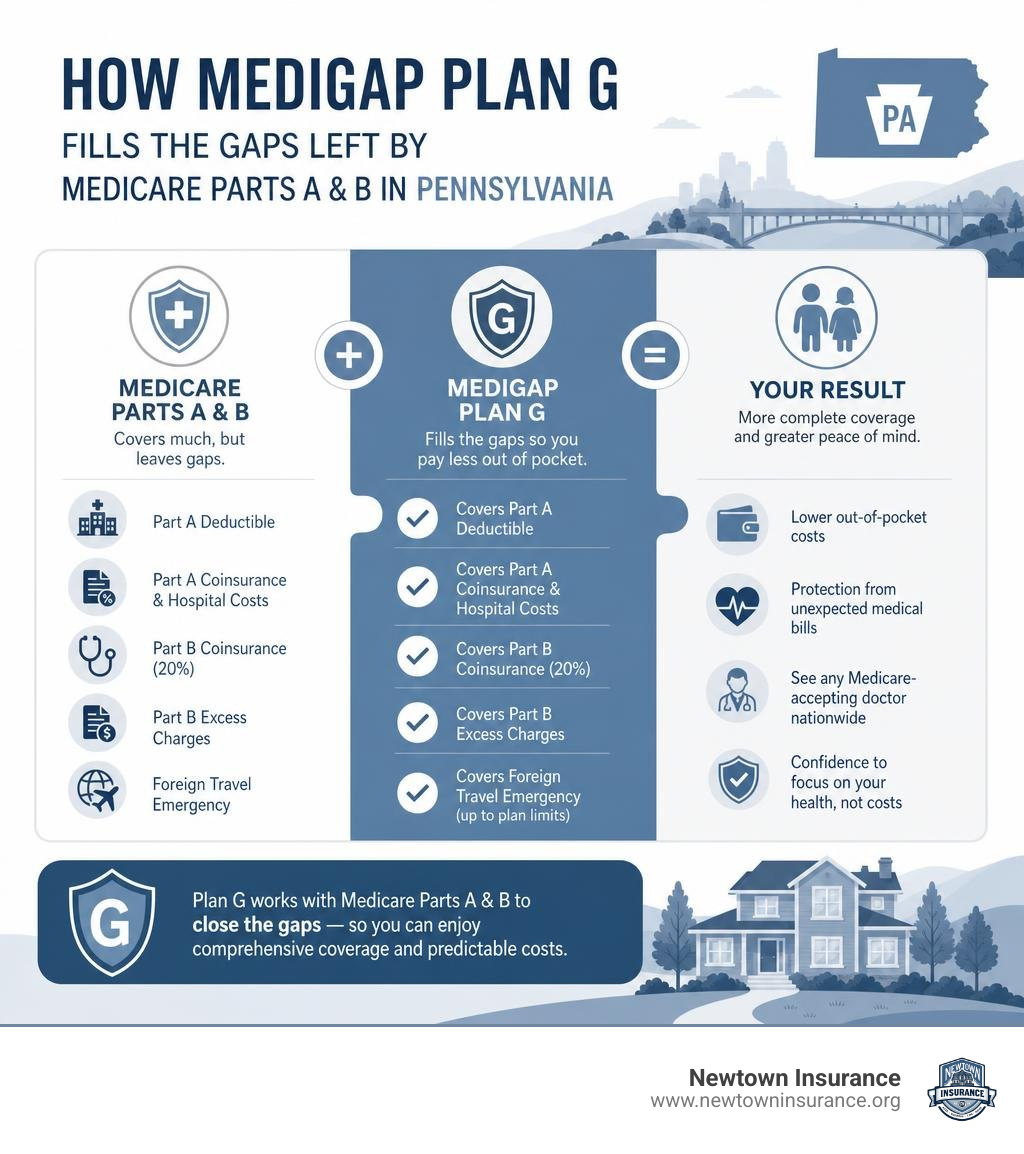
Medigap Plan G in Pennsylvania is the most popular Medicare Supplement plan in the state — and for good reason. It covers nearly every gap that Original Medicare leaves behind, giving you predictable costs and the freedom to see any Medicare-accepting doctor in the country.
Quick answer for Pennsylvania residents comparing Plan G options:
| Question | Answer |
|---|---|
| What does Plan G cover? | Part A deductible, Part A & B coinsurance, skilled nursing, Part B excess charges, foreign travel emergency |
| What doesn't Plan G cover? | Part B deductible ($283/year in 2026), prescription drugs, dental, vision, hearing |
| How much does Plan G cost in PA? | Roughly $100–$300/month for a 65-year-old, depending on carrier and zip code |
| Who offers Plan G in PA? | Various top-rated private insurance carriers licensed in the state |
| When should you enroll? | During your 6-month Medigap Open Enrollment Period starting when you turn 65 and enroll in Part B |
| Is PA community-rated? | Yes — Pennsylvania uses community rating, so premiums don't increase based on your age |
More than 680,000 Pennsylvania residents carry Medigap coverage. Of those, 37% have chosen Plan G — more than any other plan type. That's not a coincidence. Plan G hits a sweet spot: comprehensive protection without the higher premiums that come with Plan F.
But here's the problem most people run into: the benefits are identical no matter which company you buy from, yet premiums can vary by hundreds of dollars per year for the exact same coverage. Shopping blind — or sticking with the first quote you get — almost always means overpaying.
That's exactly where this guide comes in.
I'm Shawn Beihl from Newtown Insurance, and with over 15 years of specialty insurance experience — including health, benefits management, and risk advising — I've helped many Pennsylvanians navigate Medigap Plan G in Pennsylvania without overpaying or getting locked into the wrong plan. In the sections ahead, I'll walk you through everything you need to compare your options clearly and confidently.
What is Medigap Plan G and How Does It Work in Pennsylvania?
To understand Medigap Plan G, we first have to look at how Original Medicare works. Original Medicare consists of Part A (hospital insurance) and Part B (medical insurance). While Original Medicare covers a vast portion of your healthcare expenses, it doesn't cover everything. It leaves you with out-of-pocket costs like deductibles, copayments, and 20% coinsurance under Part B. There is no annual out-of-pocket maximum on Original Medicare, meaning a serious illness could result in unlimited medical bills.
This is where Medicare Supplement Insurance, commonly known as Medigap, comes in. These plans are sold by private insurance companies to fill the financial "gaps" left behind. When you have a healthcare expense, Medicare (Parts A and B) pays its approved amount first, and then your Medigap plan pays its share.
Under federal rules, Medigap policies are standardized. This means a Plan G - Medicare Supplement Insurance in Pennsylvania provides the exact same medical coverage whether you buy it from a major household brand or a lesser-known regional carrier. The only differences are the monthly premium, the company's customer service, and their history of rate stability.
Core Benefits Covered by Medigap Plan G Pennsylvania
Plan G is currently the most comprehensive Medicare Supplement plan available to new Medicare enrollees. Here is a breakdown of what Plan G covers at 100%:
- Medicare Part A Hospital Coinsurance and Costs: Covers your hospital coinsurance plus provides up to an additional 365 days of hospital coverage after your Medicare benefits are exhausted.
- Medicare Part A Deductible: Covers the full deductible required before hospital stays are covered.
- Medicare Part B Coinsurance or Copayment: Covers the 20% portion you would normally owe for doctor visits, outpatient therapy, and medical equipment.
- Blood Coverage: Pays for the first three pints of blood needed for a medical procedure.
- Hospice Care Coinsurance or Copayment: Covers the out-of-pocket costs associated with hospice care.
- Skilled Nursing Facility Care Coinsurance: Covers the daily coinsurance cost for skilled nursing stays.
- Medicare Part B Excess Charges: If a doctor does not accept "Medicare assignment" (the Medicare-approved rate), they can charge up to 15% more than the approved amount. Plan G covers 100% of these excess charges.
- Foreign Travel Emergency: Covers 80% of emergency medical costs during the first 60 days of a trip outside the United States (after a $250 annual deductible, up to a lifetime maximum of $50,000).
What Medigap Plan G Pennsylvania Does Not Cover
While Plan G is highly comprehensive, it does not cover everything. It is important to know what you will still be responsible for:
- Medicare Part B Deductible: This is the annual deductible for outpatient services. For 2026, the Part B deductible is $283. You must pay this amount out of pocket once a year before Plan G begins paying your outpatient medical bills.
- Prescription Drugs: Modern Medigap policies do not include prescription drug coverage. To avoid late-enrollment penalties, you must purchase a separate Medicare Part D prescription drug plan.
- Routine Vision, Dental, and Hearing Care: Routine exams, eyeglasses, dental cleanings, dentures, and hearing aids are not covered by Plan G.
- Long-Term Care: Plan G does not cover custodial care or long-term nursing home stays.
Comparing Medigap Plan G Pennsylvania to Other Popular Plans
Because Medigap plans are standardized by the federal government, you can easily compare Plan G against other popular options like Plan F and Plan N to see which is the best fit for your budget and lifestyle.
In Pennsylvania, 83% of all Medigap members are enrolled in one of these three popular plans. Here is a quick comparison of how they stack up:
| Benefit Covered | Medigap Plan G | Medigap Plan F | Medigap Plan N |
|---|---|---|---|
| Part A Deductible | 100% | 100% | 100% |
| Part B Coinsurance | 100% | 100% | 100% (except copays) |
| Part B Excess Charges | 100% | 100% | Not Covered |
| Part B Deductible ($283 in 2026) | No | 100% | No |
| Doctor Visit Copays | None | None | Up to $20 |
| Emergency Room Copays | None | None | Up to $50 |
| Average Cost in PA | Moderate | High | Lower |
Plan G vs. Plan F
Plan F was long considered the "gold standard" of Medicare Supplement insurance because it covers 100% of all gaps, including the Medicare Part B deductible. However, federal law instituted a major change: Plan F is unavailable to anyone who became eligible for Medicare on or after January 1, 2020.
If you were eligible for Medicare before 2020, you can still buy or keep Plan F. However, because no new, younger enrollees can join Plan F pools, the average age of Plan F members is rising rapidly. This has caused Plan F premiums to escalate much faster than Plan G premiums.
For almost everyone, Plan G is a smarter financial move. The only difference between the two is that Plan G does not cover the Part B deductible ($283 in 2026). If the annual premium savings for Plan G is greater than $283, you will save money by choosing Plan G.
Plan G vs. Plan N
Plan N is the most popular lower-premium alternative to Plan G. It is designed for cost-conscious retirees who want strong protection but don't mind paying small copayments in exchange for lower monthly premiums.
With Plan N, you will pay:
- Up to a $20 copay for some office visits (including specialists).
- Up to a $50 copay for emergency room visits (waived if you are admitted as an inpatient).
- Part B excess charges out of pocket (Plan N does not cover these, whereas Plan G does).
If you live in an area where doctors rarely charge excess charges, and you do not visit the doctor frequently, Plan N can save you roughly $20 to $60 per month in premiums compared to Plan G.
How Much Does Medigap Plan G Cost in Pennsylvania?
One of the most common questions we hear is: "What will my monthly premium be?"
In Pennsylvania, Plan G premiums typically range from $100 to $300 per month for a 65-year-old. Why such a wide range? Because insurance companies look at several factors when setting your individual rate:
- Your Zip Code: Healthcare costs vary by region. For example, a resident of Philadelphia or Pittsburgh may pay higher premiums than someone living in a rural Pennsylvania county due to local healthcare costs. In Pittsburgh, the lowest Plan G premium from any insurer starts around $133 per month for a 65-year-old female nonsmoker.
- Age and Gender: Because women have a longer life expectancy, they often pay slightly lower premiums than men of the same age.
- Tobacco Use: Smoking or using tobacco can significantly increase your Medigap premiums.
- Discounts: Many carriers offer household discounts (often 5% to 12%) if two people in the same home enroll with the same company.
To make sure you aren't overpaying, check out our Tips for Saving Money on Insurance and learn how minor adjustments can lower your overall costs.
Understanding Pennsylvania Medigap Pricing Methods
When shopping for a plan, it is critical to ask the insurance company how they price their policies. There are three rating methods used by insurers, and they have a massive impact on your premiums over time. You can read more about these rules on the Medicare Supplement | Insurance Department page.
- Community-Rated (No-Age-Rated): Under this method, everyone living in the same geographic area pays the same premium, regardless of their age. Premiums do not increase just because you get older (though they can still rise due to inflation and rising healthcare costs).
- Issue-Age-Rated: Your premium is based on the age you are when you buy (issue) the policy. Premiums are lower for people who buy at a younger age and will not increase solely because you get older.
- Attained-Age-Rated: Your premium is based on your current age (the age you have "attained"). These policies start out as the cheapest option when you are 65, but they automatically increase in price every year as you get older. Over time, attained-age policies can become very expensive.
In Pennsylvania, many of the lowest-priced starting plans are attained-age-rated. While they look attractive at age 65, it is vital to work with an independent broker to look at the carrier's historical rate increases so you don't get priced out of your plan in your 70s and 80s. To master the quoting process, see our Compare Insurance Quotes Complete Guide.
When and How to Enroll in Pennsylvania Medigap Plans
Timing is everything when it comes to buying a Medigap policy. If you miss your key windows, you could be denied coverage entirely or forced to pay much higher premiums.

The Medigap Open Enrollment Window
Your best opportunity to buy any Medigap plan — including Plan G — is during your one-time Medigap Open Enrollment Period. This is a six-month window that begins automatically the first month you are 65 or older AND enrolled in Medicare Part B.
During this six-month period, you have "guaranteed issue rights." This means:
- Insurance companies must sell you any Medigap policy they offer.
- They cannot charge you more because of pre-existing health conditions.
- They cannot make you go through medical underwriting (answering health questions or reviewing medical records).
If you miss this window and try to apply later, companies can review your medical history and deny you coverage based on your health.
Switching Plans and Guaranteed Issue Rights in PA
A common misconception is that Pennsylvania has a "birthday rule" that allows you to switch Medigap plans every year without health questions. Pennsylvania does not have a birthday rule.
If you want to switch your Medigap policy after your initial Open Enrollment Period has ended, you will usually have to go through medical underwriting. The new company will review your health history, and they can reject your application if you have chronic health conditions.
However, there are certain "Guaranteed Issue" scenarios where you can buy a plan without medical underwriting outside of your open enrollment window. These include:
- You are enrolled in an employer group health plan that is ending.
- You joined a Medicare Advantage plan when you first became eligible for Medicare, and you decide to switch back to Original Medicare within your first 12 months (known as a "trial right").
- You moved out of your current plan's service area.
- You lost Medicaid coverage due to eligibility redeterminations.
If you find yourself in one of these situations, you can use the official Find a Medigap policy that works for you tool to locate plans that must accept you.
Frequently Asked Questions About Medigap Plan G Pennsylvania
Can I have Medigap Plan G and Medicare Advantage at the same time in Pennsylvania?
No. You cannot have both a Medigap plan and a Medicare Advantage plan at the same time. In fact, it is illegal for an insurance agent to sell you a Medigap policy if they know you are enrolled in a Medicare Advantage plan (unless you are actively switching back to Original Medicare).
Medicare Advantage (Part C) replaces your Original Medicare coverage with a private managed-care network (HMO or PPO). Medigap, on the other hand, works directly with Original Medicare to pay your out-of-pocket costs.
Additionally, carrier availability and plan options can change from year to year. Working with an independent agency helps you stay up to date on which plans are currently available in your specific zip code.
What free resources are available in Pennsylvania to help me choose a plan?
If you want free, unbiased counseling, you should reach out to PA MEDI (Pennsylvania Medicare Education and Decision Insight). PA MEDI is Pennsylvania’s State Health Insurance Assistance Program (SHIP).
Their trained counselors do not sell insurance and do not work for any insurance carrier. They can help you understand your Medicare benefits, compare Medigap plans, and check if you qualify for financial assistance programs like PACE/PACENET or Medicare Savings Programs.
How do I shop for the best Plan G rates without sharing my personal information?
Many online quote engines require you to enter your phone number and email address, which often leads to dozens of unwanted sales calls.
To avoid this, we recommend reviewing our Insurance Quotes No Personal Info Guide to learn how to research rates anonymously. When you are ready to compare actual rates, check out our guide on Insurance Companies Pennsylvania to find reputable, high-performing carriers in our state.
Conclusion
Finding the right Medigap Plan G in Pennsylvania doesn't have to be an overwhelming process. Because the medical benefits of Plan G are exactly the same across every insurance company, your main goal is to find a financially stable carrier that offers a highly competitive monthly rate and a strong history of stable premiums.
At Newtown Insurance, we are proud to serve our neighbors right here in Newtown, Pennsylvania. We believe in providing tailored protection, smart savings, and completely transparent pricing. Our customer-first support is designed to help you navigate the complexities of Medicare and protect your hard-earned retirement savings.
Don't go through the Medicare maze alone. Contact us today to compare your options and let us help you find a plan that fits your life and your budget.