Why Business Insurance Coverage Is Essential for Every Business Owner

Business insurance coverage protects your company from the financial fallout of lawsuits, property damage, natural disasters, and employee injuries — risks that can shut down even a well-run business overnight.
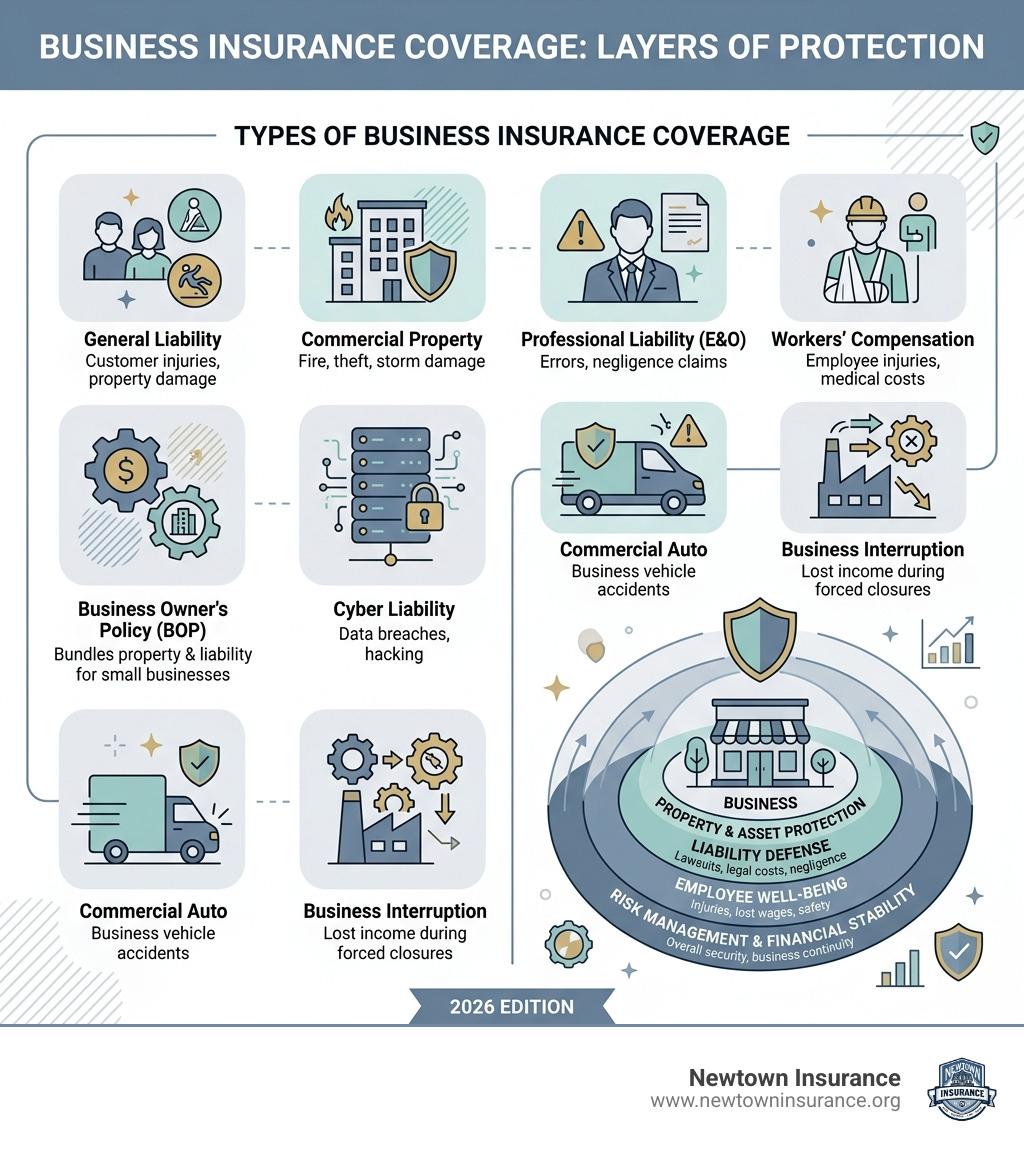
Here is a quick look at the most common types and what they cover:
| Coverage Type | What It Protects Against |
|---|---|
| General Liability | Customer injuries, property damage, advertising claims |
| Commercial Property | Fire, theft, storm damage to your building and equipment |
| Professional Liability (E&O) | Errors, negligence, or bad advice claims |
| Workers’ Compensation | Employee injuries, medical costs, lost wages |
| Business Owner’s Policy (BOP) | Bundles property and liability — ideal for small businesses |
| Cyber Liability | Data breaches, hacking, notification costs |
| Commercial Auto | Accidents involving business-owned vehicles |
| Business Interruption | Lost income when operations are forced to stop |
No matter the size of your business — a solo home-based operation or a growing company with a full team — unexpected events do not wait for a convenient time. A single injury claim can average around $30,000. A lawsuit, a fire, or a data breach can cost far more.
The right coverage keeps those costs from coming out of your pocket.
I’m Shawn Beihl, and with over 15 years of specialty insurance experience spanning commercial property and casualty, life, health, and disability, I have helped businesses of all sizes navigate the often confusing world of business insurance coverage. In this guide, I’ll break it all down in plain language so you can make confident, informed decisions for your business.
Understanding the Fundamentals of Business Insurance Coverage
At its core, business insurance coverage is about risk management and maintaining operational stability. Think of it as a financial “reset button.” When a disaster strikes—be it a burst pipe in your Newtown office or a lawsuit from a disgruntled client—insurance provides the capital necessary to keep your doors open.
The scale of these protections is massive. In 2023 alone, one major industry leader paid out $21 billion in claims globally, while another paid over $52 billion. These aren’t just numbers; they represent businesses that were saved from bankruptcy. For most business owners, the peace of mind is backed by high service standards, with many top-tier providers boasting a 92% claims satisfaction rate among clients who had to file a claim.
To get a handle on the basics, it’s helpful to view insurance as a modular system. You start with a foundation and add specific protections as your business grows. For a deeper dive into these building blocks, you can explore Small Business Insurance Basics or read about Understanding Commercial Insurance: Protect Your Business to see how these policies safeguard your investment.
Why Your Company Needs Comprehensive Business Insurance Coverage
You might think, “I run a safe operation; why do I need all this?” The reality is that we live in a litigious world. Even if you did nothing wrong, defending yourself against a frivolous lawsuit can cost tens of thousands of dollars in legal fees. Business insurance coverage provides a “duty to defend,” meaning the insurance company often handles the legal legwork and costs.
Beyond lawsuits, comprehensive coverage handles:
- Natural Disasters: From Pennsylvania ice storms to unexpected fires.
- Professional Errors: Even experts make mistakes. If your advice leads to a client’s financial loss, you’re on the hook.
- Credibility: Many clients and landlords won’t even sign a contract with you unless you can provide a Certificate of Insurance (COI). It shows you are a professional, stable entity.
For local insights on how this applies specifically to our region, check out our Business Insurance Pennsylvania Guide 2026.
Assessing Risks for Small and Large Enterprises
Every business has a unique “risk profile.” A coffee shop in Newtown faces different threats than a freelance graphic designer working from home or a large manufacturing plant.

- Small Businesses: Often face “concentration risk.” If one delivery van breaks down or one key employee gets hurt, the whole operation might stall.
- Large Enterprises: Deal with complex liability, multinational regulations, and large-scale property exposures.
- Industry-Specific Risks: A restaurant needs to worry about food spoilage and liquor liability, while a contractor needs to worry about completed operations and equipment theft.
Common Types of Policies and What They Protect
Understanding business insurance coverage requires looking at the specific “buckets” of protection available. While there are dozens of niche policies, most businesses rely on a core group of four or five. You can find a great summary of What Does Business Insurance Cover? to see how these interact.
- General Liability (GL): This is the “slip and fall” insurance. it covers bodily injury or property damage you cause to third parties.
- Commercial Property: This protects your “stuff”—your building, your inventory, your computers, and even your outdoor signage (though signs often need a specific add-on).
- Professional Liability (Errors & Omissions): Essential for anyone providing a service or advice. It protects you if a client claims your work was late, incomplete, or inaccurate.
- Cyber Insurance: In 2026, this is no longer optional. If you store customer emails, credit card info, or medical records, you are a target for hackers. This policy covers notification costs, credit monitoring for victims, and even digital ransom.
The Role of a Business Owner’s Policy (BOP)
If you are a small to medium-sized business owner, the Business Owner’s Policy (BOP) is likely your best friend. Think of it as a “Value Meal” for insurance. Instead of buying General Liability and Commercial Property separately, a BOP bundles them together.
- Efficiency: One policy, one premium, one renewal date.
- Cost-Effective: Bundling usually results in a lower price than buying individual policies. In fact, the median cost for a BOP is approximately $70 per month.
- Tailored: Most BOPs also include Business Interruption insurance, which replaces lost income if a fire or covered peril forces you to close temporarily.
We specialize in helping locals find Affordable Business Insurance by leveraging these bundled options.
Specialized Business Insurance Coverage for Specific Risks
Sometimes, the basics aren’t enough. Depending on what you do, you might need:
- Commercial Auto: Your personal auto policy almost certainly excludes business use. If you’re delivering goods or driving to client sites, you need commercial coverage.
- Product Liability: If you manufacture or sell a physical product, this protects you if that product causes injury or illness.
- Umbrella Insurance: This provides an extra layer of protection. If a massive claim exceeds your GL limits (say, a $2 million judgment when you only have $1 million in coverage), the Umbrella policy kicks in to cover the rest.
- Contractor-Specific Coverage: Construction is a high-risk game. For those in the trades, our Contractor Insurance Pennsylvania Guide covers the nuances of tools, equipment, and builder’s risk.
Legal Requirements and Compliance in Pennsylvania
In Pennsylvania, insurance isn’t just a good idea—parts of it are the law. Failing to carry mandatory coverage can lead to heavy fines, stop-work orders, or even criminal charges.
The Commonwealth has specific Business Insurance Needs – Commonwealth of Pennsylvania that every local entrepreneur should review. Generally, if you have even one employee (who isn’t an owner), you are entering mandatory compliance.
Mandatory Workers’ Compensation for Employers
Pennsylvania law is very strict regarding Workers’ Compensation. If you have employees—whether they are full-time, part-time, or even sometimes seasonal—you must carry this coverage.
- What it covers: Medical bills for work-related injuries, lost wages during recovery, and death benefits for survivors.
- The “No-Fault” System: Workers’ Comp is designed so that the employee doesn’t have to sue the employer to get help, and in exchange, the employer is generally protected from being sued for the injury.
For a deep dive into the local rules, see our guide on Workers Compensation Insurance Pa.
Federal Insurance Requirements
In addition to state laws, the federal government has its own set of requirements, primarily focused on the social safety net for employees. According to the U.S. Small Business Administration, any business with employees must pay into:
- Social Security and Medicare: Through FICA taxes.
- Federal Unemployment Tax (FUTA): To support the unemployment compensation system.
- Disability Insurance: While not required federally in every state, some states (and specific federal contracts) may mandate it.
Evaluating Costs and Choosing the Right Policy
“How much is this going to cost me?” It’s the number one question we get at Newtown Insurance. While every business is different, we can look at median costs to get a ballpark idea.
Cost Comparison Table (Median Monthly Premiums)
| Policy Type | Median Monthly Cost | Common Limit |
|---|---|---|
| Business Owner’s Policy (BOP) | $70 | $1M / $2M |
| General Liability (Standalone) | $55 – $68 | $1M / $2M |
| Professional Liability | $60 – $95 | $1M |
| Workers’ Compensation | Varies by Payroll | State Mandated |
Note: These are median figures. Your actual price will depend on your specific industry and risk factors.
Factors Influencing Your Insurance Premiums
Insurance companies use complex math to determine your price, but it usually boils down to a few key factors:
- Industry Risk: A roofing company will always pay more than an accounting firm because falling off a roof is more likely (and expensive) than a calculator error.
- Location: Operating in a high-crime area or an area prone to flooding will increase property rates.
- Payroll and Revenue: More employees mean more chances for injuries; higher revenue means higher potential stakes in a lawsuit.
- Claims History: If you’ve had three fires in five years, insurers will view you as a higher risk.
- Deductibles: Choosing a higher deductible (the amount you pay out of pocket) will lower your monthly premium.
How to Obtain an Accurate Insurance Quote
Getting a quote shouldn’t be a root canal. To get the most accurate pricing:
- Have your data ready: Know your annual revenue, payroll totals, and the square footage of your office.
- Review annually: Your business in April 2026 is likely different than it was a year ago. If you bought new equipment or hired three people, your policy needs to change.
- Home-Based Riders: If you work from home, don’t assume your homeowner’s insurance covers your business. Most don’t. You often need a specific “rider” or a small home-based business policy to protect your professional gear and liability.
Frequently Asked Questions about Business Insurance
How much does business insurance typically cost per month?
As mentioned, the median monthly cost for a commercial policy is around $55, while a more comprehensive Business Owner’s Policy (BOP) averages about $70. However, high-risk industries like construction or specialized medical services can expect to pay significantly more.
Is business insurance required for home-based businesses?
While not always required by law (unless you have employees), it is highly recommended. Standard homeowner’s policies usually have very low limits (often $2,500) for business equipment and zero liability coverage for business-related visitors. A simple rider or a home-based business policy is an affordable way to bridge that gap.
What is covered under a standard Business Owner’s Policy?
A standard BOP typically includes three things:
- General Liability: Protection against lawsuits for injury or damage.
- Commercial Property: Protection for your building and business personal property.
- Business Income Insurance: Coverage for lost revenue if you can’t operate due to a covered property loss (like a fire).
Conclusion
Navigating business insurance coverage doesn’t have to be a solo trek through a jungle of jargon. Whether you’re looking for the bare minimum to satisfy a lease or a robust shield to protect a multi-million dollar enterprise, the goal is the same: making sure that one bad day doesn’t end your dream.
At Newtown Insurance, we pride ourselves on offering tailored protection, smart savings, and transparent pricing. We are a Pennsylvania-based team that puts customers first, helping you avoid overpaying for coverage you don’t need while ensuring there are no dangerous gaps in your safety net.
Ready to protect what you’ve built? Secure your business with expert coverage today and let us do the heavy lifting for you.