Why Pennsylvania Small Business Health Insurance Is One of Your Most Important Business Decisions

Pennsylvania small business health insurance is how employers with 1–50 employees provide medical coverage to their teams — and it comes in several forms, from traditional group plans to modern alternatives like HRAs.
Here’s a quick overview of your main options:
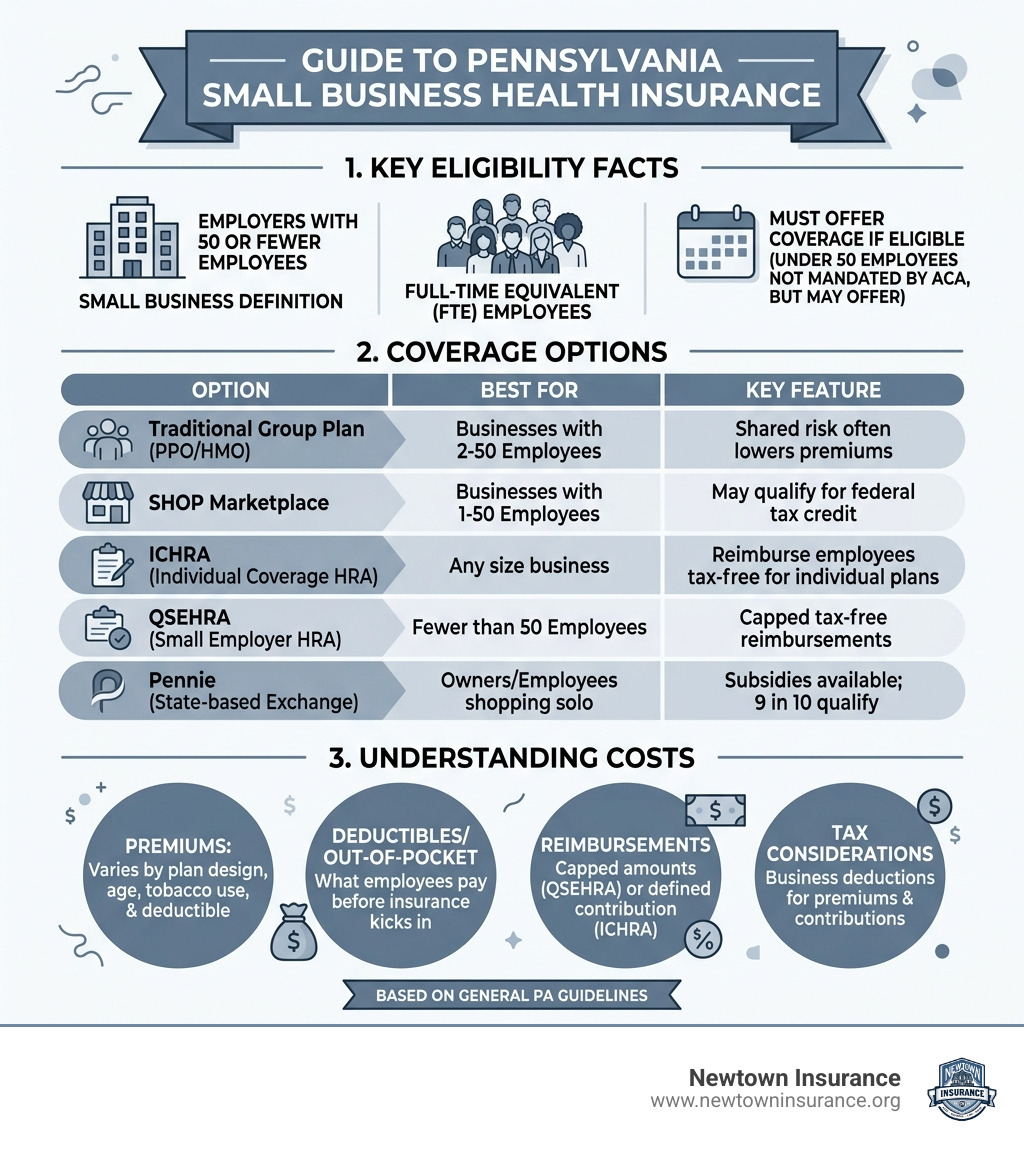
| Option | Best For | Key Feature |
|---|---|---|
| Group health plan (PPO/HMO) | Businesses with 2–50 employees | Shared risk lowers premiums |
| SHOP Marketplace | Businesses with 1–50 employees | May qualify for federal tax credit |
| ICHRA | Any size business | Reimburse employees tax-free for individual plans |
| QSEHRA | Businesses with fewer than 50 employees | Capped tax-free reimbursements |
| Pennie (individual market) | Owners/employees shopping solo | Subsidies available; 9 in 10 qualify for help |
Pennsylvania is home to 1.1 million small businesses — that’s 99.6% of all businesses in the state. Together, they employ roughly half of the state’s private workforce. Yet many small business owners still struggle to find health coverage that fits their budget without sacrificing quality.
The stakes are high. Research shows that 92% of employees rate health benefits as important, and 81% say a benefits package directly influences whether they accept a job offer. In a competitive labor market, skipping health coverage isn’t just a risk to your team’s wellbeing — it can hurt your ability to hire and keep good people.
I’m Shawn Beihl, and with over 15 years of experience in health insurance, benefits management, and commercial risk — including hands-on work with Pennsylvania small business health insurance — I’ve helped countless business owners cut through the confusion and find coverage that actually works. In this guide, I’ll walk you through everything you need to make a smart, confident decision for your team.
Pennsylvania Small Business Health Insurance Requirements and Definitions
Navigating the regulatory waters of Pennsylvania can feel like trying to row a boat through the Schuylkill during a regatta—crowded and a bit confusing. However, understanding the basic definitions is the first step toward compliance and cost savings.
In Pennsylvania, the magic number is 50. The state defines a small business for health insurance purposes as an entity with 50 or fewer full-time equivalent (FTE) employees. This definition is crucial because it dictates which laws apply to you and what kind of “small group” pricing you can access.

When we talk about FTEs, we aren’t just counting heads. We are looking at the total hours worked. For example, two part-time employees who each work 15 hours a week count as one full-time equivalent (30 hours). Understanding this math is essential for your Business Insurance Pennsylvania Guide 2026 strategy, as it determines your eligibility for specific small group protections.
For more broad information on how insurance integrates into your company’s safety net, you can explore the state’s official stance on Business Insurance Needs. Ensuring you are aligned with both state and federal mandates is a core part of our Insurance Pennsylvania Complete Guide, helping you avoid the headaches of audits or unexpected penalties.
Is Health Insurance Mandatory for Your pennsylvania small business health insurance Strategy?
The short answer for most of you reading this is: No, but with a catch.
Under the Affordable Care Act (ACA), the “Employer Mandate” only applies to Applicable Large Employers (ALEs). An ALE is a business with 50 or more full-time equivalent employees. If you fall into this category, you must provide affordable “minimum essential coverage” to at least 95% of your full-time staff, or you’ll face hefty IRS penalties.
However, if you have fewer than 50 FTEs, there is no legal requirement to offer health insurance. So why do so many PA small businesses do it anyway? Because in 2026, talent is the most expensive commodity. Whether you are looking for a Contractor Insurance Pennsylvania Guide to protect your job site or a health plan to protect your crew, benefits are what keep your best workers from jumping ship to a larger competitor.
What Qualifies as a Small Business in Pennsylvania?
To qualify for the small group market in the Keystone State, you generally need at least two employees (including the owner, provided the business is incorporated and the owner is an employee).
As we’ve mentioned, the cap is 50 employees. This range allows you to access “guaranteed issue” coverage, meaning an insurance company cannot turn you down based on the health status of your employees. This is a massive win for small teams where one chronic illness could otherwise make traditional insurance unaffordable. We specialize in finding Affordable Business Insurance that leverages these small group protections to keep your overhead low.
Comparing Plan Types and Modern Alternatives
Choosing a plan type is about balancing “freedom of choice” with “monthly cost.” In Pennsylvania, you’ll encounter four main alphabet-soup options:
| Plan Type | Network Flexibility | Cost | Best For |
|---|---|---|---|
| HMO | Low (Need a PCP referral) | Lowest | Teams looking for the most budget-friendly option. |
| PPO | High (Can go out-of-network) | Highest | Employees who want to keep their specific doctors. |
| EPO | Medium (No out-of-network) | Mid-range | A balance of lower costs and no referral requirements. |
| HDHP | High (Often paired with HSA) | Variable | Healthier, younger teams who want tax-advantaged savings. |
Many small group plans in PA now come with “embedded” benefits, such as pediatric dental and vision, which are required by the ACA. Some even include wellness programs that reward employees for hitting step goals or completing health assessments.
Traditional Group Plans vs. Individual Coverage through Pennie
In the past, group plans were the only way to go. Today, the individual market—accessed through Pennie, Pennsylvania’s official state exchange—is a formidable competitor.
- Group Plans: You (the employer) choose the plan. You usually pay at least 50% of the premium. The risk is “pooled” among your employees, which can sometimes lead to more stable rates.
- Pennie: Employees shop for their own plans. The big advantage here is that 9 out of 10 Pennie customers qualify for financial assistance. In some counties, like Philadelphia, the average silver plan for a 27-year-old might be cheaper on the individual market ($310.22) than the small group market ($342.49).
Modern Alternatives: ICHRA and QSEHRA
If you want to help your employees with health costs but don’t want the administrative burden of managing a group plan, consider an HRA (Health Reimbursement Arrangement).
- ICHRA (Individual Coverage HRA): This is the “new kid on the block” and it’s very flexible. You give employees a tax-free monthly allowance, and they buy their own plan on Pennie. There are no contribution limits, and you can offer different amounts to different “classes” of employees (e.g., full-time vs. part-time).
- QSEHRA (Qualified Small Employer HRA): Specifically for businesses with fewer than 50 employees who don’t offer a group plan. It has annual contribution caps but is a great way to provide a “health stipend” without the tax hit of a standard bonus.
Using these tools alongside other requirements like Workers Compensation Insurance Pa creates a comprehensive “safety first” culture for your business.
The Cost of pennsylvania small business health insurance in 2026
Let’s talk numbers. We know that as a business owner, your bottom line is always top of mind. In 2026, the cost of pennsylvania small business health insurance varies wildly based on age, location, and the “metal tier” you choose.

On average, Pennsylvania business owners can expect to pay at least $151 per employee per month for basic coverage. However, for a comprehensive plan, the national averages (which track closely with PA) show about $8,951 per year for individual coverage and over $25,500 for family coverage.
The “Metal Tiers” help you decide how to split costs:
- Bronze: Lowest premiums, but employees pay more when they see a doctor (around 40%).
- Silver: The “benchmark” plan. Moderate premiums and moderate out-of-pocket costs.
- Gold/Platinum: High monthly premiums, but the insurance covers 80-90% of medical costs.
For a deeper dive into these numbers, you can check out the Small Business Health Insurance in Pennsylvania: Complete Guide.
Qualifying for the Small Business Health Care Tax Credit
This is essentially “free money” from the IRS, yet many PA businesses miss out on it. To qualify for a tax credit worth up to 50% of your premium contributions, you must:
- Have fewer than 25 full-time equivalent employees.
- Pay average annual wages of roughly $50,000 or less.
- Pay at least 50% of your employees’ premium costs.
- Purchase your coverage through the SHOP (Small Business Health Options Program) marketplace.
Factors Influencing Your Monthly Premiums
Why does a business in Newtown pay different rates than one in Pittsburgh?
- Geography: Pennsylvania is divided into rating areas. Healthcare costs more in some regions than others due to provider competition.
- Age: While PA doesn’t allow “gender rating” (charging women more), they do use age-based rating. A 60-year-old employee will cost more to insure than a 22-year-old.
- Tobacco Use: Carriers can charge up to 50% more for employees who use tobacco.
Enrollment, COBRA, and Compliance
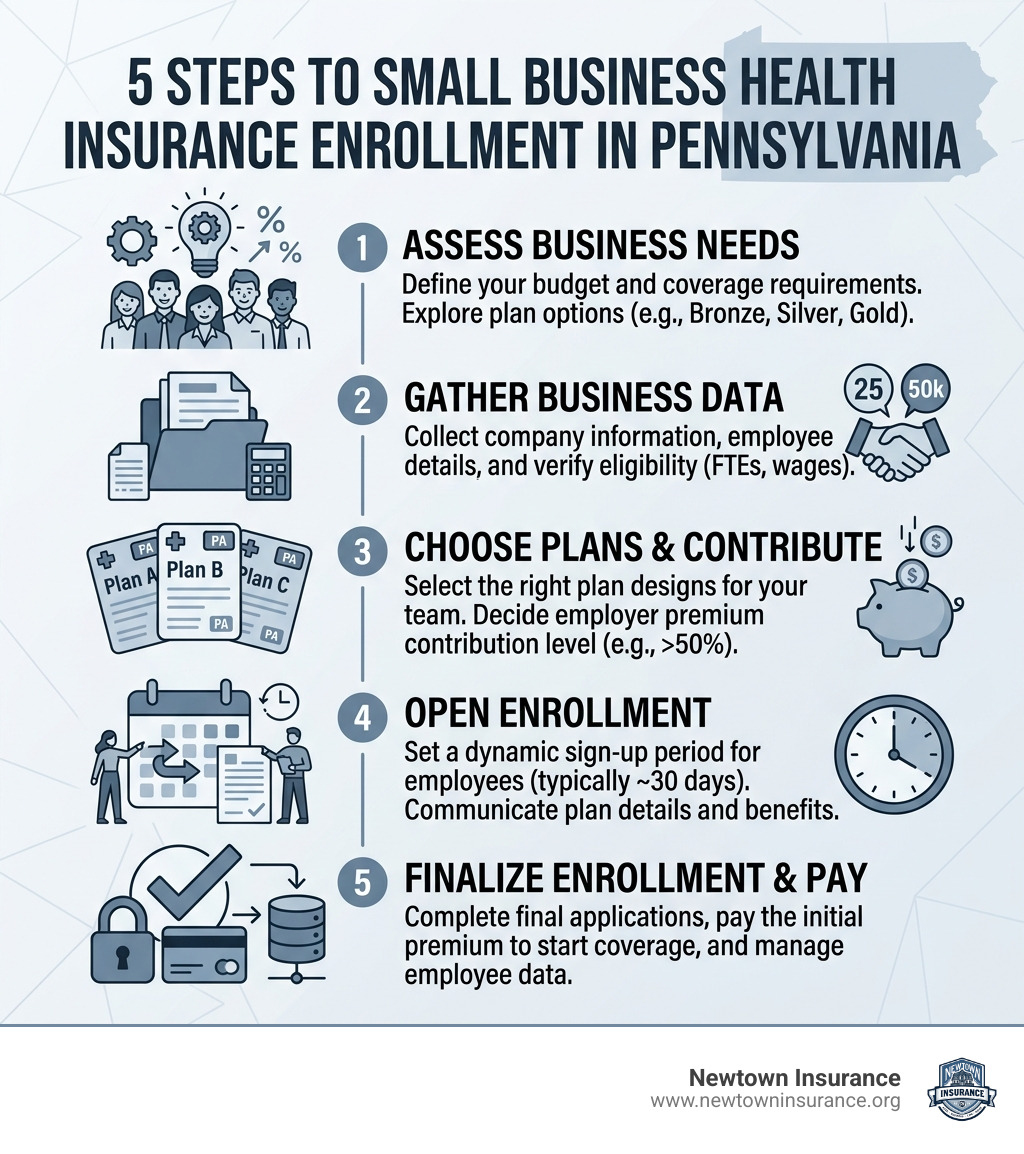
Timing is everything. For small businesses, you can actually apply for a small group plan at any time during the year. You aren’t restricted to the “Open Enrollment” window that individuals face on Pennie (which usually runs from Nov 1 to Jan 15).
However, once you pick a plan, your employees usually have a 30-day window to sign up. After that, they can only join if they have a “Qualifying Life Event” (like getting married or having a baby).
How COBRA and Mini-COBRA Work in Pennsylvania
When an employee leaves your company, they often have the right to keep their insurance for a limited time—but they have to pay the full premium themselves.
- Federal COBRA: Applies if you have 20 or more employees. It typically allows for 18 months of continued coverage.
- Pennsylvania Mini-COBRA: This is a state-specific law for the “little guys.” If you have 2 to 19 employees, your staff can still continue their coverage for up to 9 months after leaving.
As an employer, you are responsible for notifying your employees of these rights when they depart. Failing to do so can result in legal trouble, so keep your recordkeeping sharp!
How do I find a broker for pennsylvania small business health insurance?
You don’t have to do this alone. In fact, in Pennsylvania, health insurance prices are fixed by law. This means a plan costs the exact same whether you buy it directly from the insurance company or through a broker like us at Newtown Insurance.
The benefit of using a broker is that we do the “comparison shopping” for you. We can look at plans from all the leading carriers side-by-side to see which network actually includes your employees’ favorite doctors.
Frequently Asked Questions about PA Health Plans
What is the SHOP program in Pennsylvania?
SHOP stands for the Small Business Health Options Program. While Pennsylvania uses Pennie for individual plans, SHOP is the “portal” for small group plans that allows businesses to access federal tax credits. You generally work with a broker to navigate the SHOP requirements.
Can I offer dental and vision as add-ons?
Absolutely. These are called “ancillary benefits.” They are relatively inexpensive—often costing just a few dollars a month—but they are highly valued by employees. Offering dental and vision can reduce absenteeism (no more putting off that root canal!) and boost overall productivity.
Are there geographic restrictions on plans?
Yes. Many PA carriers operate on a county-by-county basis. For instance, a plan that is fantastic in Allegheny County might not have any “in-network” doctors in Bucks County. Always check the “Provider Directory” before signing a contract.
Conclusion
Finding the right pennsylvania small business health insurance doesn’t have to be a source of stress. Whether you choose a traditional PPO, a cost-effective HMO, or a flexible ICHRA, the goal is to protect your most valuable asset: your people.
At Newtown Insurance, we pride ourselves on offering tailored protection and smart savings. We believe in transparent pricing and customer-first support, ensuring you never overpay for the coverage your team deserves. We understand the local PA market because we live and work here too.
Ready to see how much you could save while providing better care for your team?