
Understanding Your Home Insurance Deductible

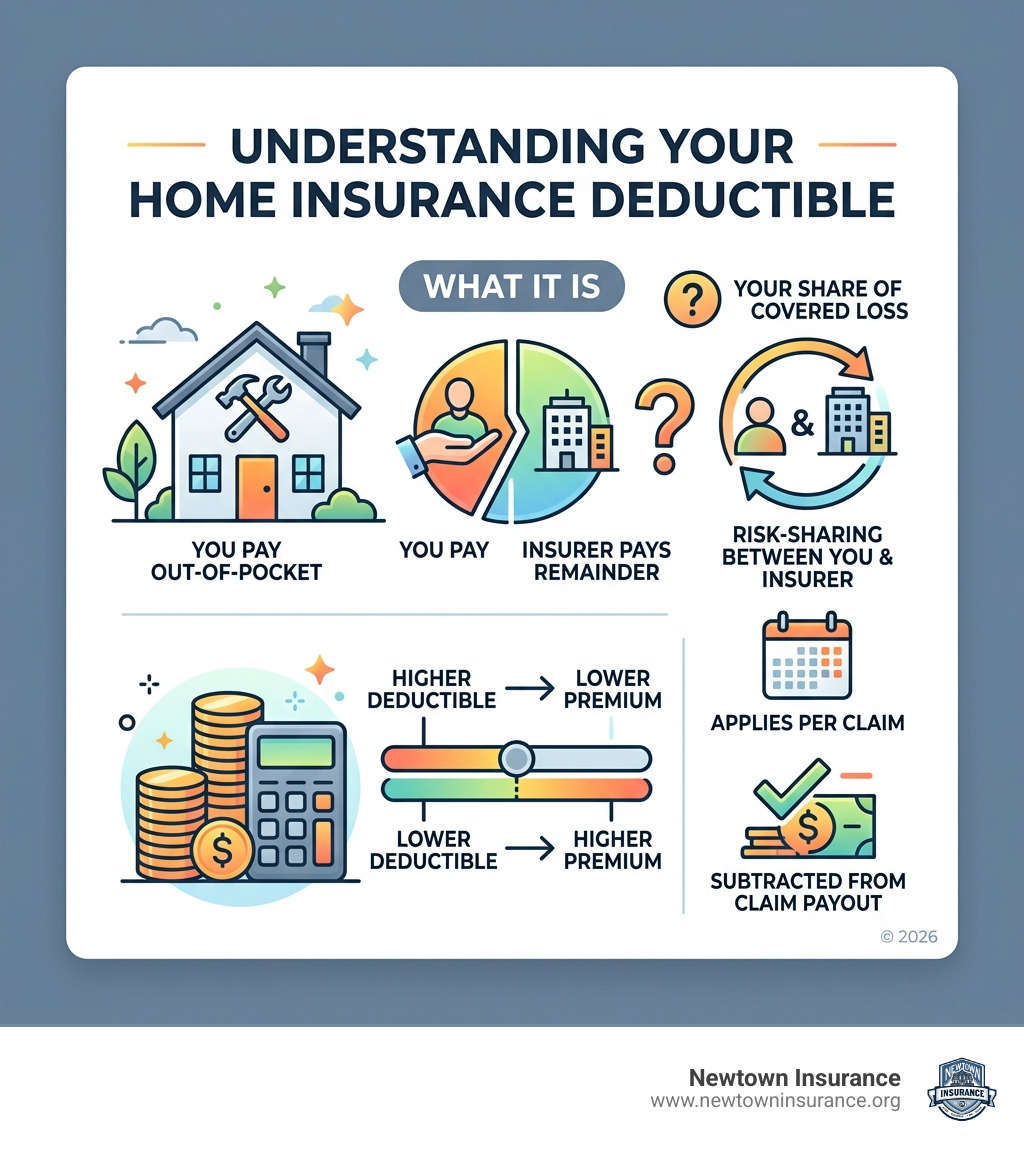
A Home insurance deductible is the amount of money you pay out-of-pocket for a covered loss before your insurance company starts paying. Think of it as your share of the repair or replacement cost.
Here’s a quick overview of what it means:
- Your Responsibility: It’s the portion of a claim you agree to cover.
- Risk Sharing: It helps share the risk between you and your insurer.
- Premium Impact: A higher deductible usually means a lower monthly premium.
- Per Claim: It typically applies to each separate claim you make.
- Not Upfront: You don’t usually pay the deductible directly to your insurer beforehand. Instead, it’s subtracted from the total payout for your claim.
Understanding your deductible is key to managing your insurance costs and knowing what to expect if you ever need to file a claim. Many homeowners find this part confusing, especially with different types of deductibles out there. But knowing how it works can save you money and stress.
I’m Shawn Beihl, and with over 15 years in specialty insurance, I’ve helped countless clients understand and manage their home insurance deductible to find the right balance for their financial protection. Let’s break down how these crucial policy elements work.
What is a Home Insurance Deductible and How Does It Work?
At its simplest, a Home insurance deductible is a form of risk-sharing. When we issue a policy at Newtown Insurance, we are agreeing to take on the “big” risks—like your house burning down or a massive storm ripping off the roof—while you agree to handle the “smaller” risks.
But how does it work in a real-world scenario? Imagine a heavy Pennsylvania snowstorm causes a tree limb to crash through your roof, resulting in $10,000 worth of property damage. If you have a $1,000 deductible, you are responsible for that first $1,000. We (the insurer) would then issue a claim payout for the remaining $9,000.
One of the most important things to remember is that homeowners insurance deductibles apply on a per-claim basis. This is a major point of confusion for many people because health insurance deductibles usually reset once a year. In home insurance, if you have a kitchen fire in January and a pipe bursts in December, you’ll have to account for your deductible for both separate incidents.
Your deductible typically applies to the “property” sections of your policy, which include:
- Dwelling coverage: The physical structure of your home.
- Other structures: Things like your detached garage, fence, or shed.
- Personal property: Your furniture, clothes, electronics, and appliances.
As noted by the Insurance Information Institute, deductibles are essential because they discourage “nuisance claims”—those tiny $200 repairs that would drive up everyone’s premiums if the insurance company had to process them. To learn more about how these coverages fit into the bigger picture, check out our Home Insurance Pennsylvania Complete Guide.
The Difference Between Flat and Percentage Home Insurance Deductibles
When you look at your policy declarations page, you’ll likely see your Home insurance deductible listed in one of two ways: as a flat dollar amount or as a percentage.
Flat Deductibles
These are the most straightforward. You choose a specific dollar amount, such as $500, $1,000, or $2,500. Regardless of the size of the claim (as long as it’s covered and exceeds the deductible), that dollar amount is what you pay. Flat deductibles in the industry typically range from $250 all the way up to $10,000.
Percentage Deductibles
These are a bit more “math-heavy.” Instead of a fixed dollar amount, the deductible is calculated as a percentage of your home’s insured value (specifically your Dwelling Limit or “Coverage A”). These usually run between 0.5% and 5%, though in some disaster-prone areas, they can go as high as 15%.
For example, if your home is insured for $400,000 and you have a 2% deductible, your out-of-pocket cost for a claim would be $8,000. It is crucial to understand this because as your home’s insured value increases over time due to inflation or renovations, your percentage deductible also increases in dollar terms.
| Deductible Type | How It’s Calculated | Example ($300k Home) | Predictability |
|---|---|---|---|
| Flat Dollar | Fixed amount chosen by you | $1,000 | High |
| Percentage | % of Dwelling Coverage | 2% = $6,000 | Variable |
While percentage deductibles are common in states with high hurricane or earthquake risk, you may still encounter them in Pennsylvania for specific perils.
When Your Deductible Does Not Apply
Believe it or not, there are parts of your policy where you don’t have to worry about a deductible at all. This is great news for your bank account!
Generally, a Home insurance deductible does not apply to:
- Liability claims: If a guest slips on an icy patch on your Newtown driveway and sues you, your liability coverage kicks in from the first dollar. There is typically no deductible for legal defense or settlements.
- Medical payments to others: If a neighbor’s child accidentally gets injured on your property and needs a quick trip to the ER, this “no-fault” coverage usually pays out without a deductible.
- Loss of Use (Additional Living Expenses): If a fire makes your home uninhabitable and you have to stay in a hotel, many policies apply the deductible to the dwelling repair claim but not to the hotel bills.
- Scheduled Personal Property: If you have specifically “scheduled” a high-value item, like an engagement ring or a rare art piece, these riders often come with a $0 deductible.
Understanding these distinctions helps you realize that insurance is there to protect more than just the bricks and mortar. For a deeper dive into these secondary coverages, see our Insurance Pennsylvania Complete Guide.
Disaster-Specific Deductibles: Hurricanes, Wind, and Floods

In Pennsylvania, we don’t just deal with standard “all-peril” deductibles. Because our region can be affected by the remnants of hurricanes, heavy windstorms, and severe hail, your policy might have “trigger-based” deductibles.
Hurricane Deductibles
Pennsylvania is one of the 19 states (plus D.C.) where insurers often include specific hurricane deductibles. These are usually percentage-based (1% to 5%). They only “trigger” when the National Weather Service officially declares a hurricane or names a storm. If a storm is just a “heavy rain event,” your standard flat deductible applies. But if it’s a named hurricane, that 2% deductible could suddenly mean a much higher out-of-pocket cost.
Wind and Hail Deductibles
In some areas of PA prone to summer storms, insurers might require a separate wind/hail deductible. This is often used to keep the overall premium lower. If a windstorm blows shingles off your roof, you’d pay this specific deductible instead of your “all-other-perils” deductible.
According to the Pennsylvania Insurance Department’s Homeowners Guide, it is vital to check your declarations page to see if you have one of these separate amounts lurking in the fine print.
Earthquake and Flood Insurance Deductibles
Standard homeowners insurance policies almost never cover floods or earthquakes. To get protection for these, you need a separate policy or a specific endorsement, and they come with their own unique deductible rules.
- Flood Insurance: Most flood policies are issued through the National Flood Insurance Program (NFIP). These have flat deductibles that apply separately to the building and your contents. This means if a flood ruins your basement and your furniture, you might have to pay two deductibles. These typically range from $1,000 to $10,000.
- Earthquake Insurance: While not as common in Newtown as in California, some PA homeowners choose earthquake endorsements. These deductibles are almost always percentage-based, ranging from 2% to 20% of the replacement value.
How Your Deductible Choice Impacts Your Monthly Premium
This is where you have the most power as a consumer. There is an inverse relationship between your Home insurance deductible and your premium: as one goes up, the other goes down.
Why? Because when you choose a higher deductible, you are telling the insurance company, “I’ll take on more of the small risks myself.” In exchange, we reduce the price of your policy.
The Numbers:
- The $500 to $1,000 Jump: Switching from a $500 deductible to a $1,000 deductible can save you as much as 20% on your premium.
- The $1,000 to $2,500 Jump: Raising your deductible to $2,500 can save an average of 9% on your premium.
- The Long-Term View: If raising your deductible saves you $200 a year, and you don’t file a claim for five years, you’ve “saved” $1,000—which exactly covers the extra cost if you eventually have a claim.
However, you have to be careful. A single claim can raise your premium by an average of 10% regardless of your deductible. This is why we often advise our clients in Pennsylvania to avoid filing small claims that are only slightly above their deductible amount. To see how these choices affect local rates, visit our page on Homeowners Insurance PA Cost.
Factors to Consider When Selecting Your Home Insurance Deductible
Choosing the “right” number isn’t just about finding the cheapest premium. It’s about a “break-even” analysis of your personal finances.
- Your Emergency Savings: Statistics show that only about 44% of U.S. adults could pay a $1,000 emergency expense from their savings. If you are part of the 56% who would struggle, a $2,500 deductible might be a risky move, even if it saves you money monthly.
- Claim Frequency: Do you live in an area with lots of mature trees (risk of wind damage) or older plumbing? If you think you might need to use your insurance every few years, a lower deductible might be better.
- The “Sleep at Night” Factor: Some people hate the idea of a surprise $5,000 bill. For them, paying a slightly higher premium for a $500 flat deductible is worth the peace of mind.
For a step-by-step guide on weighing these factors, Reviews.com offers a great framework for choosing the right amount based on your risk tolerance.
Strategies for Managing Your Out-of-Pocket Costs
One of the best ways to “manage” your Home insurance deductible is to make sure you never have to pay it. This sounds obvious, but proactive home maintenance is the best insurance policy there is.
- Maintenance vs. Claims: If a small leak under the sink costs $400 to fix, pay it out of pocket. If you file a claim with a $1,000 deductible, the insurance company pays nothing, but the “claim” stays on your record and could increase your rates.
- The “Deductible Fund”: We recommend setting up a dedicated savings account. If you choose a $2,500 deductible to save on premiums, put those monthly savings into that account until you hit $2,500. Now, you have the “best of both worlds”—low premiums and a “pre-paid” deductible.
Renters and Condo Considerations
If you don’t own a traditional single-family home, deductibles still matter.
- Renters Insurance: Deductibles are usually lower, ranging from $500 to $1,000. Since you aren’t insuring the building, the deductible only applies to your personal belongings. Learn more at Renters Insurance Pennsylvania.
- Condo Insurance: You have to coordinate your personal deductible with your Condo Association’s master policy deductible. Sometimes, if a leak from your unit damages the building, the association might try to pass their (often very high) deductible down to you.
Changing Your Deductible After Purchase
You aren’t stuck with the choice you made when you first bought your home. You can typically change your Home insurance deductible at any time, though the most common time to do it is at your policy renewal.
If your financial situation has improved and you’ve built up a healthy emergency fund, calling us to raise your deductible is a quick way to lower your annual expenses. Conversely, if you’re expecting a baby or tightening the belt and want more certainty, you might choose to lower it.
When shopping for a new policy, always ask for quotes at different deductible levels ($500, $1,000, and $2,500) so you can see the exact “price of risk.” You can use the Best Website to Compare Home Insurance Quotes to get a head start on this comparison.
Frequently Asked Questions about Home Insurance Deductibles
What happens if my claim is less than the deductible?
If the damage to your home costs $800 to fix and your deductible is $1,000, your insurance company will not pay anything. In fact, we generally recommend not even calling in the claim if you know it’s under the limit. Even a $0 payout claim can sometimes count against your “claims history” and affect your future eligibility for discounts.
Can I avoid paying my deductible to a contractor?
You might hear a contractor say, “I’ll waive your deductible!” Be very careful. In many states, including Pennsylvania, it is technically insurance fraud for a contractor to inflate an estimate to cover the cost of your deductible. The deductible is your legal obligation under the contract you signed with us. If a deal sounds too good to be true, it probably is.
Does my deductible reset every year like health insurance?
No. Homeowners insurance deductibles are “per occurrence.” If you have three separate covered incidents in one year, you will likely have to pay your deductible three times. The only common exception is in some states like Florida or Louisiana for hurricane seasons, but in Pennsylvania, the per-claim rule is the standard.
Conclusion
At Newtown Insurance, we believe that an informed homeowner is a protected homeowner. Your Home insurance deductible shouldn’t be a mystery that only reveals itself after a disaster. It is a tool you can use to balance your monthly budget against your long-term financial risks.
Take a moment this week to find your policy declarations page. Look for those dollar amounts and percentages. If you see a “2% Wind/Hail” deductible and realize that means $8,000 out of your pocket, it’s better to know that now than when the storm clouds are rolling in.
We are here to help you navigate these choices. Whether you want to lower your premium or ensure you have the most robust protection possible, we offer tailored protection and transparent pricing right here in Pennsylvania.
Ready to see how much you could save by optimizing your deductible? Get a Personalized Home Insurance Quote today and let us help you pay less and stress less.