

Protect Your LLC: The Ultimate Guide to PA Business Insurance
Why Commercial Insurance in PA Is Essential for Every Business Owner

Commercial insurance in PA is a broad term for the policies that protect your business from financial loss — whether that's a car accident on the job, a customer injury, a fire at your office, or an employee getting hurt at work.
Here's a quick overview of what Pennsylvania businesses need to know:
| Coverage Type | Required by PA Law? | Who Needs It |
|---|---|---|
| Commercial Auto | Yes (if you own business vehicles) | Any business with company-owned vehicles |
| Workers' Compensation | Yes (1+ employees) | Most employers with staff |
| General Liability | No (but often required by contracts) | Almost all businesses |
| Business Owners Policy (BOP) | No | Small to mid-size businesses |
| Professional Liability | No | Service-based businesses |
| Cyber Insurance | No | Businesses storing customer data |
Pennsylvania has 1.2 million small businesses — 99.6% of all companies in the state. Most of them are one mistake, one lawsuit, or one bad accident away from a serious financial hit. The right coverage is what stands between your LLC and losing everything you've built.
This guide walks you through exactly what coverage you need, what's optional, and how to avoid overpaying.
I'm Shawn Beihl from Newtown Insurance, and over my 15+ years working in commercial insurance in PA, I've helped hundreds of business owners identify the gaps in their coverage before those gaps became costly problems. Let's make sure your LLC is properly protected — without the confusing jargon or hidden fees.
Understanding Commercial Insurance PA Requirements
When you register an LLC in Pennsylvania, you gain a powerful shield that separates your personal assets from your business liabilities. However, that shield is not impenetrable. If your business is sued and lacks proper insurance, a court judgment can drain your business bank accounts, halt your operations, and effectively end your entrepreneurial dream.
To keep your business running smoothly, you must understand both what the state mandates and what real-world risks require. While some policies are optional, others are strictly enforced by the Commonwealth of Pennsylvania. For a deeper dive into how these coverages interact, check out our Insurance Pennsylvania Complete Guide and our comprehensive Business Insurance Pennsylvania Guide 2026.
Mandatory Workers' Compensation for Pennsylvania LLCs
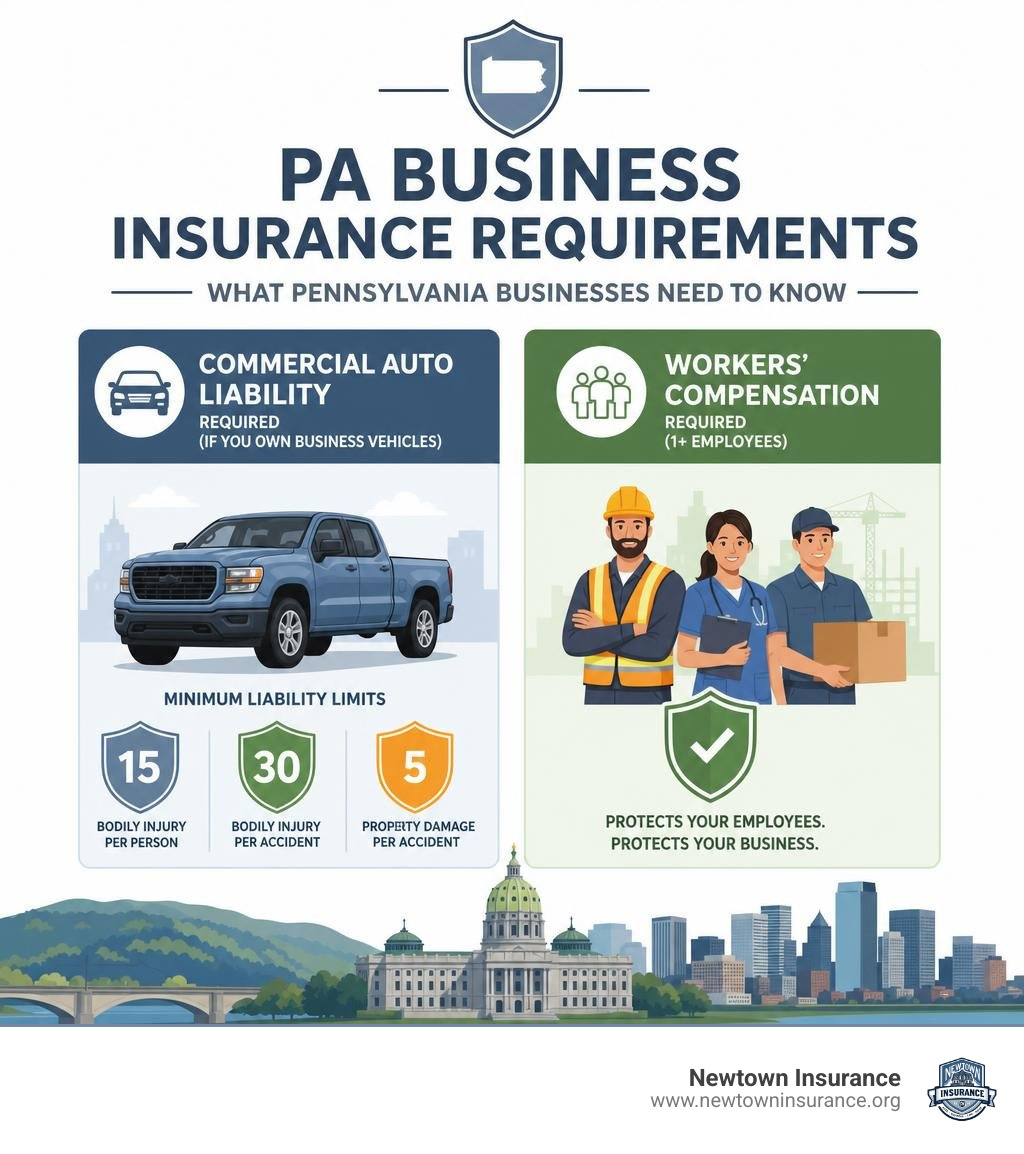
If your LLC has even one employee—whether they are full-time, part-time, or even a seasonal helper—Pennsylvania law requires you to carry workers' compensation insurance. The state operates on a strict "no-fault" system, meaning that if an employee is injured on the job, their medical expenses and a portion of their lost wages are covered regardless of who caused the accident.
Do not make the mistake of thinking your business is "too small" to worry about this. In 2023, the Bureau of Labor Statistics reported 115,200 non-fatal workplace injuries and illnesses in Pennsylvania alone. From a simple slip on a wet floor in a Newtown boutique to a ladder fall at a local construction site, accidents happen.
Failing to carry mandatory workers' comp is a misdemeanor in PA, carrying steep penalties. You could face fines of up to $2,500 per day you are uninsured, and even criminal charges. More importantly, without coverage, your LLC is directly responsible for paying the injured worker’s medical bills and lost wages out of pocket.
If you are looking to offer benefits beyond basic workers' comp to attract top talent, you might also want to review the rules surrounding Pennsylvania Small Business Health Insurance to see how health coverage fits into your overall employee package.
Commercial Insurance PA Auto Liability Mandates
If your business owns, leases, or registers vehicles in the Commonwealth, you cannot rely on personal auto coverage. Pennsylvania state law requires all small businesses with company-owned vehicles to maintain a commercial auto insurance policy.
The absolute minimum liability limits required by Pennsylvania law are:
- $15,000 for bodily injury per person
- $30,000 for bodily injury per accident
- $5,000 for property damage per accident
- $5,000 in first-party medical benefits (often referred to as Personal Injury Protection, or PIP)
This is commonly referred to in the industry as 15/30/5 coverage.
While these are the legal minimums to get your vehicles registered, we strongly advise against carrying only the state minimums. If one of your employees causes a multi-car pileup on I-95, a $5,000 property damage limit will barely cover a scratched bumper in 2026, let alone a totaled modern vehicle. Most commercial clients opt for a Combined Single Limit (CSL) of $500,000 to $1,000,000 to ensure they are fully protected against catastrophic lawsuits.
| Feature | Personal Auto Insurance | Commercial Auto Insurance |
|---|---|---|
| Primary Purpose | Personal travel, commuting, errands | Transporting goods, tools, clients, or business operations |
| Policy Limits | Typically lower (e.g., $15k/$30k/$5k up to $250k/$500k) | Significantly higher (often $500k to $1,000,000+ Combined Single Limit) |
| Driver Coverage | Named policyholders and household members | Business owners, listed employees, and permissive business drivers |
| Vehicle Types | Sedans, SUVs, light pickup trucks | Box trucks, cargo vans, heavy machinery, fleets, and passenger vans |
| Business Exclusions | Standard personal policies explicitly exclude commercial deliveries or services | Built specifically to cover business-use risks and liabilities |
Commercial Auto Insurance vs. Personal Auto Insurance

One of the most common mistakes we see small business owners make is assuming their personal auto insurance policy will cover them when they are driving for work. It’s a costly misunderstanding.
Standard personal auto policies contain explicit exclusion clauses for "commercial use." If you or an employee are involved in an accident while delivering goods, driving to a client meeting with equipment, or transporting paying passengers, your personal insurer will almost certainly deny the claim. This leaves your business exposed to thousands of dollars in vehicle repairs, medical bills, and potential lawsuits.
To find options that fit your budget, you can explore our resources on finding Affordable Business Insurance.
Who Needs Commercial Auto Coverage?
If your business operations rely on wheels, you likely need commercial auto coverage. It isn't just for massive logistics companies with fleets of 18-wheelers. It is crucial for:
- Contractors and Tradespeople: Electricians, plumbers, landscapers, and HVAC technicians carrying heavy tools, ladders, and materials to job sites. If you want to see how this fits into your broader trade coverage, read our Contractor Insurance Pennsylvania Guide.
- Real Estate Agents and Sales Professionals: If you regularly drive clients around Newtown or travel extensively for scheduled appointments, a personal policy may not cut it.
- Food Trucks and Caterers: Vehicles outfitted with expensive cooking equipment, generators, and propane tanks require specialized coverage that accounts for both the vehicle and the built-in commercial kitchen.
- Delivery Services: Whether you run a local florist shop delivering arrangements or a restaurant offering its own delivery service, any vehicle used to transport goods for a fee requires commercial protection.
Covered Vehicles and FMCSA Compliance
Commercial auto insurance covers a wide variety of vehicles that personal policies won't touch. This includes:
- Box trucks and cargo vans used for local deliveries.
- Heavy-duty pickup trucks outfitted with snowplows, tool racks, or towing hitches.
- Service utility vehicles used by mobile mechanics or technicians.
Furthermore, if your business operates larger commercial vehicles that cross state lines, or if you transport hazardous materials, you must comply with the Federal Motor Carrier Safety Administration (FMCSA) and the United States Department of Labor (USDOT) regulations.
These federal guidelines mandate much higher liability limits (often starting at $750,000 and reaching up to $5,000,000 for hazardous cargo) and require filing specific compliance paperwork (like the MCS-90 endorsement). Failing to secure these filings can result in heavy federal fines, vehicle impoundment, or the immediate suspension of your business operating authority.
Essential Coverage Options for Comprehensive Protection

While auto and workers' comp are often mandated by law, a truly resilient risk management strategy requires a broader suite of coverages. Building a robust safety net for your LLC means looking at your business from all angles. For a deeper breakdown of these policies, explore our guide on Business Insurance Coverage.
Commercial Property and Business Interruption
Your physical assets—your building, inventory, computers, specialized tools, and office furniture—are the lifeblood of your day-to-day operations. Commercial property insurance protects these assets from perils like fire, theft, vandalism, windstorms, and winter freeze damage.
When structuring your property policy, you must choose how your losses will be settled:
- Replacement Cost (RC): Pays to replace or rebuild your damaged property with new materials of like kind and quality, without any deduction for depreciation.
- Actual Cash Value (ACV): Pays the value of the property at the time of the loss, which means deducting depreciation based on age and wear-and-tear.
To see why this matters, consider a 20-year-old commercial roof on a building in Newtown. If a severe winter storm causes the roof to collapse, replacing it entirely might cost $80,000. Under a Replacement Cost policy, your insurer pays the full $80,000 (minus your deductible). Under an Actual Cash Value policy, the insurer will factor in 20 years of wear and tear, meaning they might only write you a check for $35,000, leaving your LLC to scramble to find the remaining $45,000.
Additionally, pay close attention to the coinsurance clause in your property policy. Most insurers require you to insure your property for at least 80% to 90% of its actual replacement value. If you underinsure your property to save on monthly premiums, the insurer can penalize you by proportionally reducing your payout on any claim—even a partial one.
But what happens if a fire forces you to close your doors for three months while the building is being rebuilt? Your bills don't stop just because your revenue did. This is where Business Interruption Coverage (also known as Business Income coverage) comes in. It replaces your lost profits and covers ongoing fixed expenses—such as rent, taxes, and payroll—so you can keep your key employees and pay your bills until you are back on your feet.
If you want to make sure your property and income are fully protected without overpaying, you can Get a Customized PA Business Insurance Quote directly from our team.
Optional Commercial Insurance PA Add-Ons
Depending on your specific industry, you may want to tailor your coverage with these highly recommended add-ons:
- Inland Marine Insurance: Despite the confusing name, this has nothing to do with boats. It covers your tools, equipment, and inventory while they are in transit or stored at a temporary job site. If you are a contractor with $15,000 worth of tools in the back of your truck, standard commercial property insurance won't cover them once you drive away from your main office. Inland marine fills this gap.
- Cyber Liability Insurance: If your LLC stores sensitive customer data, processes credit cards, or relies on cloud-based systems, you are a target for hackers. Cyber liability covers the costs of data breach notifications, credit monitoring for affected clients, legal fees, and digital forensic investigations.
- Professional Liability (Errors & Omissions): Essential for service providers like consultants, accountants, and real estate professionals. It protects you if a client sues, alleging that your advice, design, or professional error caused them financial harm.
- Equipment Breakdown Coverage: Standard property insurance covers external damage (like a fire), but it excludes internal mechanical or electrical breakdowns. This add-on covers the repair or replacement of expensive equipment, like commercial HVAC units, electrical panels, or specialized machinery, when they suffer a sudden mechanical failure.
Factors Influencing Your Commercial Insurance Costs
We believe in complete pricing transparency. When you apply for commercial insurance in PA, insurance carriers do not pull premium prices out of a hat. They evaluate several key risk factors to determine your monthly or annual costs:
- Your Industry and Profession: High-risk industries naturally pay more. A tree-trimming service working with heavy machinery at heights will pay a higher premium than a local lawn care specialist working at ground level. Similarly, a roofing contractor faces higher risks than a graphic designer working from a home office.
- Your Claims History: A clean track record pays off. If your LLC has operated for five years without a single claim, insurers view you as a low-risk client and will reward you with lower rates. Conversely, a history of frequent small claims indicates a lack of safety protocols, driving your premiums up.
- Your Physical Location: Location matters. Businesses operating in densely populated, high-traffic urban areas like Philadelphia typically face higher premium rates than businesses located in quieter, suburban communities like Newtown due to higher rates of traffic accidents, theft, and property claims.
- Vehicle and Equipment Types: For commercial auto, the make, model, weight, and safety features of your vehicles dictate your rates. A fleet of heavy-duty box trucks costs more to insure than a couple of fuel-efficient hybrid sedans.
- Driver Records and Travel Radius: Insuring drivers with clean motor vehicle records (MVRs) is significantly cheaper than insuring drivers with recent speeding tickets or accidents. Additionally, a business whose delivery drivers travel within a tight 15-mile local radius will pay less than a business whose drivers log hundreds of miles daily across state lines.
To learn more about how you can optimize these factors to lower your rates, read our guide on securing Affordable Business Insurance.
Frequently Asked Questions About PA Business Insurance
Navigating commercial policies can raise a lot of questions. Here are some of the most common inquiries we receive from Pennsylvania business owners:
What documents do I need to get a commercial insurance quote in Pennsylvania?
To make the quoting process as fast and accurate as possible, you should gather the following information before speaking with an agent:
- Your federal Employer Identification Number (EIN) or Social Security Number.
- Details about your business operations, including estimated annual revenue and payroll.
- Information on all business-owned vehicles, including years, makes, models, and Vehicle Identification Numbers (VINs).
- Driver’s license numbers and driving histories for all employees who will operate your business vehicles.
- A copy of your current insurance policies (if applicable) and loss runs (a documented history of your insurance claims over the past 3 to 5 years).
Is a Business Owners Policy (BOP) mandatory for Pennsylvania LLCs?
No, a Business Owners Policy (BOP) is not legally mandated by the state. However, it is highly recommended for small to mid-sized businesses because it bundles General Liability, Commercial Property, and Business Interruption insurance into one convenient, discounted package.
Furthermore, while the state doesn't require it, your landlord or clients might. Most commercial lease agreements require tenants to carry a minimum amount of general liability coverage before they can move into an office or storefront. Similarly, many clients will refuse to sign a contract with your LLC until you provide a Certificate of Insurance (COI) proving you have adequate liability protection.
Can I add employees as drivers to my commercial auto policy?
Yes, and you absolutely should. Any employee who regularly or even occasionally drives a business-owned vehicle for work purposes should be explicitly listed as an approved driver on your commercial auto policy.
While some policies offer "permissive use" coverage for occasional drivers, relying on this can be risky if an unlisted employee is involved in a serious accident. Listing your drivers ensures that there are no surprises or coverage denials when a claim is filed. That your insurer will run a motor vehicle report on all listed drivers, so it is wise to establish clear hiring standards regarding clean driving records.
Conclusion
Protecting your Pennsylvania LLC is about more than just checking off legal boxes—it is about securing the future of everything you have worked so hard to build. Whether you need a robust commercial auto policy to protect your vehicles on local roads, workers' comp to keep your team safe, or a comprehensive property package to safeguard your physical assets, we are here to help.
At Newtown Insurance, we pride ourselves on delivering tailored protection, smart savings, and completely transparent pricing. As a local business based right here in Newtown, Pennsylvania, we understand the unique challenges and opportunities facing Keystone State entrepreneurs. We don't believe in one-size-fits-all policies, and we hate overpaying just as much as you do.
Ready to secure your business and get peace of mind? Don't leave your LLC's survival to chance. Get a Customized PA Business Insurance Quote today, and let's build a customized protection plan that fits your business and your budget perfectly.