
Introduction

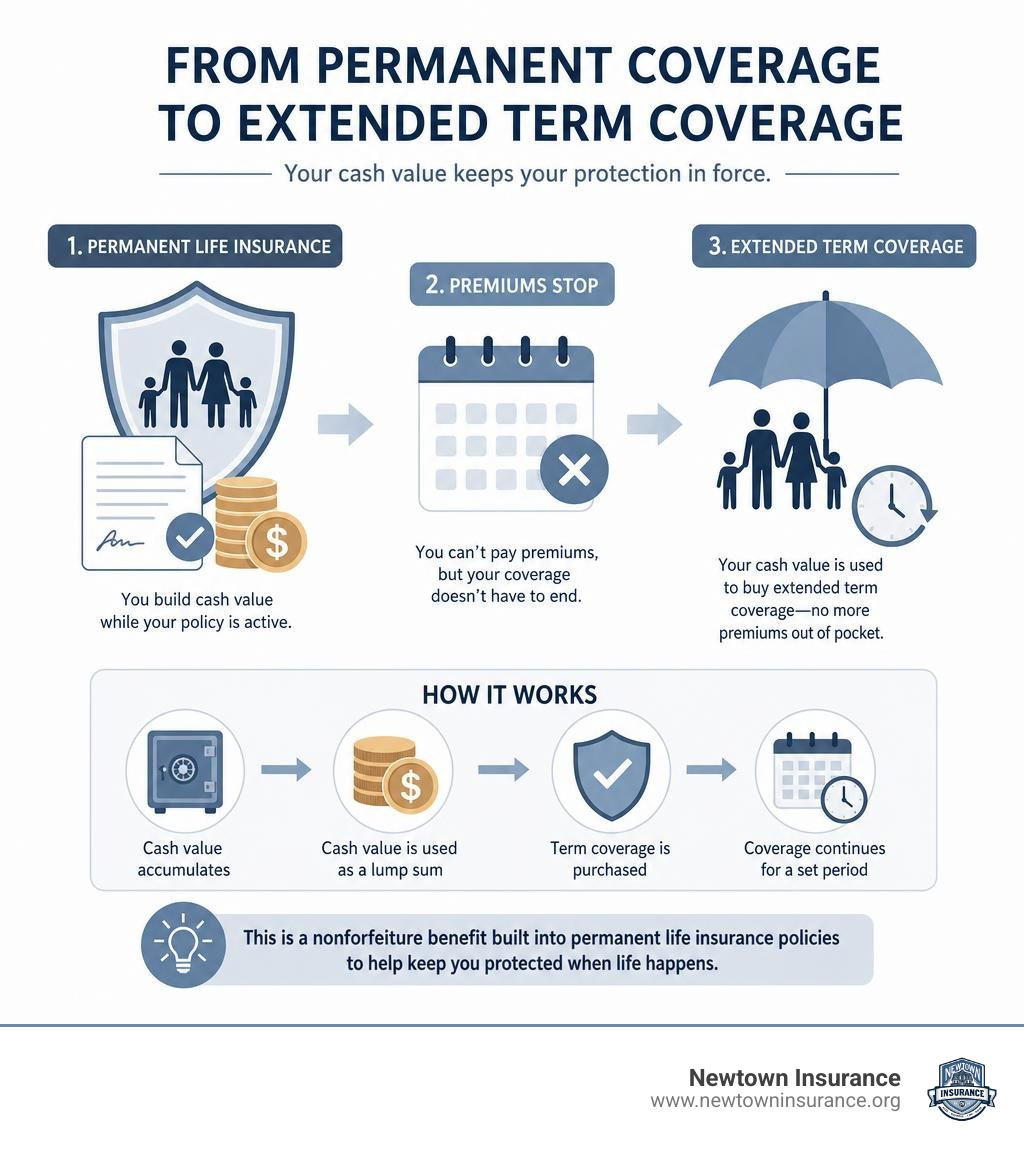
Extended term insurance is a nonforfeiture option built into permanent life insurance policies that lets you keep your death benefit in force — as a term life policy — using your accumulated cash value, without paying another premium out of pocket.
Here’s the quick answer:
- What it is: A feature in whole life and other permanent policies that converts your coverage to term life when you stop paying premiums
- How it works: Your policy’s cash value is used as a lump sum to “buy” a term policy equal to your original death benefit
- Who it’s for: Policyholders who can no longer afford premiums but still need coverage
- How long it lasts: Depends on your age and how much cash value you’ve built up — a 50-year-old with $20,000 in cash value might get 15 years of coverage; a 70-year-old with the same amount might get only 7
- What it costs: Nothing out of pocket — your existing cash value covers it
- Key limitation: Coverage is temporary and most riders do not carry over
This option is often the default setting insurers apply when a permanent policy lapses due to missed premiums — so understanding it before that happens puts you in control.
I’m Shawn Beihl of Newtown Insurance, and with over 15 years working across life insurance and specialty coverage, I’ve helped many Pennsylvania policyholders navigate exactly these kinds of decisions — including when extended term insurance is the right move and when another nonforfeiture option serves them better. In the sections below, we’ll walk through everything you need to know to make that call confidently.
What Is Extended Term Insurance and How Does It Work?
If you have ever stared at a life insurance bill during a tight financial month and wondered if there was a way to keep your coverage without emptying your wallet, you are not alone. This is where the concept of a nonforfeiture benefit comes into play. When you buy a permanent policy, such as whole life, a portion of every premium you pay goes into an investment component known as cash value.
If you decide to stop paying premiums, the insurance company cannot simply pocket that cash accumulation and leave you empty-handed. Legally, they must offer you options to recover or utilize that equity.
What Is Extended Term Insurance? 2026 Guide explains how this option acts as a financial bridge. Instead of letting your policy lapse or surrendering it for a cash payout, you can use your accumulated cash value to purchase a new Basic Term Life Insurance policy. Under this arrangement, your premium payments stop completely, but your life insurance coverage remains active for a specified term.
The Mechanics of Policy Conversion
The transition from a permanent policy to an extended term insurance policy is a mathematical conversion managed entirely by your insurance carrier. When you trigger this option, the insurer calculates the net cash value of your policy (the cash value minus any outstanding loans or fees).
This net cash value is treated as a “net single premium.” The insurer uses this lump sum to buy a term life insurance policy. The face value of this new term policy is exactly equal to the death benefit of your original permanent policy.
Because you are paying for the entire term policy upfront with your cash value equity, you preserve your original level of financial protection without writing another check.
The Role of Accumulated Cash Value
Your policy’s cash value is the fuel that powers the extended term insurance option. Without cash accumulation, this transition is impossible (which is why standard term policies, which do not build cash value, do not offer nonforfeiture options).
Once your cash value reaches a self-sustaining level, it holds enough purchasing power to fund term coverage for a meaningful duration. The insurance company assesses your “attained age” (your age at the time of the conversion) and applies mortality tables to determine how many years and days of term coverage your specific cash value balance can buy.
Essentially, your permanent policy’s investment component is liquidated to purchase temporary, fully paid-up protection.
Comparing Nonforfeiture Options: Extended Term vs. Reduced Paid-Up and Cash Surrender
When you decide to stop paying premiums on a permanent policy, you generally have three primary nonforfeiture paths. Choosing the right one depends on whether you prioritize keeping your full death benefit, keeping lifetime coverage, or getting immediate cash.
| Feature | Extended Term Insurance | Reduced Paid-Up Insurance | Cash Surrender Value |
|---|---|---|---|
| Death Benefit Amount | Same as original policy | Reduced amount | None (coverage terminates) |
| Coverage Duration | Temporary (set term) | Lifetime (to age 100+) | None |
| Future Premiums | None | None | None |
| Cash Value Left | Used to buy term policy | Remains in policy (grows slowly) | Paid out to policyholder |
| Best For | Maximizing short-term protection | Maintaining permanent, smaller coverage | Getting immediate cash |
To help you navigate these choices, it helps to read our Ultimate Life Insurance Guide 2026. Let’s look closer at the two primary alternatives to extended term.
Reduced Paid-Up Insurance
If your main goal is to keep some form of life insurance active until you die, but you absolutely cannot afford future premiums, reduced paid-up insurance is an excellent alternative.
With this option, your cash value is used to buy a fully paid-up permanent policy. Your premium payments stop forever, and you keep lifetime protection. The catch? Your death benefit is reduced—often significantly—depending on how much cash value you had accumulated.
Unlike extended term insurance, which keeps your full death benefit but adds an expiration date, reduced paid-up insurance keeps the lifetime guarantee but shrinks the payout. Some participating policies may also allow this reduced benefit to continue earning dividends over time.
Cash Surrender Value
The most straightforward way to walk away from a policy is to surrender it. When you choose cash surrender, you tell the insurance company to cancel your coverage entirely and send you a check for your accumulated cash value.
While getting a lump sum of cash sounds appealing, there are several major downsides:
- You must pay any applicable surrender charges or fees, which can heavily drain your cash value in the early years of a policy.
- Your life insurance coverage is terminated immediately, leaving your beneficiaries with nothing.
- Any amount you receive that exceeds the total premiums you paid into the policy (your cost basis) will be taxed as ordinary income.
Eligibility, Duration, and Key Cost Factors

Understanding how long your coverage will last and whether you qualify is critical before making any changes to your policy.
Eligibility Requirements for Activating Extended Term Insurance
To activate extended term insurance, your policy must meet a few basic criteria:
- Policy Type: It must be a permanent life insurance policy (such as whole life or universal life) that accumulates cash value.
- Minimum Cash Value: The policy must have been active long enough to build sufficient cash value to purchase at least some term coverage (typically at least three years, though some policies build cash value faster).
- Grace Period Status: If you miss a premium payment, you must make the election during the policy’s standard 31-day grace period, or the policy will automatically default to the nonforfeiture option specified in your contract (which is very often extended term).
How Cash Value Determines the Length of Extended Term Insurance
The duration of your new term coverage is determined by a simple formula: Available Cash Value ÷ Cost of Insurance at Your Attained Age = Coverage Duration.
Because the cost of life insurance rises as you get older, your age at the time of conversion plays a massive role.
- A 50-year-old with $20,000 in cash value might secure 15 years of extended term coverage.
- A 70-year-old with the exact same $20,000 in cash value might only get 7 years of coverage because their statistical risk of passing away is higher.
Any accumulated dividends or paid-up additions left in the policy will be added to your cash value, extending your coverage duration. For Pennsylvania residents looking to understand their rights and policy structures, the Pennsylvania Insurance Department Life Insurance Guide is an invaluable resource. If you want to run the numbers on how term insurance pricing compares to investing on your own, check out our Buy Term And Invest The Difference Calculator.
The Impact of Outstanding Policy Loans and Debts
If you have borrowed money from your policy’s cash value and have not paid it back, it will directly impact your extended term insurance configuration:
- Reduced Cash Value: The outstanding loan balance (plus accumulated interest) is deducted from your cash value before the term coverage is purchased. This means you have less purchasing power, resulting in a shortened term duration.
- Reduced Death Benefit: In many contracts, the outstanding debt is also deducted from the face value of the term policy. For example, if you had a $100,000 policy and a $10,000 outstanding loan, your extended term death benefit would drop to $90,000.
Advantages and Disadvantages of Choosing This Option

Before choosing this nonforfeiture option, it is vital to weigh the pros and cons to see if it aligns with your family’s financial roadmap.
Benefits of Maintaining Full Death Benefits
- No Out-of-Pocket Cost: You maintain vital life insurance coverage without having to pay another dime in monthly or annual premiums.
- Full Payout Preservation: Unlike reduced paid-up coverage, your loved ones will still receive the full original death benefit if you pass away during the term.
- Perfect for Temporary Debts: If you only need coverage to protect a 15-year mortgage or keep your family secure until your kids finish college, extended term can perfectly bridge that gap. For more on this, read about Life Insurance For Homeowners.
- No Medical Exams: You do not have to prove your insurability or undergo a medical checkup to convert to extended term coverage.
Limitations, Expirations, and Rider Impacts
- Coverage Expiration: Once the calculated term ends, your coverage vanishes completely. If you outlive the term, your beneficiaries receive nothing.
- No Future Cash Value Growth: Because your cash value was fully used to purchase the term policy, you no longer have an accumulating investment component.
- Loss of Policy Loans: You cannot take out loans against an extended term insurance policy, as there is no longer cash value to borrow against.
- Rider Termination: Most secondary benefits—such as waiver of premium, accidental death riders, or long-term care riders—are cancelled when the policy converts.
Frequently Asked Questions About Nonforfeiture Provisions
What happens to my policy riders when I switch to extended term coverage?
When you convert your permanent policy to extended term insurance, almost all supplemental riders are terminated.
Features like the waiver of premium rider (which pays your premiums if you become disabled) become obsolete because there are no more premiums to pay. Other riders, like accidental death benefits or child term riders, are typically stripped away because the cash value is strictly allocated to funding the base death benefit.
Always review your specific policy contract or speak with us at Newtown Insurance to confirm which riders you might lose during a conversion.
Can I convert my extended term policy back to permanent life insurance?
Yes, but it is not as simple as flipping a switch. Reinstating a lapsed policy that has gone into extended term usually requires you to:
- Apply for reinstatement within a specific timeframe (often 3 to 5 years from the default date).
- Provide evidence of insurability, which means you may have to pass a new medical exam.
- Pay all missed premiums plus interest to restore the policy’s original cash value and structure.
If your health has declined since you first bought the policy, the insurance company may deny your request to reinstate.
Is activating an extended term option a taxable event?
In most cases, activating extended term insurance is not a taxable event because you are not actually withdrawing cash from the policy; you are simply exchanging one internal benefit for another (often treated as a tax-free exchange under IRS rules).
However, if you have outstanding policy loans that exceed your cost basis (the total premiums you paid), and those loans are extinguished during the conversion, the IRS may view the forgiven debt as taxable income. It is always wise to consult a local Pennsylvania tax professional before finalizing your decision.
Conclusion
Navigating life insurance transitions can feel overwhelming, but you do not have to do it alone. Extended term insurance is a powerful safety net designed to protect your family when premium payments become a burden, ensuring that the equity you built over years of payments does not go to waste.
Whether you are looking to transition an existing policy or want to build a brand new coverage plan that fits your budget, we are here to help. At Newtown Insurance, we specialize in providing tailored protection, smart savings, and transparent pricing for families and business owners across Newtown and the wider Pennsylvania region.
Ready to explore your options or get a clear, transparent look at your coverage? How To Get A Personalized Quote For Life Insurance is your first step toward securing peace of mind. To learn more about our commitment to putting clients first and helping you avoid overpaying, visit our Tailored Protection and Smart Savings page today.