
Why a Buy Term and Invest the Difference Calculator Changes How You Think About Life Insurance

A buy term and invest the difference calculator is a tool that shows you exactly how much wealth you could build by choosing affordable term life insurance and investing the money you save compared to a pricier whole life policy.
Here is what you need to know right away:
| Input | What to Enter |
|---|---|
| Monthly budget | Total amount you can spend on insurance + investing |
| Term life premium | Your actual or quoted monthly cost |
| Term length | 10, 20, or 30 years |
| Projected annual return | 6-7% is a realistic long-term estimate |
| Result | Estimated investment balance at end of term |
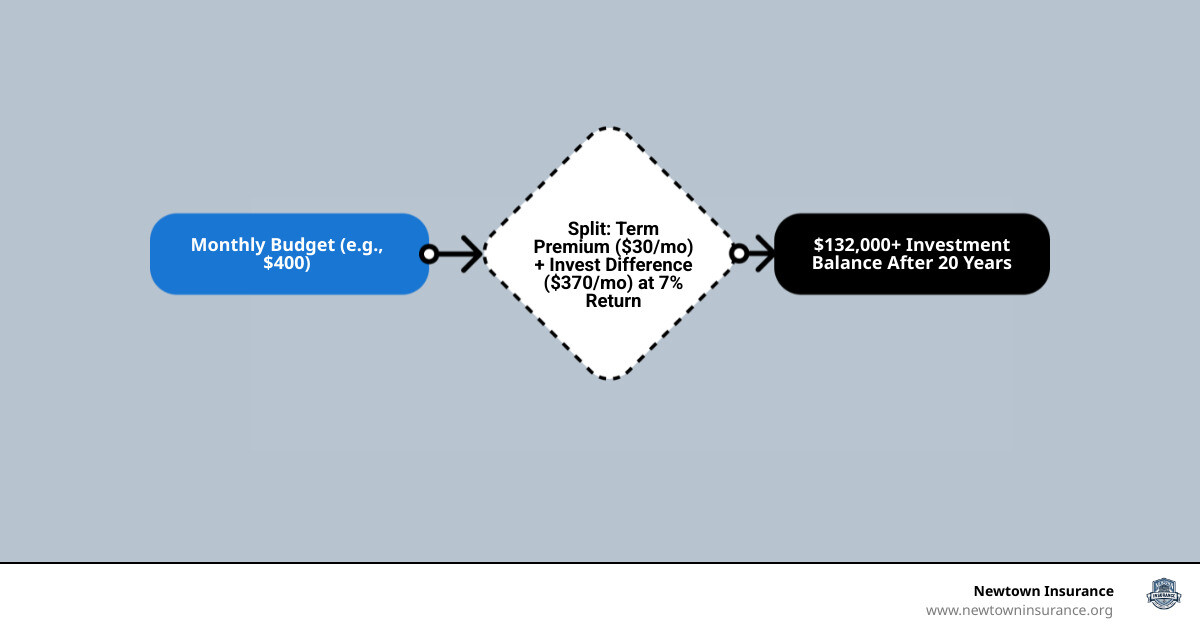
Quick example: A healthy 35-year-old pays around $30/month for a $500,000 20-year term policy. The same coverage in whole life costs $400-$600/month. Investing the $270-$370 monthly difference at 7% annually could grow to over $132,000 in 20 years.
Term life insurance costs 10-15 times less than whole life per dollar of death benefit. That gap is exactly where your wealth-building opportunity lives.
For most Pennsylvania families, the math is straightforward. The challenge is knowing which numbers to use – and what to do with the result.
I’m Shawn Beihl, and with over 15 years of specialty insurance experience across life, health, and commercial lines, I have helped countless families run exactly this kind of analysis using a buy term and invest the difference calculator to find coverage that protects without overpaying. In the sections below, I will walk you through every step so you can make a confident, data-driven decision.
Understanding the Buy Term and Invest the Difference Strategy
At its core, the “Buy Term and Invest the Difference” (BTID) strategy is about unbundling your financial life. For decades, the insurance industry has marketed permanent policies—like whole life or universal life—as “all-in-one” products that provide both a death benefit and a savings account (known as cash value). While that sounds convenient, it often comes with a high price tag and mediocre returns.
When we talk about BTID, we are separating pure protection from wealth accumulation. Term life insurance is pure protection; you pay a small premium, and if you pass away during the term, your beneficiaries receive a check. There is no “cash value” cluttering up the policy. Because it’s so simple, it is incredibly inexpensive.
The “difference” refers to the premium gap. If a whole life policy costs you $500 a month and a term policy with the same death benefit costs only $40, you have a $460 “difference” every single month. By choosing term, you reclaim that $460. The BTID strategy suggests you take that money and put it into the market—stocks, mutual funds, or ETFs—where it has the potential to grow much faster than the 1% to 3% typically seen in whole life cash values.
This approach respects your Human Life Value. In your 30s and 40s, your “value” to your family is highest because you have decades of future earnings ahead of you. You need a massive death benefit, but you might not have a massive budget. BTID allows you to get that $500,000 or $1,000,000 of coverage for the price of a couple of pizzas, freeing up your cash flow to build a real nest egg. To see how this fits into your broader insurance plan, check out our Compare Insurance Quotes Complete Guide.
Term Life vs. Whole Life: The Comparison Table
| Feature | Term Life Insurance | Whole Life Insurance |
|---|---|---|
| Monthly Cost | Very Low ($25–$50) | Very High ($400–$600) |
| Duration | Fixed (10, 20, 30 years) | Permanent (Lifelong) |
| Cash Value | None | Yes (Grows slowly) |
| Investment Returns | Variable (Market-based) | Low (Guaranteed 1–3%) |
| Flexibility | High (Easy to cancel/change) | Low (High fees to exit early) |
| Control | You manage the investments | Insurance company manages funds |
How to Use a Buy Term and Invest the Difference Calculator
Using a buy term and invest the difference calculator is the best way to move past “gut feelings” and look at the hard math. These calculators are designed to simulate two parallel universes: one where you buy the expensive policy, and one where you buy the cheap policy and invest the savings.

To get an accurate picture, you need to start with your monthly budget. This isn’t just what the insurance costs; it’s the total amount you are willing to commit to your financial security. If you’ve decided you can afford $300 a month for “financial stuff,” that is your starting point.
Next, you look at the premium comparison. You’ll input the quote for a term policy and the quote for a whole life policy. The calculator then identifies the “investable difference.” The most critical part of the calculation is the time horizon. If you are 35 and buying a 20-year term, your horizon is 20 years. Finally, you’ll enter your projected returns. While the stock market has historically returned 7-10% annually, many conservative planners use 6% to account for inflation and fees. You can experiment with different scenarios using this Buy Term, Invest the Difference Calculator – AgentDecks.
Key Inputs for Your Buy Term and Invest the Difference Calculator
To get the most out of your simulation, you need to be precise with your inputs. Don’t just guess—get Personalized Insurance Quotes to ensure the numbers reflect your actual age, health status, and location here in Pennsylvania.
- Coverage Amount: Usually $500,000 to $1,000,000. This should be the same for both the term and whole life sides of the calculator to ensure a fair comparison.
- Term Length: How long do you need the protection? Most families choose 20 or 30 years to cover the duration of a mortgage or until children reach adulthood.
- Annual Return: Be realistic. While 10% is the long-term S&P 500 average, using 7% is safer for long-term planning.
- Tax Bracket: This is often overlooked. If you are investing in a taxable brokerage account, you’ll owe capital gains taxes. A good calculator will factor this in.
Interpreting Results from a Buy Term and Invest the Difference Calculator
When the calculator spits out a result, it usually shows you two ending balances. One is the “Cash Value” of the whole life policy, and the other is the “Investment Balance” of the BTID strategy.
In almost every scenario for a healthy individual under age 50, the BTID strategy wins by a landslide. Why? Compounding growth. Because term insurance is so cheap, you are investing a much larger sum of money starting in year one. While the whole life policy uses your early premiums to pay high agent commissions and administrative costs, your BTID strategy is already earning interest on the full “difference.”
By the end of a 20-year term, it is common to see a BTID balance that is $150,000 to $300,000 higher than the whole life cash value. For a deep dive into these projections, you can use the Buy Term Life Insurance and Invest the Difference Calculator.
Maximizing Your Returns: Where to Invest the Difference
The “Invest the Difference” part of the name isn’t just a suggestion—it’s the engine that makes the whole strategy work. If you buy term and then spend the difference on fancy dinners or a new car, the strategy fails. You must be disciplined about where that money goes.
We generally recommend low-cost, diversified investments. Index funds and ETFs (Exchange Traded Funds) that track the S&P 500 or the total stock market are favorites because they have extremely low fees (often 0.03% to 0.10%). Over 20 or 30 years, those low fees save you tens of thousands of dollars compared to the high internal costs of a whole life policy.
Where you hold these investments matters for taxes:
- Roth IRA: If you qualify, this is the “gold standard.” Your money grows tax-free, and you won’t owe the IRS a dime when you withdraw it in retirement.
- Brokerage Account: More flexible than a Roth IRA, but you will owe capital gains taxes on your growth.
- 401(k) or 403(b): If your employer offers a match, investing your “difference” here is like getting an immediate 100% return on that portion of your money.
For more on how different returns impact your wealth, visit Investment Returns – Financial Calculators from Dinkytown.net. And if you’re looking for more ways to find that investable cash, check out our Tips For Saving Money On Insurance.
The Reality Check: Risks and Behavioral Challenges
If the math is so clearly in favor of BTID, why does anyone still buy whole life? The answer isn’t math—it’s psychology. The biggest risk to the BTID strategy isn’t market volatility; it’s the behavior gap.
Many people have the best intentions but fall victim to spending temptation. It is very easy to see an extra $300 in your checking account and decide you need a weekend getaway rather than a transfer to your Vanguard account. Whole life insurance acts as a “forced savings” mechanism because if you don’t pay the premium, you lose the coverage.
There are also market risks. If the stock market crashes right when your 20-year term expires, your investment balance might be lower than you hoped. However, history shows that over 20-30 year periods, the market has a very strong track record of positive growth.
Another concern is term expiration. What happens in 2046 when your 20-year term ends? If you still need insurance, buying a new policy at age 55 or 60 will be significantly more expensive. The goal of BTID is to be “self-insured” by that point—meaning your investments have grown so large that your family doesn’t need a death benefit anymore. For more ways to stay on track, see our Insurance Savings Tips.
Frequently Asked Questions about BTID
Is BTID better than whole life insurance for most families?
For the vast majority of families in Pennsylvania, yes. The 10-15x savings in premiums allow for much greater investment control. Unless you have a very high net worth (estates over $13.6 million in 2026) or complex estate planning needs, the simplicity and cost-efficiency of term life make it the superior choice. It allows homeowners to protect their biggest asset without draining their monthly budget. Learn more at Life Insurance For Homeowners.
What happens when my term life insurance expires in 2026?
You have several options. Most modern term policies include conversion options, which allow you to turn part of your term policy into a permanent one without a new medical exam. You can also “ladder” policies (buying multiple terms of different lengths) to ensure coverage declines as your mortgage is paid off. Ideally, by the time the policy expires, your BTID investment account is large enough that you no longer need insurance.
How do taxes and fees affect my total investment gains?
Taxes are the “silent killer” of wealth. In a BTID strategy, you must account for capital gains taxes (usually 15% for most people) and dividend taxes. However, even after these taxes, the higher growth rate of the stock market typically outperforms the tax-deferred growth of a whole life policy because the underlying returns in whole life are so much lower. Always look for low expense ratios in your investments to keep more of what you earn.
Conclusion
Building a financial legacy doesn’t require complex, expensive insurance products. It requires a plan, a little bit of math, and a lot of discipline. By using a buy term and invest the difference calculator, you can see through the marketing fog and realize that the most powerful wealth-building tool you have is your own monthly cash flow.
At Newtown Insurance, we believe in tailored protection that fits your life in Pennsylvania. We aren’t here to sell you the most expensive policy; we’re here to help you find the smart savings that let you protect your family while still growing your net worth. Whether you are just starting your family or looking to optimize your current coverage, we provide the transparent pricing and customer-first support you deserve.
Ready to see the math for yourself? Start your financial journey with our expert guidance and let us help you find the perfect term policy to kickstart your “invest the difference” strategy today.