

A–Z Guide to Auto Insurance Coverage
Why Auto Insurance Coverage Is More Important Than You Think

Auto insurance coverage is the financial safety net that protects you, your passengers, and your wallet when something goes wrong on the road — whether that's a fender bender, a stolen vehicle, or a serious injury claim.
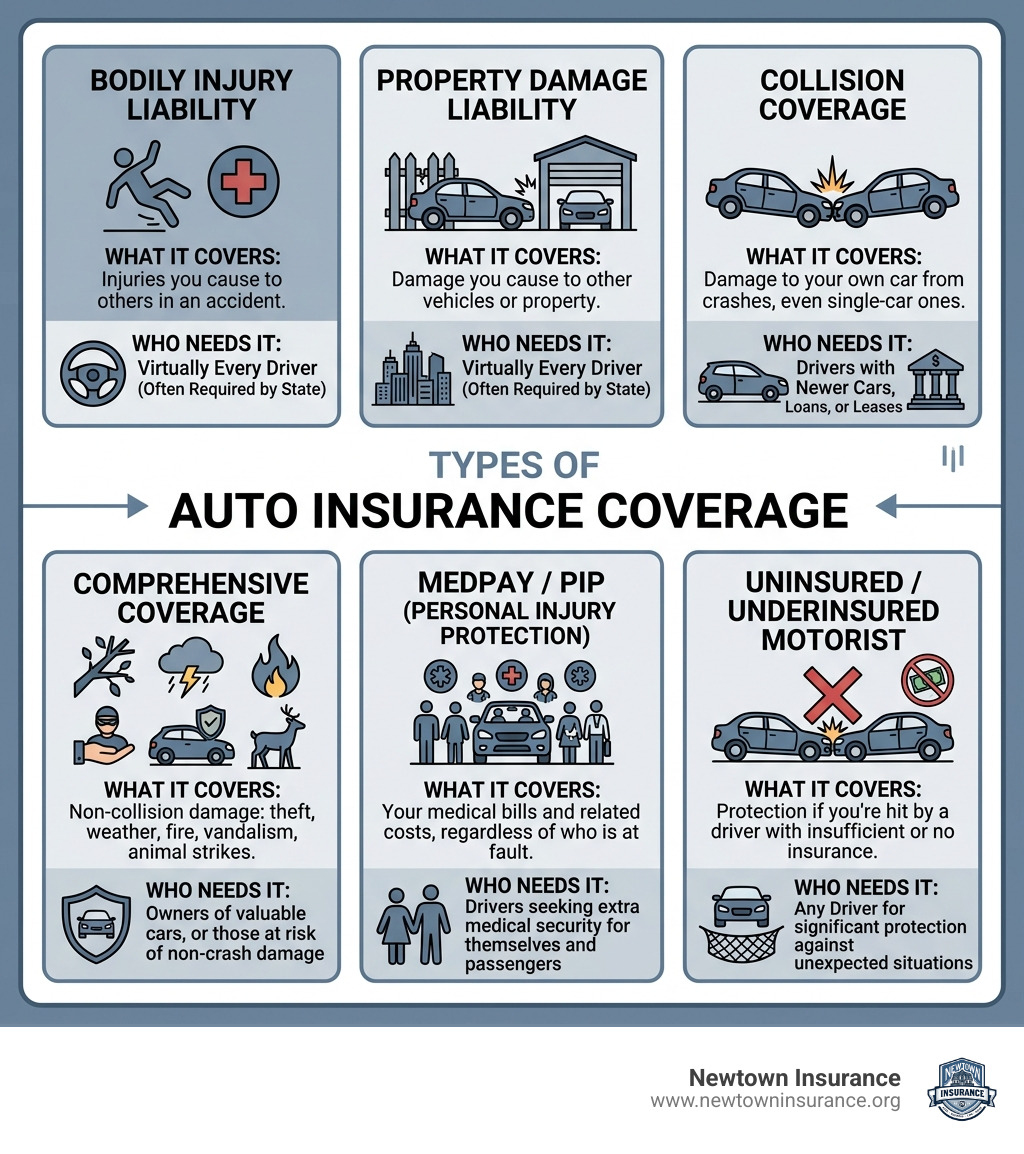
Here's a quick breakdown of the main types of coverage:
| Coverage Type | What It Pays For |
|---|---|
| Bodily Injury Liability | Injuries you cause to others |
| Property Damage Liability | Damage you cause to others' property |
| Collision | Damage to your own car from a crash |
| Comprehensive | Theft, weather, fire, vandalism, and more |
| MedPay / PIP | Your medical bills, regardless of fault |
| Uninsured/Underinsured Motorist | Protection when the other driver has no (or not enough) insurance |
| Gap Insurance | Covers the difference between your loan balance and car value |
Most U.S. states require drivers to carry at least liability coverage — but state minimums are often far too low to fully protect your assets if a serious accident occurs.
And yet, many drivers are still paying for policies they don't fully understand — or worse, overpaying for coverage that doesn't actually fit their needs.
This guide walks you through every major type of auto insurance coverage, what it does and doesn't cover, how your premiums are calculated, and how to make smarter choices as a Pennsylvania driver.
I'm Shawn Beihl, and with over 15 years of specialty insurance experience spanning commercial P&C, life, health, and risk management, I've helped countless clients cut through the confusion around auto insurance coverage to find protection that actually works for them. Let's break it all down.
Understanding the Core Components of Auto Insurance Coverage

When you sign an auto insurance policy, you aren't just buying a piece of paper to keep in your glove box for the police; you are entering into a legal contract. This contract outlines your financial responsibility to others and the insurance company’s responsibility to you.
The foundation of almost every policy is liability insurance. If you are at fault in an accident, liability coverage is what prevents a victim from coming after your personal assets—like your home or savings—to pay for their medical bills or car repairs. It is essentially your first line of defense against potentially bankrupting lawsuits.
To get a firm grasp on how this works, it helps to look at Auto insurance basics—understanding your coverage. Most basic policies are built on the "third-party" principle, meaning the money goes to the people you hit, not to you.
Bodily Injury vs. Property Damage Liability
Liability is typically split into two distinct categories. Understanding the difference is vital because they cover very different types of losses.
- Bodily Injury Liability (BI): This kicks in when you (or someone driving your car with permission) injure someone else. It covers their medical expenses, rehabilitation, and even lost wages if they can’t work. Perhaps most importantly, it also pays for your legal fees if that person decides to sue you.
- Property Damage Liability (PD): This covers the "stuff" you hit. While this usually means the other person’s car, it also includes stationary objects. If you lose control and take out a neighbor’s fence, a city lamp post, or a storefront, PD coverage pays for the repairs.
| Liability Type | Covers | Does NOT Cover |
|---|---|---|
| Bodily Injury | Other people's medical bills, legal defense | Your own medical bills |
| Property Damage | Other people's cars, fences, buildings | Damage to your own vehicle |
Mandatory Auto Insurance Coverage Requirements by State
Every state has its own idea of what "enough" insurance looks like. As we head into April 2026, these requirements continue to evolve. While we focus on our neighbors here in Pennsylvania, it’s helpful to see how we compare to other regions to understand the national landscape.
- Pennsylvania: In the Commonwealth, you are required to carry a minimum of $15,000 for bodily injury (per person), $30,000 for bodily injury (per accident), and $5,000 for property damage. You also must carry $5,000 in medical benefits. You can learn more about these specifics via the Auto Insurance - Commonwealth of Pennsylvania portal.
- Arizona: Drivers must meet 25/50/15 limits ($25,000 per person/$50,000 per accident for BI, and $15,000 for PD).
- Georgia: Requirements are slightly higher for property damage at 25/50/25.
- North Dakota: This state requires 25/50/25 liability, plus $25,000/$50,000 in uninsured motorist coverage and a hefty $30,000 in basic no-fault coverage.
One thing we always tell our clients: state minimums are just that—the bare minimum. If you cause a multi-car pileup in Newtown or scrape a brand-new electric vehicle, a $5,000 property damage limit will disappear in the blink of an eye, leaving you personally responsible for the rest.
Physical Damage and First-Party Protections
While liability protects your bank account from others, physical damage coverage protects the investment you’ve made in your vehicle. These are often referred to as "first-party" coverages because they pay you.
When you have these coverages, the insurance company typically pays the Actual Cash Value (ACV) of the car. This means they take the replacement cost and subtract depreciation. Because cars lose value the moment you drive them off the lot, this is a crucial distinction to remember.
To make these coverages more affordable, we often suggest looking at Auto Insurance Payment Plans to spread out the cost, or checking out our guide on Moneysaving Car Insurance to balance your deductibles with your monthly budget.
Comprehensive vs. Collision: When Are They Necessary?
These two are the "dynamic duo" of vehicle protection. If you are financing or leasing your car, your lender will almost certainly require both.
- Collision Coverage: This pays for damage to your car resulting from a crash with another vehicle or an object (like a tree or a pothole). It even covers rollovers. If you're at fault, collision is what gets your car back on the road.
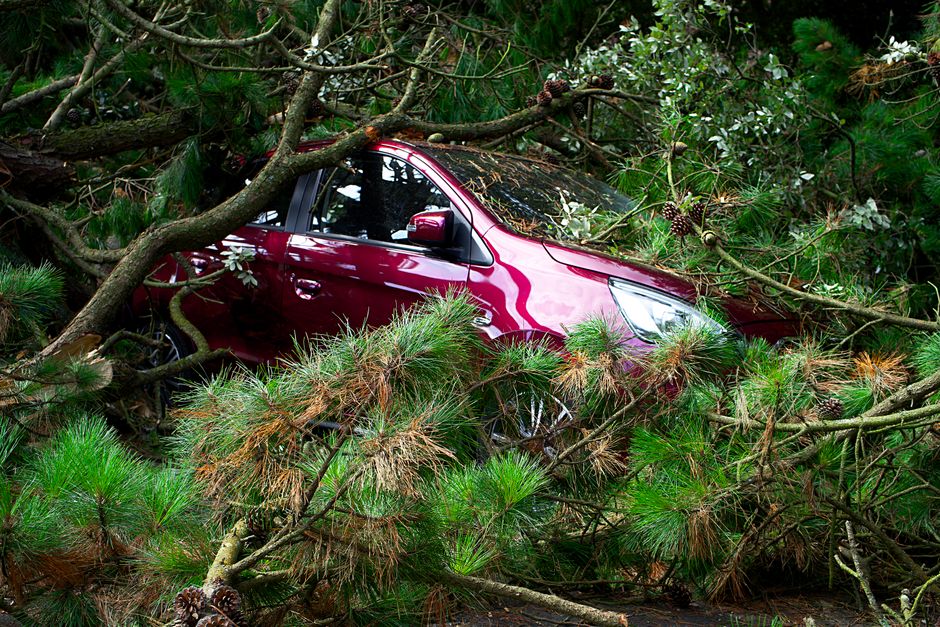
- Comprehensive Coverage: Think of this as "everything but a crash." It protects against theft, vandalism, fire, and "acts of God" like hail or flooding. It even covers hitting an animal (a common occurrence on PA backroads!). Fun fact: most comprehensive policies would even cover you if your car was hit by a falling asteroid—though we hope you never have to test that theory.
If you live in areas like Hatboro, you know that weather and tight parking can lead to non-collision damage frequently. You can read more about local considerations in our post on Car Insurance Hatboro.
Medical Payments (MedPay) and Personal Injury Protection (PIP)
Pennsylvania is a "choice no-fault" state. This means that regardless of who caused the accident, your own insurance is responsible for paying your medical bills up to a certain limit.
- Personal Injury Protection (PIP): This is often more robust than standard medical payments. It can cover medical bills, lost wages (usually up to 75%), and even "replacement services" (like paying someone to mow your lawn if you're too injured to do it).
- Medical Payments (MedPay): This is a smaller, more focused coverage that strictly pays for medical or funeral expenses for you and your passengers.
For a deeper dive into how these "no-fault" systems work generally, Basics of Auto Insurance | Mass.gov provides an excellent educational overview of how PIP functions to keep people out of court for minor injuries.
Essential Add-ons and Specialized Auto Insurance Coverage
Beyond the basics, there are several "add-on" coverages that can save you from massive headaches. These are often inexpensive but provide immense value when things go sideways.
- Uninsured/Underinsured Motorist (UM/UIM): This is arguably the most important "optional" coverage. If you are hit by someone who has no insurance (uninsured) or someone whose limits are too low to pay for your injuries (underinsured), your own policy steps in to fill the gap.
- Gap Insurance: If your car is totaled and you owe $25,000 on your loan but the car is only worth $20,000, the insurance company only pays the $20,000. Gap insurance covers that $5,000 difference so you aren't paying for a "ghost car" you can no longer drive.
- Rental Reimbursement: If your car is in the shop after a covered accident, this pays for a rental car so you can still get to work.
- Roadside Assistance: This covers towing, flat tire changes, and jump-starts.
For residents in Northern PA, we have specific insights on Auto Insurance Scranton PA that cover how these add-ons perform in different environments.
Navigating Rideshare and TNC Insurance Requirements
If you drive for a Transportation Network Company (TNC) like Uber or Lyft, your personal auto insurance coverage likely has a "livery exclusion." This means the moment you turn on that app to make money, your personal policy stops working.
TNC insurance is generally broken down into three periods:
- Period 1: App is on, but you haven't accepted a ride. Your personal policy usually won't cover you here, and the TNC's coverage is often limited.
- Period 2: Ride accepted, and you are on your way to pick up the passenger. Minimum requirements here are often $50,000/$100,000 for bodily injury and $25,000 for property damage.
- Period 3: Passenger is in the car. Most TNCs provide $1 million in total liability coverage during this phase.
To stay fully protected, we recommend a rideshare endorsement on your personal policy to bridge these gaps.
Coverage for Borrowed, Rented, or Replacement Vehicles
A common question we get is, "Does my insurance follow me or the car?" The answer is: usually both, but it's complicated.
- Permissive Use: If you let a friend borrow your car, your insurance is generally the "primary" coverage. If they get into an accident, your policy pays first.
- Rental Cars: Your personal policy usually extends to a rental car used for vacation, but it often won't cover "loss of use" fees charged by the rental company. Also, standard policies almost never cover moving trucks (like U-Hauls).
- Replacement Vehicles: If you buy a new car, most policies give you a "grace period" (often 20 days) of automatic coverage, but you must notify us promptly to ensure the coverage stays in place.
If you are looking for something smaller, like a scooter or moped, the rules change again. Check out our guide on Moped Insurance Price for those specifics.
Factors Influencing Your Premiums and Policy Rights
Why does your neighbor pay less for insurance than you do? It isn't just luck. Insurance companies use complex math to determine how "risky" you are.
Key factors include:
- Driving Record: Tickets and at-fault accidents are the biggest drivers of rate increases.
- Credit History: In many states, including Pennsylvania, your credit-based insurance score is a major factor. Statistically, people with higher credit scores tend to file fewer claims.
- Location: Living in a high-traffic or high-theft ZIP code will increase your rates.
- C.L.U.E. Reports: Insurers check the Comprehensive Loss Underwriting Exchange to see your entire history of claims, even if they were with a different company.
We’ve compiled a list of Insurance Savings Tips to help you navigate these factors and keep your costs down.
Discounts and Strategies to Lower Your Rates
The good news is that there are dozens of ways to save. We always look for these "hidden" discounts for our clients:
- Multi-Policy (Bundling): This is usually the biggest discount. Combining your Car Motorcycle and Home Insurance Combined can save you up to 20%.
- Good Student: If you have a young driver on your policy with a "B" average or higher, tell us!
- Safety Devices: Anti-theft systems and advanced safety features can earn you small but steady discounts.
- Defensive Driving: Taking an approved course can often lead to a mandatory discount for several years.
For more ideas, see our Tips for Saving Money on Insurance.
Policy Cancellations, Nonrenewals, and Exclusions
It is important to know your rights as a consumer. An insurance company can’t just stop covering you for no reason.
- Cancellation: This happens mid-term. The most common reason is non-payment of premium. Companies must typically give you a 10-day notice.
- Nonrenewal: This happens at the end of your policy term. The company may decide not to offer you a new contract if your risk profile has changed too much (e.g., too many accidents).
- Exclusions: Every policy has things it won't cover. Common exclusions include "business use" (like delivering pizzas) or "household exclusions," which might limit coverage if one family member sues another after an accident.
For a deeper look at the regulatory side of things, the Auto insurance guide from Texas (though a different state) provides a great general template for how these consumer protections work nationwide.
Frequently Asked Questions about Auto Insurance
What constitutes "full coverage" auto insurance?
"Full coverage" is actually a bit of a myth—it isn't a specific type of insurance you can buy. When people use this term, they usually mean a policy that includes Liability, Collision, and Comprehensive coverage. However, a "full" policy can still leave you with gaps if you don't have UM/UIM or Gap insurance. It is always better to customize your policy to your specific life situation rather than just asking for "full coverage."
What should I do immediately after an accident?
- Safety First: Move to a safe area and check for injuries.
- Call the Police: Even for minor accidents, a police report is a vital piece of evidence.
- Exchange Info: Get names, phone numbers, and insurance details from everyone involved.
- Take Photos: Document the damage to all vehicles and the surrounding scene.
- Notify Us: Contact your agent as soon as possible. Important: Never admit fault at the scene. Let the adjusters and police determine that based on the facts.
How do deductibles affect my premiums and claims?
There is an "inverse relationship" between your deductible and your premium.
- High Deductible ($1,000+): You pay more out-of-pocket if you have a claim, but your monthly premium will be much lower.
- Low Deductible ($250-$500): You pay less when an accident happens, but you’ll pay more every month for the privilege. If you have a healthy emergency fund, taking a higher deductible is often a great way to save money over the long term.
Conclusion
At Newtown Insurance, we believe that auto insurance coverage shouldn't be a "one-size-fits-all" product. As a Pennsylvania-based provider, we understand the local roads, the local risks, and the local laws that affect your protection. Whether you are looking for smart savings or tailored protection for a new vehicle, our team is here to ensure you never overpay for the coverage you need.
Ready to see how much you could be saving? We offer Personalized Insurance Quotes that take your unique history and needs into account. If you're in the Western part of the state, we can even help with Car Insurance Quotes in Irwin PA.
Don't wait until an accident happens to find out if you're properly covered. Get a Tailored Quote Today and drive with the peace of mind that comes from having a professional team in your corner.