

Don't Let Funeral Costs Bury Your Pennsylvania Family
Why Burial Insurance in Pennsylvania Costs More Than Most Families Expect

Burial insurance in Pennsylvania is a small whole life insurance policy designed to cover funeral and final expenses - so your family isn't left scrambling for cash at the worst possible moment.
Quick answer: What you need to know about burial insurance in Pennsylvania
| Question | Answer |
|---|---|
| What is it? | A whole life policy paying $1,000-$35,000 to cover funeral, burial, or cremation costs |
| Average cost in PA | ~$147.76/month for an average death benefit of $24,612 |
| Typical burial cost in PA | $8,573 (burial) or $6,498 (cremation) |
| Medical exam required? | No - most policies only ask a few health questions |
| Waiting period? | Simplified issue = none; Guaranteed issue = 2 years |
| Free look period | 10 days to cancel for a full refund |
| Companies available in PA | Multiple carriers are available through licensed agents |
| Government help available? | Only $255 from Social Security - rarely enough |
Here's the uncomfortable truth: the average Pennsylvania funeral costs over $8,500, and the government pays just $255 toward it. That gap falls on your family.
Most people don't realize how fast costs add up - basic funeral services, a casket, burial permits, and cemetery fees can easily exceed what most families have sitting in savings. And if your estate is tied up in probate, your family may need cash immediately, before anything is settled.
That's exactly the problem burial insurance solves.
I'm Shawn Beihl from Newtown Insurance, and with over 15 years of experience in life and specialty insurance, I've helped Pennsylvania families navigate burial insurance in Pennsylvania without overpaying for coverage they don't need or underbuying and leaving loved ones short. In this guide, I'll walk you through exactly how to compare plans, understand real costs, and choose coverage that fits your budget.
For general background on how life insurance works, it can help to understand where burial insurance fits within the broader category of permanent coverage.
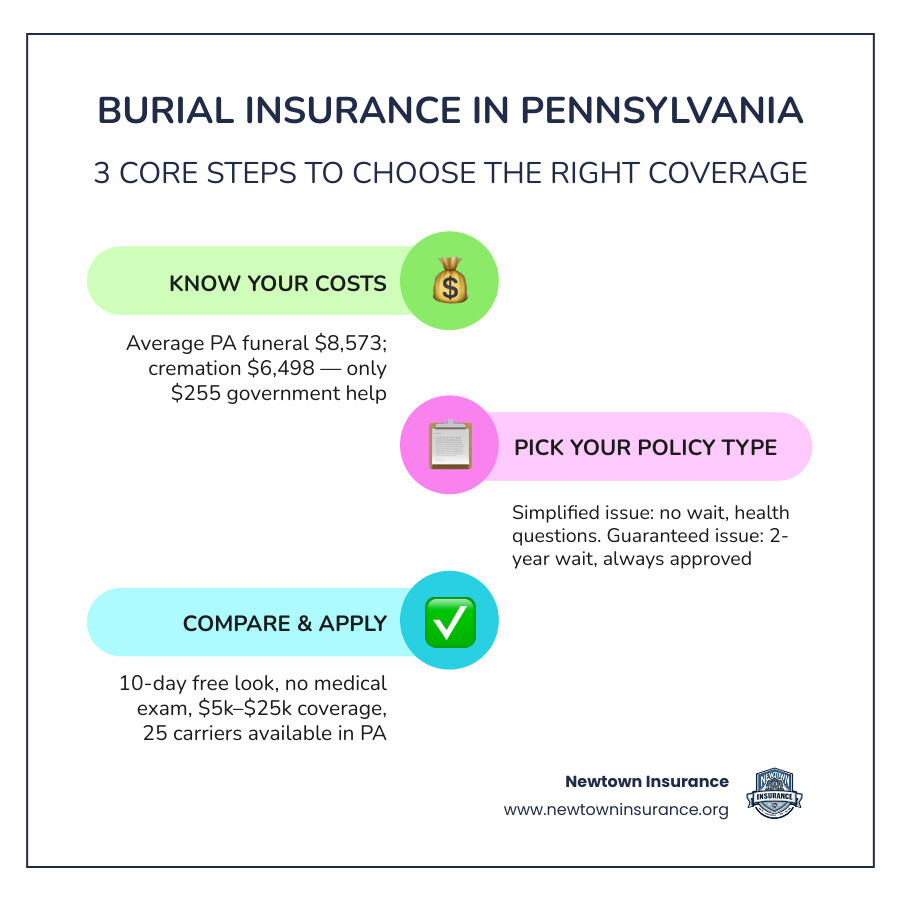
What Burial Insurance Pennsylvania Buyers Need to Know First
When most people search for burial insurance Pennsylvania, they are really looking for one thing: a simple way to make sure their family is not hit with a big bill during an already awful week.
Burial insurance is usually a small permanent life insurance policy, often called final expense insurance. It is designed for modest face amounts, commonly from $5,000 to $25,000, though some plans go lower or higher. Coverage is typically whole life, which means premiums stay level, the death benefit stays level, and the policy can build a little cash value over time.
What burial insurance is and what it actually pays for
Despite the name, the money does not have to be used only for burial.
Your beneficiary usually receives a tax-free lump sum and can use it for:
- Funeral home charges
- Burial or cremation costs
- Medical bills
- Credit card balances
- Small debts
- Travel for family members
- Household bills while everyone regroups
That flexibility is one of the biggest advantages. Unlike some prepaid funeral arrangements, the benefit is not locked to one funeral home or one itemized package.
For a deeper look at how final expense protection works, see our guide to Funeral Expense Coverage.
Burial insurance vs other life insurance options
Burial insurance is not the same thing as term life, traditional whole life, or pre-need funeral planning.
| Option | Best for | Key features | Main drawback |
|---|---|---|---|
| Burial insurance | Final expenses | Small whole life policy, fixed premium, simple approval | Higher cost per dollar of coverage than large life policies |
| Term life | Income replacement | Larger benefit for lower initial premium | Expires after term unless renewed |
| Traditional whole life | Long-term estate and family planning | Lifelong coverage, larger design flexibility | Usually more expensive and more underwriting |
| Pre-need funeral plan | Locking in specific funeral arrangements | Tied to a funeral contract or provider | Less flexibility and not the same consumer protections as life insurance |
A few practical differences matter:
- Burial insurance is usually easier to qualify for than traditional fully underwritten life insurance.
- Term life is usually cheaper for large coverage amounts, but it is not built specifically for final expenses.
- Pre-need plans can help with planning, but they may tie your money to a funeral home, location, or contract terms that are less flexible if you move or change your mind.
- Burial insurance is generally portable. If you move within or outside Pennsylvania, the policy usually stays with you.
Who should consider burial insurance in Pennsylvania
Burial insurance can make sense for:
- Seniors who do not want family members paying funeral bills out of pocket
- Retirees living on fixed income
- People with health conditions who may not qualify for traditional life insurance
- Families without dedicated emergency savings
- Homeowners who want quick cash available before an estate settles
- Adults who already have life insurance but want a small policy dedicated to final costs
If someone has plenty of liquid savings, a strong estate plan, and family members who can access funds quickly, burial insurance may be optional. But many families discover too late that "we'll just use savings" was more of a hope than a plan.
Pennsylvania Funeral Costs and State Rules That Affect Your Decision

You cannot choose the right coverage amount unless you understand what a funeral actually costs in Pennsylvania. Spoiler: it is rarely just the casket.
Average funeral and burial costs across Pennsylvania
Based on the research, average Pennsylvania costs look like this:
- Burial with services: about $8,573
- Cremation with services: about $6,498
- Direct burial: about $4,469
- Direct cremation: about $1,319 to $2,825 depending on what is included
- Basic services fee: about $3,142
- Embalming: about $810
- Casket or alternative container: averages can reach $7,147
That casket figure is exactly why families get sticker shock. One line item can eat half the budget before cemetery costs, transportation, flowers, obituary notices, clergy honorariums, or luncheon expenses are added.
Philadelphia and Pittsburgh funeral cost breakdowns
Prices in larger metro areas such as Philadelphia and Pittsburgh can vary based on:
- Funeral home overhead
- Service package structure
- Cemetery and plot pricing
- Religious or cultural customs
- Transportation needs
- Viewing and visitation choices
The exact total often depends less on the city name and more on the services chosen. A simple direct cremation is one thing. A full viewing, hearse, burial vault, cemetery opening fee, and traditional casket is another universe entirely.
That is why we encourage families to ask for itemized price lists instead of comparing only package headlines.
Pennsylvania rules on death certificates, embalming, preservation, and cremation
Pennsylvania has several practical rules that affect both timing and cost:
- A death certificate is needed to process insurance claims and handle many legal tasks after death.
- If final disposition will not occur within 24 hours, the body generally must be preserved by refrigeration or embalming.
- Embalming is not automatically required in Pennsylvania.
- Embalming is generally required if there will be a public viewing more than 24 hours after death.
- Cremation cannot occur within the first 24 hours after death in Pennsylvania.
- Burial or transit permits may apply depending on the arrangements.
These rules matter because they affect what a funeral home may need to charge. Families sometimes think embalming is always mandatory. In Pennsylvania, that is not generally true.
Your consumer protections when buying funeral-related services and insurance
Pennsylvania residents have several important protections.
First, life insurance policies in Pennsylvania include a 10-day free look period. That means you can review the policy after delivery and cancel within that window for a full refund if it is not what you expected.
Second, the FTC Funeral Rule gives consumers rights when dealing with funeral homes. Among other protections, funeral providers must:
- Give you an itemized General Price List
- Quote prices over the phone if you ask
- Let you buy only the goods and services you want
- Accept a casket or urn purchased elsewhere without charging a handling fee
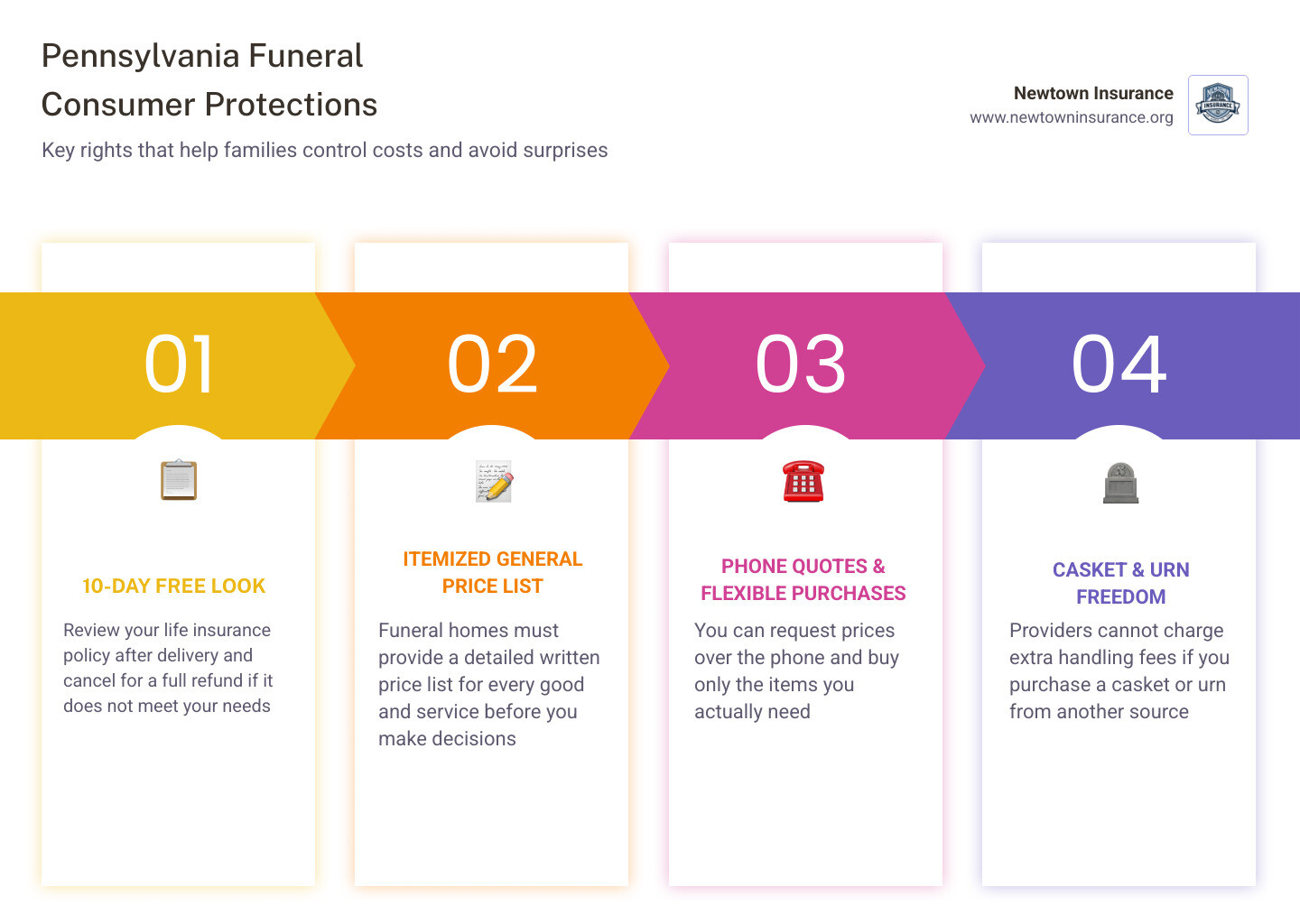
Use these rights. It is hard to comparison shop while grieving, but the law exists for exactly that reason.
Burial Insurance Pennsylvania Plan Types, Eligibility, and Approval
Understanding plan types is one of the most important parts of shopping for burial insurance Pennsylvania coverage. The right policy depends on your health, age, budget, and whether you need immediate coverage or are willing to accept a waiting period.
Simplified issue vs guaranteed issue in Pennsylvania
There are two main types of burial insurance:
Simplified issue
- No medical exam
- Short health questionnaire
- Often immediate full coverage from day one if approved
- Usually better value than guaranteed issue
Guaranteed issue
- No medical exam
- No health questions
- Usually a graded death benefit for the first two years
- If death from natural causes occurs during the waiting period, beneficiaries often receive premiums back plus interest instead of the full death benefit
- Accidental death is often covered immediately
In plain English: if you can medically qualify for simplified issue, it is usually the better deal.
Eligibility by age, health, and common medical conditions
Many burial insurance buyers in Pennsylvania are between ages 50 and 85, though some carriers allow younger or older applicants.
Approval often depends on things like:
- Tobacco use
- Diabetes
- Heart disease
- COPD
- Medications taken
- Recent hospitalizations
- Cancer history
- Oxygen use
- Memory-related conditions
A condition does not always mean a decline. Many people with controlled diabetes, blood pressure issues, or past heart trouble can still qualify for simplified issue coverage.
Application process for Pennsylvania residents
The application process is usually much easier than people expect:
- Compare quotes from multiple carriers.
- Choose a coverage amount and beneficiary.
- Answer health questions if applying for simplified issue.
- Complete the application by phone or e-signature.
- Wait for underwriting, which may take a few days.
- Review the delivered policy during the 10-day free look period.
If you want to understand how quote shopping works before you apply, our Life Insurance Quote No Personal Info Guide 2026 is a helpful starting point.
Medical exam requirements and what can trigger a decline
Most final expense policies in Pennsylvania do not require a medical exam. But "no exam" does not mean "no underwriting."
Insurers may check:
- Prescription drug history
- MIB records
- Build or height/weight
- Recent diagnoses
- Smoking or nicotine use
- Hospital or treatment history
Common factors that can trigger a decline for simplified issue include:
- Current oxygen use
- Recent cancer treatment
- Serious memory impairment or residency in memory care
- Very recent heart events or hospitalizations
If that happens, guaranteed issue may still be available, but expect a waiting period.
How Much Burial Insurance Costs in Pennsylvania by Age and Budget

Cost depends mostly on age, gender, health, tobacco use, and whether the plan is simplified issue or guaranteed issue.
Simplified issue vs guaranteed issue in Pennsylvania
There are two main types of burial insurance:
Simplified issue
- No medical exam
- Short health questionnaire
- Often immediate full coverage from day one if approved
- Usually better value than guaranteed issue
Guaranteed issue
- No medical exam
- No health questions
- Usually a graded death benefit for the first two years
- If death from natural causes occurs during the waiting period, beneficiaries often receive premiums back plus interest instead of the full death benefit
- Accidental death is often covered immediately
In plain English: if you can medically qualify for simplified issue, it is usually the better deal.
Eligibility by age, health, and common medical conditions
Many burial insurance buyers in Pennsylvania are between ages 50 and 85, though some carriers allow younger or older applicants.
Approval often depends on things like:
- Tobacco use
- Diabetes
- Heart disease
- COPD
- Medications taken
- Recent hospitalizations
- Cancer history
- Oxygen use
- Memory-related conditions
A condition does not always mean a decline. Many people with controlled diabetes, blood pressure issues, or past heart trouble can still qualify for simplified issue coverage.
Application process for Pennsylvania residents
The application process is usually much easier than people expect:
- Compare quotes from multiple carriers.
- Choose a coverage amount and beneficiary.
- Answer health questions if applying for simplified issue.
- Complete the application by phone or e-signature.
- Wait for underwriting, which may take a few days.
- Review the delivered policy during the 10-day free look period.
If you want to understand how quote shopping works before you apply, our Life Insurance Quote No Personal Info Guide 2026 is a helpful starting point.
Medical exam requirements and what can trigger a decline
Most final expense policies in Pennsylvania do not require a medical exam. But "no exam" does not mean "no underwriting."
Insurers may check:
- Prescription drug history
- MIB records
- Build or height/weight
- Recent diagnoses
- Smoking or nicotine use
- Hospital or treatment history
Common factors that can trigger a decline for simplified issue include:
- Current oxygen use
- Recent cancer treatment
- Serious memory impairment or residency in memory care
- Very recent heart events or hospitalizations
If that happens, guaranteed issue may still be available, but expect a waiting period.
Typical monthly premiums by age and gender
Rates vary by carrier, but the research gives us useful benchmarks.
For a 65-year-old in good health in Pennsylvania:
- Female: about $22/month for $5,000
- Female: about $41/month for $10,000
- Female: about $97/month for $25,000
- Male: about $29/month for $5,000
- Male: about $54/month for $10,000
- Male: about $130/month for $25,000
Research also notes that a 65-year-old man might pay around $35/month for $5,000 with a no-health-questions plan, and an 80-year-old woman might pay about $126/month for $10,000 on guaranteed issue coverage.
As a rule:
- Women usually pay less than men
- Younger applicants pay much less than older applicants
- Guaranteed issue costs more than simplified issue
- Tobacco users often pay more
What common budgets can realistically buy
Here is a realistic planning framework:
- $25/month: often enough for smaller coverage, commonly around $3,000 to $5,000 depending on age and health
- $50/month: may buy roughly $5,000 to $10,000 for many shoppers
- $75/month: often fits the middle ground for meaningful funeral coverage
- $100/month: can sometimes reach $10,000 to $15,000 or more, depending on age and underwriting class
Coverage in Pennsylvania can start as low as $1,000, but that amount usually will not go very far for a traditional burial.
How to choose the right death benefit for burial or cremation
A practical target for many Pennsylvania residents is $10,000 to $15,000.
That range can help cover:
- Funeral home basic services
- Burial or cremation
- A cemetery plot or urn
- Transportation and paperwork
- Small unpaid bills
- A cushion for price increases
If you want a traditional burial with viewing, a larger amount may be wise. If you prefer direct cremation and have savings for the rest, a smaller policy may work.
Also remember inflation. Funeral costs are not famous for getting cheaper.
For more on how premiums work over time, see our guide to Life Insurance Premium.
How fixed-benefit burial insurance plans work and the tradeoffs to watch for
Some plans use a simple fixed death benefit. Others use more confusing pricing structures. In any case, watch for:
- Age-based coverage value that may be lower than expected
- Two-year graded benefits
- Limited face amounts
- Marketing that emphasizes price but not actual payout
- Policies that are hard to compare apples-to-apples
Transparency matters. If a plan sounds clever but makes you do math worthy of a tax accountant, we would rather keep shopping.
How to Compare Pennsylvania Burial Insurance Providers Without Overpaying
When comparing burial insurance Pennsylvania options, price matters, but it should not be the only filter.
What to compare besides price
Look at:
- Financial strength ratings
- Complaint trends
- Underwriting friendliness for your health profile
- Waiting periods
- Payout speed
- Policy exclusions
- Cash value features
- Riders or optional benefits
- Whether premiums and benefit are fixed for life
A cheap policy with a hidden waiting period is not a bargain. It is just a surprise with paperwork.
Red flags and mistakes Pennsylvania shoppers should avoid
Common mistakes include:
- Buying too little coverage because the cheapest premium looks attractive
- Buying too much coverage that strains the budget and risks lapse
- Missing a graded death benefit disclosure
- Assuming all no-exam plans are identical
- Letting an agent pressure you into a same-day decision
- Failing to review the policy during the free look period
Pros and cons of burial insurance vs personal savings
Burial insurance advantages:
- Immediate liquidity for family
- No need to wait for estate settlement
- Fixed premium and predictable benefit
- Can be easier to protect from being spent on other things
Savings advantages:
- Full flexibility
- No underwriting
- No ongoing premium obligation
Savings drawbacks:
- Money may get used for emergencies
- Inflation can erode the plan
- Family may not have quick access
- Many people simply never set enough aside
Best way to shop quotes and review policy details
We recommend a simple process:
- Get multiple quotes side by side.
- Compare both monthly premium and waiting period.
- Check whether the policy is simplified issue or guaranteed issue.
- Confirm the exact death benefit.
- Verify beneficiary details.
- Read the policy during the 10-day free look period.
For a broader planning framework, see our Ultimate Life Insurance Guide 2026 and Insurance Pennsylvania Complete Guide.
Government Help With Funeral Costs in Pennsylvania
Government help exists, but it is usually limited.
What assistance is available through Pennsylvania DHS
Pennsylvania's Department of Human Services may provide burial or cremation payment for certain eligible individuals. Eligibility may include people who, before death, were:
- Receiving SSI
- Receiving cash assistance through DHS
- Found eligible for cash assistance
- Certain long-term qualifying nursing home residents with older legacy eligibility rules
Eligibility is generally determined through local County Assistance Offices, and funeral directors must be registered providers to receive payment.
Social Security and other limited benefits
Social Security offers a $255 lump-sum death benefit in qualifying situations. Helpful? Yes. Sufficient for a Pennsylvania funeral? Not even remotely.
Other possible sources of help can include:
- Workers' compensation death benefits in qualifying cases
- Veterans benefits for eligible veterans and families
Even when available, these benefits often cover only a small portion of total final expenses.
When insurance is still necessary even if aid may be available
This is the key point: most aid programs are limited by eligibility rules, low payout amounts, or timing delays.
Insurance is still often necessary because:
- Many families do not qualify for DHS help
- Social Security's payment is tiny relative to real funeral costs
- Funeral homes usually need payment promptly
- Extra expenses like travel, flowers, and unpaid bills are not fully covered
Frequently Asked Questions About Burial Insurance Pennsylvania
Is burial insurance in Pennsylvania worth it if I already have life insurance?
Often, yes. A larger life insurance policy may be meant for a spouse, mortgage payoff, or income replacement. Burial insurance can act as a supplement specifically for immediate expenses. That way, loved ones do not have to wait on probate, paperwork, or estate access.
If you are a homeowner, our article on Life Insurance for Homeowners may also help you think through how different policies serve different goals.
How quickly is a burial insurance claim paid in Pennsylvania?
In many cases, claims can be paid within days after the insurer receives the claim forms and certified death certificate. Timing varies by insurer and circumstances, but burial insurance is often used precisely because it can provide funds faster than waiting on estate settlement.
Can I buy burial insurance in Pennsylvania with serious health issues?
Usually, yes. If you cannot qualify for simplified issue because of serious medical conditions, guaranteed issue may still be available. Just understand the tradeoff: these policies usually come with a two-year graded benefit period for natural death.
Conclusion
Funeral planning is not cheerful. Neither is discovering your family needs thousands of dollars on short notice.
That is why burial insurance Pennsylvania shoppers should focus on three things:
- Real funeral costs in Pennsylvania
- The difference between simplified issue and guaranteed issue
- Comparing plan details, not just the lowest monthly premium
For many families, the sweet spot is a policy large enough to cover a realistic funeral bill and a small cushion, but still affordable enough to keep for life. That is where good comparison shopping matters.
At Newtown Insurance, we believe in tailored protection, smart savings, and transparent pricing so you do not overpay for coverage that misses the mark. If you are ready to compare plans and protect your family with more confidence, learn more about our services here: More info about our services.
You can also explore our local resource on Newtown Burial Insurance Options for more Pennsylvania-specific planning help.