What Pennsylvania Drivers Must Know About Auto Insurance Laws

Understanding auto insurance requirements in Pennsylvania is essential before you get behind the wheel. Here’s a quick summary of what the law requires:
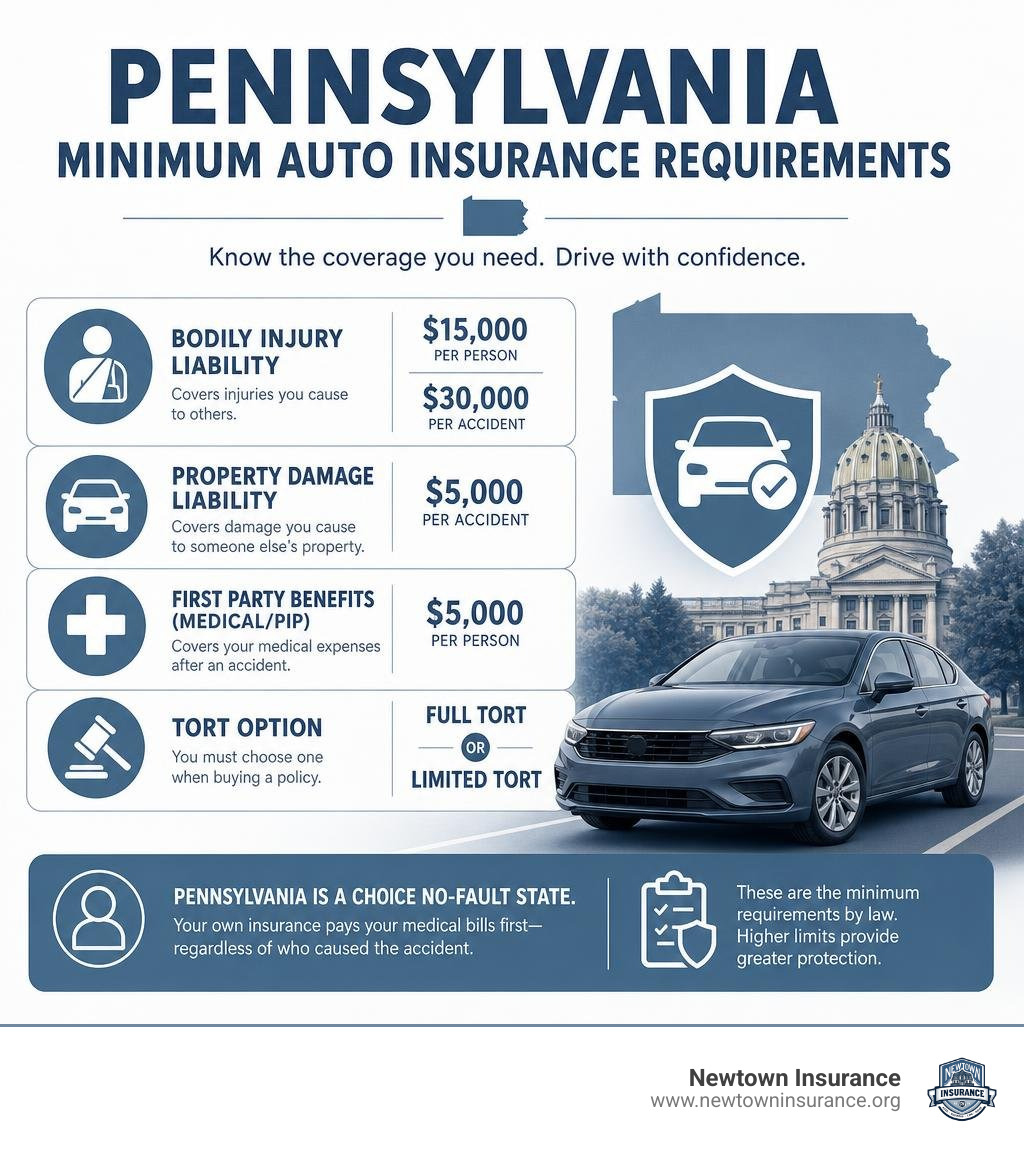
Pennsylvania Minimum Auto Insurance Requirements
| Coverage Type | Minimum Required |
|---|---|
| Bodily Injury Liability | $15,000 per person / $30,000 per accident |
| Property Damage Liability | $5,000 per accident |
| First Party Benefits (Medical/PIP) | $5,000 per person |
| Tort Option | Full tort or limited tort (must choose) |
Pennsylvania is also a choice no-fault state, meaning your own insurance pays your medical bills first — regardless of who caused the accident.
Pennsylvania has over 9 million licensed drivers on its roads, and more than 100,000 motor vehicle accidents were reported in 2024 alone. With that much traffic and that many collisions, the state takes financial responsibility seriously. Driving without the required coverage isn’t just risky — it can cost you your license, your registration, and hundreds of dollars in fines and fees.
Whether you recently moved to the state or have been driving here for years, the rules can be surprisingly complex. Between tort elections, PIP coverage, and PennDOT’s strict compliance procedures, many drivers don’t realize what they’re missing until something goes wrong.
I’m Shawn Beihl from Newtown Insurance, and with over 15 years of experience advising clients on property and casualty coverage — including helping Pennsylvania residents navigate auto insurance requirements in Pennsylvania — I’ve seen how the wrong policy choices can leave drivers exposed. This guide will walk you through everything you need to know to stay legal, protected, and confident on the road.
Understanding the Mandatory Auto Insurance Requirements in Pennsylvania
When you sit down to purchase or renew a car insurance policy in the Keystone State, you aren’t just shopping for peace of mind; you are fulfilling a strict legal obligation. Under Chapter 17. – Title 75 – VEHICLES, every motor vehicle registered in the Commonwealth must maintain continuous financial responsibility.
In plain English, “financial responsibility” means you must have a way to pay for damages or medical bills if you cause an accident. For 99% of us, this means buying a licensed auto insurance policy that meets or exceeds the state’s minimum coverage limits.
The state mandates three primary types of coverage on every basic policy: Bodily Injury Liability, Property Damage Liability, and First Party Benefits (often called Personal Injury Protection, or PIP). If you fail to carry these, your vehicle is considered uninsured, which opens the door to a world of legal headaches.
To help make sense of how these limits function in the real world, let’s take a look at how the mandatory minimums compare to what you actually get when an accident occurs:
| Required Coverage | State Minimum Limit | What It Actually Pays For | Why the Minimum Might Not Be Enough |
|---|---|---|---|
| Bodily Injury Liability | $15,000 per person / $30,000 per accident | Medical bills, rehab, and legal defense for other people you injure in a crash. | A single night in a modern emergency room can easily surpass $15,000. If you cause a multi-car pileup, $30,000 will be gone in the blink of an eye. |
| Property Damage Liability | $5,000 per accident | Repairing or replacing other people’s property (cars, fences, lampposts) that you damage. | The average price of a new car in 2026 is well over $45,000. If you total someone’s vehicle, a $5,000 limit leaves you personally on the hook for the remaining balance. |
| First Party Benefits (PIP) | $5,000 per person | Your own medical bills, plus those of your passengers, regardless of who caused the accident. | Severe injuries require intensive care, surgeries, and physical therapy, which quickly exhaust a $5,000 medical benefit. |
While these minimums will keep you legal in the eyes of PennDOT, they represent the absolute bare minimum of protection. If you are involved in a moderate to severe collision, relying solely on minimum Liability Insurance PA can leave your personal assets—like your home, savings, and future wages—vulnerable to lawsuits.
Bodily Injury and Property Damage Liability Limits
Let’s break down the liability numbers. In Pennsylvania, these are often written in insurance shorthand as 15/30/5.
- $15,000 Bodily Injury per person: This is the maximum amount your insurance company will pay for medical bills, lost wages, and pain and suffering for any one individual injured in an accident you cause.
- $30,000 Bodily Injury per accident: This is the total cap your insurer will pay out for injuries per accident, no matter how many people are hurt. If you injure four people in another car, they must split that $30,000 maximum.
- $5,000 Property Damage per accident: This pays for damage to the other driver’s vehicle, a telephone pole, a storefront, or even a neighbor’s mailbox.
If you are trying to keep your monthly bills low, choosing these state minimums might seem like a great way to secure cheap coverage. However, when you look at the Average Cost of Car Insurance in PA, you will often find that upgrading your liability limits to 100/300/100 ($100,000 per person, $300,000 per accident, and $100,000 for property damage) costs only a few dollars more per month. It is a small price to pay to avoid a devastating financial judgment.
First Party Benefits (PIP) Medical Coverage
Pennsylvania’s choice no-fault system means that if you are hurt in a car crash, your own insurance company pays for your medical treatment first. This is where First Party Benefits (FPB) come into play.
The state requires a minimum of $5,000 in medical benefits. This coverage applies to you, any relatives living in your household, and passengers who do not have their own auto insurance policies. It kicks in immediately to cover emergency room visits, doctor appointments, dental work, and prosthetic devices resulting from the crash.
What happens if $5,000 isn’t enough? You have the option to purchase much higher medical limits through your insurer, ranging up to $100,000 or more. Additionally, Pennsylvania insurance companies must offer Extraordinary Medical Benefits. This optional coverage picks up where your primary medical benefit leaves off, covering medical expenses that exceed $100,000 up to a maximum of $1.1 million.
To explore how these medical benefits interact with other parts of your policy, check out our comprehensive Pennsylvania Car Insurance Guide 2026.
Is Pennsylvania a No-Fault State? Choice Tort Options Explained
Yes, Pennsylvania is technically a “choice no-fault” state. But what does that actually mean?
In a traditional “at-fault” state, the driver who caused the accident is responsible for paying the medical bills of everyone involved. In a “no-fault” state, everyone’s own insurance policy pays for their own medical treatment via First Party Benefits, regardless of who ran the red light. This system was designed to speed up medical payments and keep minor personal injury claims out of the court system.
However, Pennsylvania adds a unique twist: the “Choice” part. When you purchase a policy, you must choose between two “tort” options that dictate your right to sue the at-fault driver for non-monetary damages, such as pain and suffering.

Your tort selection is a major decision that affects both your monthly premiums and your legal rights. The rules governing this choice are codified under Section 1705.0 – Title 75 – VEHICLES. For a deeper dive into how this impacts your overall coverage strategy, you can read our Insurance Pennsylvania Complete Guide.
Limited Tort vs. Full Tort Elections
When setting up your policy, you will be asked to sign a form selecting either Limited Tort or Full Tort.
- Limited Tort: Choosing this option will save you money on your monthly premium (usually around 15% to 20% off the liability portion of your bill). In exchange for these savings, you agree to give up your right to sue an at-fault driver for “pain and suffering” and other non-monetary damages unless your injuries are deemed “serious.” Under Pennsylvania law, a serious injury is defined as death, permanent severe disfigurement, or serious impairment of a body function.
- Full Tort: This option costs more, but it preserves your unrestricted right to sue the negligent driver for all damages, including pain and suffering, even for minor injuries like whiplash or soft-tissue damage.
If you do not return the tort election form to your insurance company, Pennsylvania law applies a default presumption: you are automatically assigned Full Tort coverage. However, if you let your insurance lapse or fail to maintain financial responsibility, the law deems you to have selected the Limited Tort option by default during the period of non-compliance.
The official guidance provided in The Pennsylvania Insurance Department Auto Insurance Guide reminds drivers that there are exceptions to the Limited Tort restriction. Even if you chose Limited Tort, you may still seek full recovery if the at-fault driver:
- Is convicted of driving under the influence (DUI) in connection with the accident.
- Is operating a vehicle registered in another state.
- Intentionally injured themselves or someone else.
- Is a commercial vehicle operator or a passenger in a commercial vehicle.
Uninsured and Underinsured Motorist (UM/UIM) Coverage
While liability insurance covers damage you cause to others, Uninsured Motorist (UM) and Underinsured Motorist (UIM) coverages protect you when the other driver is either completely uninsured or doesn’t carry enough coverage to pay for your injuries.
In Pennsylvania, insurance companies are required by law to offer UM and UIM coverage with limits equal to your bodily injury liability limits. However, you have the right to reject these coverages entirely or select lower limits by signing a written waiver.
Another critical concept is stacking. Stacking allows you to combine the UM/UIM limits of multiple vehicles on your policy (or across multiple policies in your household) to increase your total protection. For example, if you have two cars insured on a policy with $50,000 in UIM coverage:
- Stacked: Your total available UIM limit is $100,000 ($50,000 x 2 vehicles).
- Non-Stacked: Your total available UIM limit remains $50,000.
By law, stacked coverage is automatically applied to your policy unless you sign a written waiver to reject it. Rejecting stacking will lower your premium, but it reduces your overall safety net.
To help you build a complete picture of your coverage options, here is a list of common optional coverages you can add to your Pennsylvania auto policy:
- Collision Coverage: Pays to repair your car if you hit another vehicle, a tree, or a guardrail.
- Comprehensive Coverage: Pays for damage to your car caused by things out of your control, like hitting a deer, hail, theft, vandalism, or a cracked windshield.
- Funeral Benefits: Provides a set payout (usually around $2,500) to cover funeral expenses if a covered driver or passenger passes away in a crash.
- Income Loss Benefits: Helps replace lost wages if your injuries prevent you from working.
- Rental Reimbursement: Covers the cost of a rental car while your vehicle is in the shop after an accident.
- Gap Coverage: Pays the difference between what your car is worth and what you still owe on your auto loan if the vehicle is totaled.
To see how adding these coverages affects your premium, read our Car Insurance Rates Pennsylvania Guide 2026.
Penalties, Compliance, and Proof of Financial Responsibility
Operating a vehicle without active insurance in Pennsylvania is a serious offense. Because insurance companies are legally required to notify PennDOT of policy cancellations within 10 days of the termination date, the state will find out quickly if your coverage lapses.
If you are caught driving without insurance, or if PennDOT detects a lapse in your financial responsibility, you face severe consequences outlined by the Insurance Overview | Driver and Vehicle Services | Commonwealth of Pennsylvania.
These penalties include:
- A minimum criminal fine of $300.
- A three-month suspension of your vehicle registration.
- A three-month suspension of your driver’s license.
- Fees to restore your registration and driver’s license ($94 for a standard license, $202 for a CDL).
- Impoundment of your vehicle if you are stopped by law enforcement while driving uninsured.
Registration Suspensions and the $500 Civil Penalty Option
If your insurance policy is canceled, you have a 30-day grace period to surrender your registration plate and card to PennDOT to avoid a suspension. The 30-day window starts from the actual cancellation date of your policy, not from the date you receive a letter from PennDOT.
However, if your insurance lapses and you did not operate the vehicle during that time, you might be exempt from the suspension if you meet the following conditions:
- The lapse in coverage was 30 days or less.
- You provide a signed affidavit proving the vehicle was not driven during the lapse.
What happens if your lapse is longer than 30 days, or you simply cannot afford to have your vehicle registration suspended for three months? Under Chapter 221. Obligations of Insurer and Vehicle Owners, Pennsylvania offers an alternative. You can pay a $500 civil penalty in lieu of serving the three-month registration suspension.
That you can only use this civil penalty option once in any 12-month period. You must still pay the standard registration restoration fee, and you must obtain valid insurance before your registration can be restored.
How to Prove You Meet the Auto Insurance Requirements in Pennsylvania
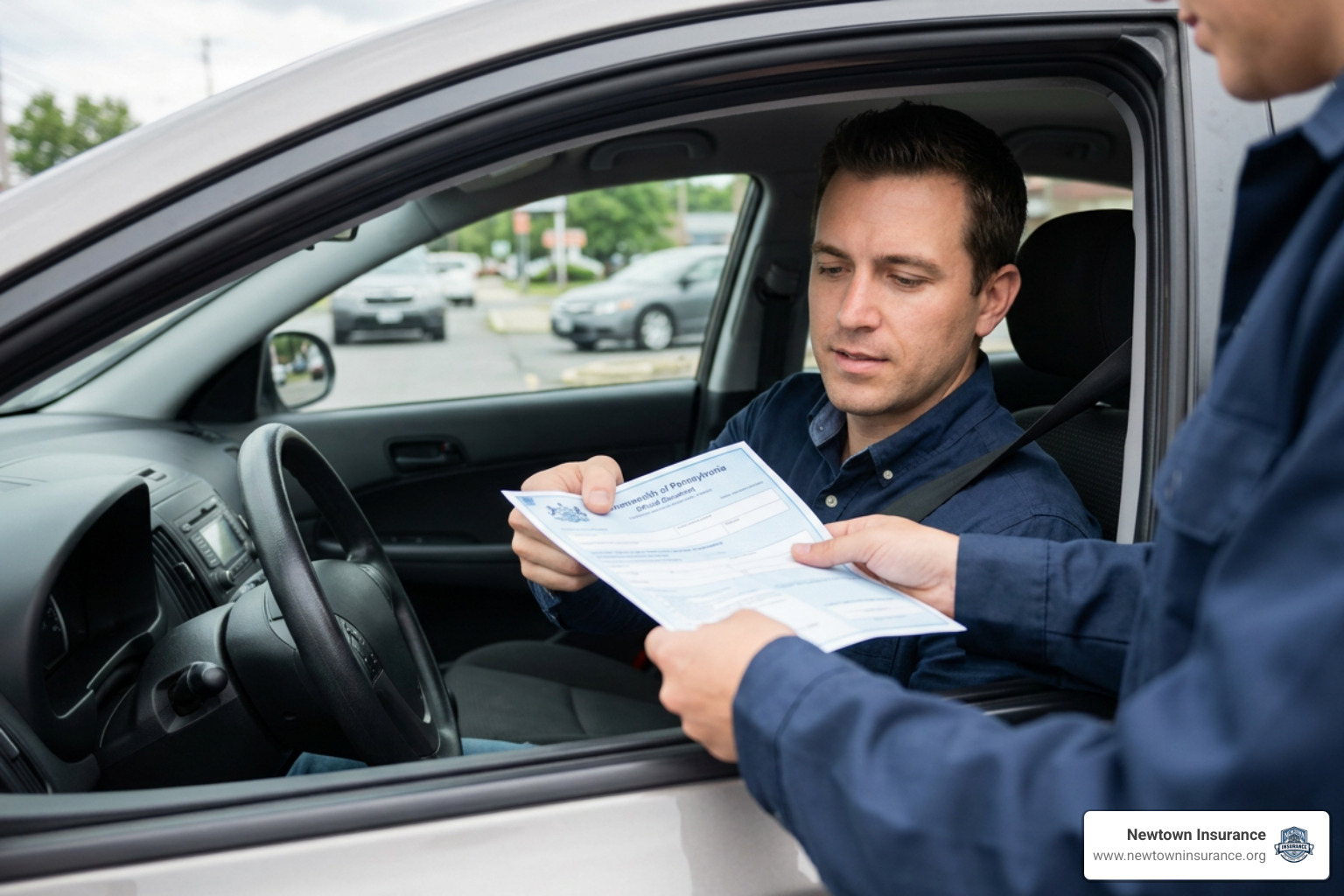
When you are pulled over by law enforcement, register a vehicle, or take your car in for its annual safety inspection, you must show valid proof of insurance.
PennDOT accepts several forms of documentation as proof of financial responsibility:
- A valid insurance identification card issued by your insurance company.
- The declaration page of your insurance policy.
- A valid insurance binder (a temporary insurance contract valid for 30 or 60 days).
- A copy of your application to the Pennsylvania Assigned Risk Plan (for high-risk drivers).
- An official letter from your insurance carrier on corporate letterhead, signed by an authorized representative.
If you are looking for ways to keep your coverage active without breaking the bank, take a look at our guide on securing Low Cost Auto Insurance PA.
Self-Insurance and Alternative Compliance Options
For most individuals, standard auto insurance is the only practical way to comply with the law. However, if you own a fleet of vehicles or have significant financial resources, you can apply to become a self-insurer.
To obtain a Certificate of Self-Insurance from PennDOT, you must submit an MV-219 application and meet strict financial requirements outlined in the Self-Insurance Package for an Individual.
To qualify, you must:
- Provide a complete balance sheet and income statement for your previous fiscal year.
- Deposit acceptable collateral with PennDOT. The minimum collateral is $50,000 for the first vehicle and $10,000 for each additional vehicle, up to a maximum of $1,000,000.
- Renew your self-insurance certificate annually by March 1.
If any of your collateral is withdrawn or falls below the required limits, you must replace it within 72 hours or risk having your self-insurance certificate canceled.
Frequently Asked Questions About PA Car Insurance
Navigating state insurance laws can raise plenty of questions. Here are some of the most common inquiries we receive from local drivers in Newtown, Pennsylvania.
What are the minimum auto insurance requirements in Pennsylvania?
Pennsylvania law requires all drivers to carry a minimum of $15,000 in bodily injury liability per person, $30,000 in bodily injury liability per accident, $5,000 in property damage liability, and $5,000 in First Party Benefits (PIP) medical coverage. You must also select a tort option (limited or full tort) when setting up your policy. To explore your options and see how these coverages fit into your budget, you can request Auto Insurance Quotes online.
What is the difference between full tort and limited tort?
The main difference lies in your right to sue an at-fault driver for non-monetary damages like pain and suffering. Limited tort reduces your monthly premium but prevents you from suing for pain and suffering unless your injuries are “serious” (such as permanent disfigurement or death). Full tort costs more but preserves your unrestricted right to seek compensation for all injuries, regardless of severity.
What happens if my car insurance lapses in PA?
If your insurance lapses, your insurance company will notify PennDOT. Unless you surrender your license plate within 30 days or prove the vehicle was not driven during a lapse of 30 days or less, PennDOT will suspend your vehicle registration and driver’s license for three months. You may also face a $300 fine and must pay restoration fees to get your driving privileges back.
Conclusion
Staying compliant with auto insurance requirements in Pennsylvania is about more than just avoiding a ticket from local police or a suspension letter from PennDOT. It is about protecting your family, your hard-earned savings, and your peace of mind every time you pull out of your driveway.
At Newtown Insurance, we believe that you shouldn’t have to overpay to get the protection you deserve. Located right here in Newtown, Pennsylvania, we specialize in providing tailored protection, smart savings, and transparent pricing. Our customer-first support team is always ready to help you navigate the complexities of tort options, liability limits, and PIP coverage so you can drive with confidence.
Don’t risk getting sidelined by an unexpected lapse or an underinsured accident. Get a tailored quote from Newtown Insurance today, and let us help you find the perfect balance of legal compliance and robust financial protection.