What You’re Actually Paying for Car Insurance in Pennsylvania
Car insurance rates in Pennsylvania vary more than most drivers realize — and that gap could mean hundreds of dollars a year in savings if you know where to look.
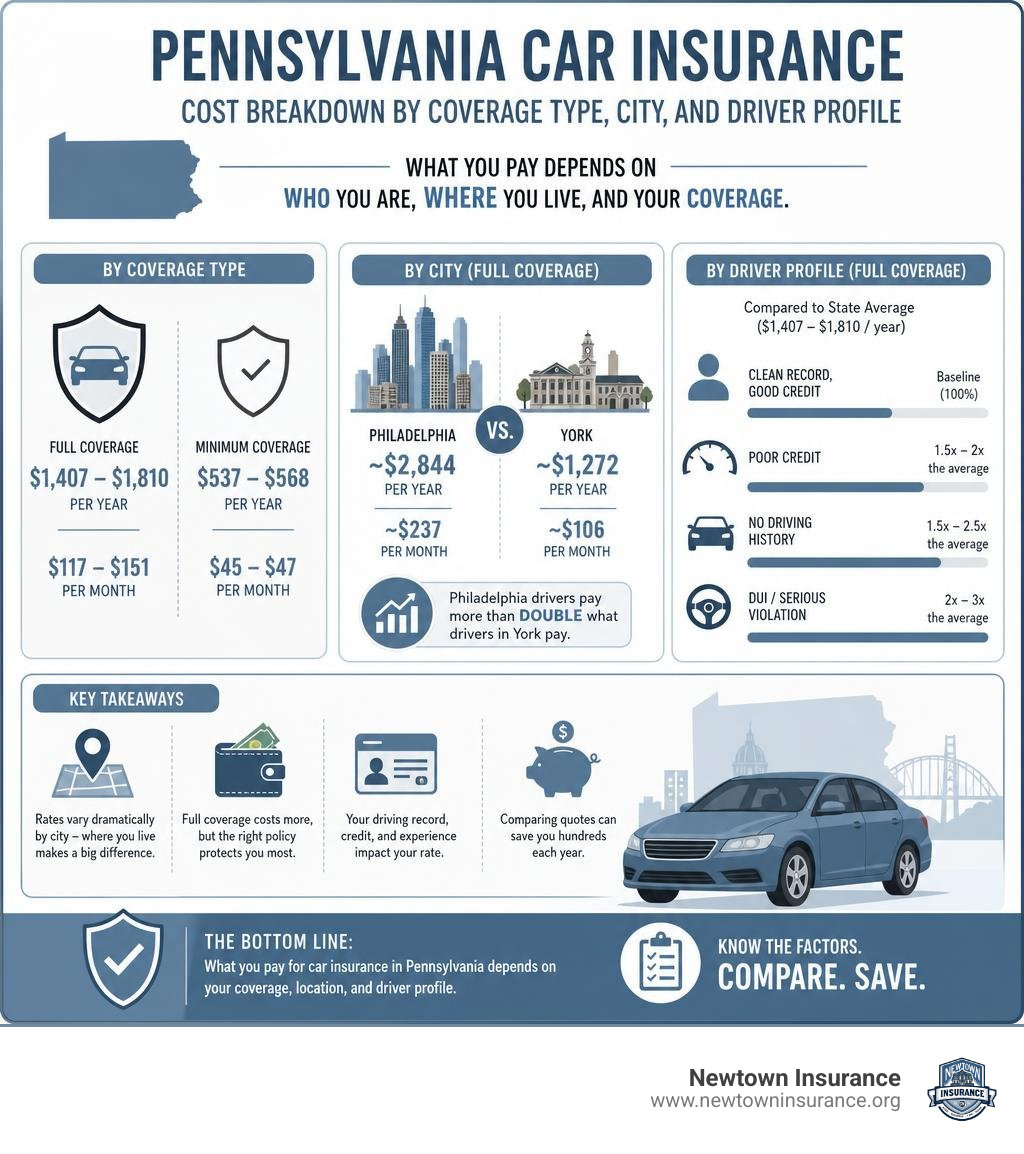
Here’s a quick snapshot of what Pennsylvania drivers pay on average in 2026:
| Coverage Type | Average Annual Cost | Average Monthly Cost |
|---|---|---|
| Full Coverage | $1,407 – $1,810 | $117 – $151 |
| Minimum Coverage | $537 – $568 | $45 – $47 |
| Philadelphia (Full) | ~$2,844 | ~$237 |
| York (Full) | ~$1,272 | ~$106 |
A few things stand out right away:
- Pennsylvania’s full coverage rates are slightly below the national average of around $124/month
- But rates swing wildly by city — Philadelphia drivers pay more than double what drivers in York pay
- The cheapest full coverage available in the state starts as low as $68/month, while the most expensive providers charge nearly twice that
- Drivers with a DUI, bad credit, or no driving history can pay two to three times the state average
The bottom line: what you pay depends heavily on who you are, where you live, and who you’re insured with — not just some statewide average.
I’m Shawn Beihl from Newtown Insurance, and with over 15 years of specialty insurance experience — including personal auto coverage across Pennsylvania — I’ve helped countless drivers understand exactly what’s driving their premiums up and how to bring those costs down. Whether you’re trying to make sense of car insurance rates in Pennsylvania for the first time or you’re ready to stop overpaying, this guide walks you through everything you need to know.
Understanding Car Insurance Rates in Pennsylvania
When looking at the average car insurance rates in Pennsylvania, the numbers can feel a bit like a moving target. Depending on which study you read, the statewide average for a standard full coverage policy in 2026 ranges from $1,407 to $2,258 annually.
Why is there such a massive spread? It comes down to how different organizations gather their data and the specific driver profiles they use. For example, some averages account for high-risk drivers with multiple violations, while others look strictly at 40-year-old drivers with spotless records. According to the Average Cost of Car Insurance in Pennsylvania for 2026 – Experian, the typical baseline for full coverage hover around $1,764 to $2,258 per year, which translates to roughly $147 to $188 per month.
To help you visualize what these different tiers look like, let’s break down the realistic averages for both minimum and full coverage across the state:
| Coverage Level | What It Includes | Average Annual Cost | Average Monthly Cost |
|---|---|---|---|
| Minimum Liability Only | State-mandated 15/30/5 liability limits plus $5,000 First-Party Medical Benefits. | $537 – $568 | $45 – $47 |
| Standard Full Coverage | 100/300/100 liability limits, $5,000 Medical Benefits, plus Collision and Comprehensive coverage with a $500 deductible. | $1,407 – $1,810 | $117 – $151 |
| Premium Protection | High liability limits (250/500/100), roadside assistance, rental car reimbursement, and low deductibles. | $2,258 – $3,002 | $188 – $250 |
Choosing between minimum and full coverage is about balancing immediate monthly savings with long-term financial security. While minimum coverage keeps your monthly bank statement happy, it leaves you entirely unprotected if your own car is damaged in a storm, hit-and-run, or single-vehicle accident. For a deeper look into structuring these coverages safely, check out our Personal Vehicle Insurance Guide 2026.
Pennsylvania’s Unique Insurance Laws and Requirements
Pennsylvania is not like most other states when it comes to auto insurance. The Keystone State operates under a unique legal framework designed to manage how accident claims are handled and litigated. If you are shopping for coverage here, you cannot simply look at the price tag; you have to understand the rules of the road that dictate how those policies pay out.

To navigate these laws successfully, you need to understand two major concepts: the state’s choice no-fault system and the mandatory coverages required to register a vehicle. For a comprehensive breakdown of basic auto insurance terms, you can read our Ultimate Auto Insurance Guide.
Limited Tort vs Full Tort: How Your Choice Impacts Car Insurance Rates in Pennsylvania
Pennsylvania is one of the few states that uses a “choice no-fault” system. When you purchase a policy, you must make a crucial legal decision: do you want Limited Tort or Full Tort?
- Limited Tort: Choosing this option typically saves you about 15% on your bodily injury liability premium. In exchange for this discount, you agree to limit your right to sue an at-fault driver for non-monetary damages, such as “pain and suffering,” unless your injuries meet a high legal threshold defined as “serious injury” (such as permanent impairment or disfigurement).
- Full Tort: This option costs more, but it preserves your unrestricted right to sue an at-fault driver for all damages, including pain and suffering, regardless of the severity of the injury.
Opting for limited tort is a very common way to secure a Low Cost Auto Insurance Pa, but it is a decision that should be made carefully before an accident occurs, as you cannot change your selection retroactively after a collision.
Mandatory Minimum Coverages and First-Party Benefits
To legally drive in Pennsylvania, the state requires you to carry specific minimum levels of insurance. According to the Pennsylvania Insurance Department Auto Insurance Guide, every registered driver must carry:
- Bodily Injury Liability: $15,000 per person / $30,000 per accident. This pays for medical bills and rehabilitation for other people if you cause an accident.
- Property Damage Liability: $5,000 per accident. This pays to repair or replace another person’s property (like their vehicle or a mailbox) damaged in an accident you caused.
- First-Party Medical Benefits (PIP): $5,000 minimum. Because Pennsylvania is a no-fault state for medical bills, this coverage pays for your own medical expenses after an accident, regardless of who caused it.
While these are the bare minimums, we almost always advise against driving with just 15/30/5 limits. If you cause an accident that totals a modern vehicle or results in emergency room visits for multiple people, a $5,000 property damage limit and $15,000 bodily injury limit will be exhausted almost instantly, leaving you personally liable for the remaining balance.
Key Factors That Influence Your Premium
Have you ever wondered why your neighbor pays significantly less for auto insurance than you do, even though you drive similar cars? Insurance carriers use complex, proprietary algorithms to evaluate risk, and even minor differences in your personal profile can cause your rates to shift.

Under the guidelines set by the Pennsylvania Insurance Department, carriers can use a variety of personal details to calculate your risk level. Let’s look at the primary factors that move the needle on your premium.
How Location and ZIP Codes Affect Car Insurance Rates in Pennsylvania
Where you park your car at night is one of the single most influential factors in determining your premium. Densely populated cities with high rates of traffic congestion, accidents, vehicle thefts, and litigation naturally command much higher rates than quiet, rural towns.
- Philadelphia: Drivers in Philly pay some of the highest rates in the state, averaging $2,844 to $2,981 annually for full coverage. This is driven by dense urban traffic, higher rates of uninsured motorists, and elevated vandalism statistics. If you live in or near the city, finding Affordable Car Insurance Philadelphia requires careful shopping and maximizing local discounts.
- Reading: Rates in Reading are moderate compared to Philadelphia but still reflect urban driving risks. You can read more about local options in our guide to Car Insurance Reading Pa.
- Newtown: If you live near our home base, you will find that suburban areas enjoy much lower averages due to lower accident frequencies. Learn more about local pricing trends in our article on Newtown Car Insurance Rates.
- York: On the other end of the spectrum, York drivers enjoy some of the lowest rates in the state, averaging around $106 per month ($1,272 per year) for full coverage due to lower traffic density and fewer claims.
The Impact of Age, Credit Score, and Driving History
Aside from location, your personal history and demographic profile play a massive role in what you pay:
- Age: Teen drivers represent the highest risk group for insurers. A 16-year-old added to a family policy in Pennsylvania costs an average of $336 per month for full coverage. Rates drop significantly as drivers gain experience, particularly at ages 19 and 25. Interestingly, Pennsylvania law prohibits insurance companies from considering gender when setting rates, meaning young male and female drivers with identical records will see the same base pricing.
- Credit Score: Pennsylvania allows insurers to use credit-based insurance scores to price policies. The difference is stark: drivers with poor credit pay an average of $217 per month for full coverage, compared to just $117 per month for those with good credit. However, state law protects you by preventing insurers from using your credit score to raise your premiums at renewal—they can only use it to grant you a discount at inception or lower your rates later.
- Driving History: Tickets, accidents, and serious violations will cause your rates to skyrocket. A single speeding ticket can increase your premium by 13% to 22%. An at-fault accident can raise rates by 41%, while a DUI conviction in Pennsylvania is particularly devastating, increasing full coverage premiums by an average of 105% (from $108 to $221 per month).
To see how these rates compare and how to navigate quotes when you have various marks on your record, consult our Compare Insurance Quotes Complete Guide.
Actionable Strategies to Lower Your Insurance Costs
You do not have to accept high insurance bills as an unchangeable fact of life. There are several highly effective, practical steps you can take to immediately reduce what you pay for auto coverage.
First, consider raising your deductibles. If you currently have a $250 or $500 deductible for collision and comprehensive coverage, raising it to $1,000 can save you between $272 and $453 per year on your premium. Just make sure you keep that deductible amount set aside in an emergency fund so you can cover it if you ever need to file a claim.
Second, make a habit of shopping around. Rates change constantly as insurance companies adjust their underwriting models. For more smart strategies, read our guides on Tips For Saving Money On Insurance and Moneysaving Car Insurance.
Leveraging Discounts and Bundling Opportunities
One of the easiest ways to slash your premium is by taking advantage of the discounts carriers already offer. Here are some of the most lucrative discounts you should ask about:
- Multi-Policy (Bundling): Combining your auto insurance with your homeowners, renters, or condo insurance is the single most effective discount available, often saving you 5% to 25% across both policies. Learn how this works in our guide on the Auto And Home Bundle.
- Safe Driver Programs (Telematics): Many carriers now offer usage-based programs that track your driving habits (like braking, speed, and mileage) via a smartphone app. Safe drivers can save up to 30% by proving their good habits.
- Defensive Driving Courses: Pennsylvania law mandates that insurers provide at least a 5% discount to drivers aged 55 and older who complete an approved mature driver improvement course.
- Anti-Theft Devices: If your car is equipped with active or passive anti-theft systems, vehicle tracking devices, or recovery systems, you can qualify for specialized discounts. Check out our post on the Anti Theft Discount Auto Insurance.
- Paperless & Autopay: Signing up for electronic policy delivery and automatic monthly bank drafts can instantly knock a few dollars off your monthly bill.
For a comprehensive list of opportunities to save, check out our article on 6 Car Insurance Discounts You Should Ask About.
Frequently Asked Questions about Pennsylvania Auto Insurance
What are the penalties for driving without insurance in Pennsylvania?
Driving without insurance in Pennsylvania is a serious offense with severe financial and legal consequences. If you are caught driving without valid coverage, you face:
- A minimum fine of $300.
- A mandatory three-month suspension of your driver’s license.
- A mandatory three-month suspension of your vehicle’s registration.
- Fees to reinstate your license and registration once the suspension period ends.
If your coverage lapses for more than 30 days, PennDOT will automatically suspend your registration. However, under state law, if you have a lapse of 30 days or less and can prove the vehicle was not driven during that time, you may avoid suspension. Additionally, you may pay a $500 civil penalty in lieu of the registration suspension once every 12 months to keep your license plates active. To learn more about avoiding hidden costs and maintaining continuous coverage, read our guide on No Hidden Fee Insurance.
Why is car insurance in Pennsylvania so expensive compared to other states?
While Pennsylvania’s statewide average is actually slightly below the national average, certain areas and profiles face incredibly high costs. The primary drivers of these high rates include:
- The No-Fault System: Because every driver is required to carry Personal Injury Protection (PIP) to cover their own medical bills, insurance companies must pay out medical claims quickly after an accident, regardless of who caused it. This increases the baseline expense for carriers.
- Uninsured Drivers: Around 8.9% of drivers in Pennsylvania operate without insurance. This forces insured drivers to carry higher limits and drives up the cost of Uninsured/Underinsured Motorist coverage.
- Severe Weather: Pennsylvania experiences harsh winters, freeze-thaw cycles that cause severe potholes, and localized flooding. These environmental hazards lead to a high volume of comprehensive and collision claims.
If you are looking for coverage in areas prone to high rates, check out our regional guide on Auto Insurance Scranton Pa.
How often should I compare car insurance quotes?
We recommend reviewing your insurance coverage and comparing rates at least once a year, or whenever you experience a major life milestone. Excellent times to shop around include:
- When you move to a new ZIP code.
- When you buy a new vehicle or remove a vehicle from your policy.
- When a teen driver in your household turns 19 or 25 (the ages where rates drop most significantly).
- After a speeding ticket or minor accident falls off your record (typically after three years).
- When your credit score improves significantly.
If you want to explore rates without having your phone ring off the hook with sales calls, read our Car Insurance Quote No Personal Info Guide.
Conclusion
Finding car insurance rates in Pennsylvania that fit your budget doesn’t mean you have to settle for bare-minimum coverage that leaves you vulnerable. By understanding the state’s unique laws, knowing how your personal profile affects your rates, and actively seeking out discounts, you can secure robust protection at a price that makes sense.
At Newtown Insurance, we believe in providing tailored protection, smart savings, and completely transparent pricing. We take a customer-first approach to ensure you never pay for coverage you don’t need, while protecting what matters most.
Ready to see how much you could save on your Pennsylvania auto policy? Get a quote from Newtown Insurance today, and let our local experts build the perfect policy for you.