

Pennsylvania Business Insurance 101: Protect Your Passion
Why Business Insurance in Pennsylvania Matters for Small Business Owners
Business insurance in Pennsylvania is something every business owner in the state needs to understand — whether you're just starting out or have been running your company for years.
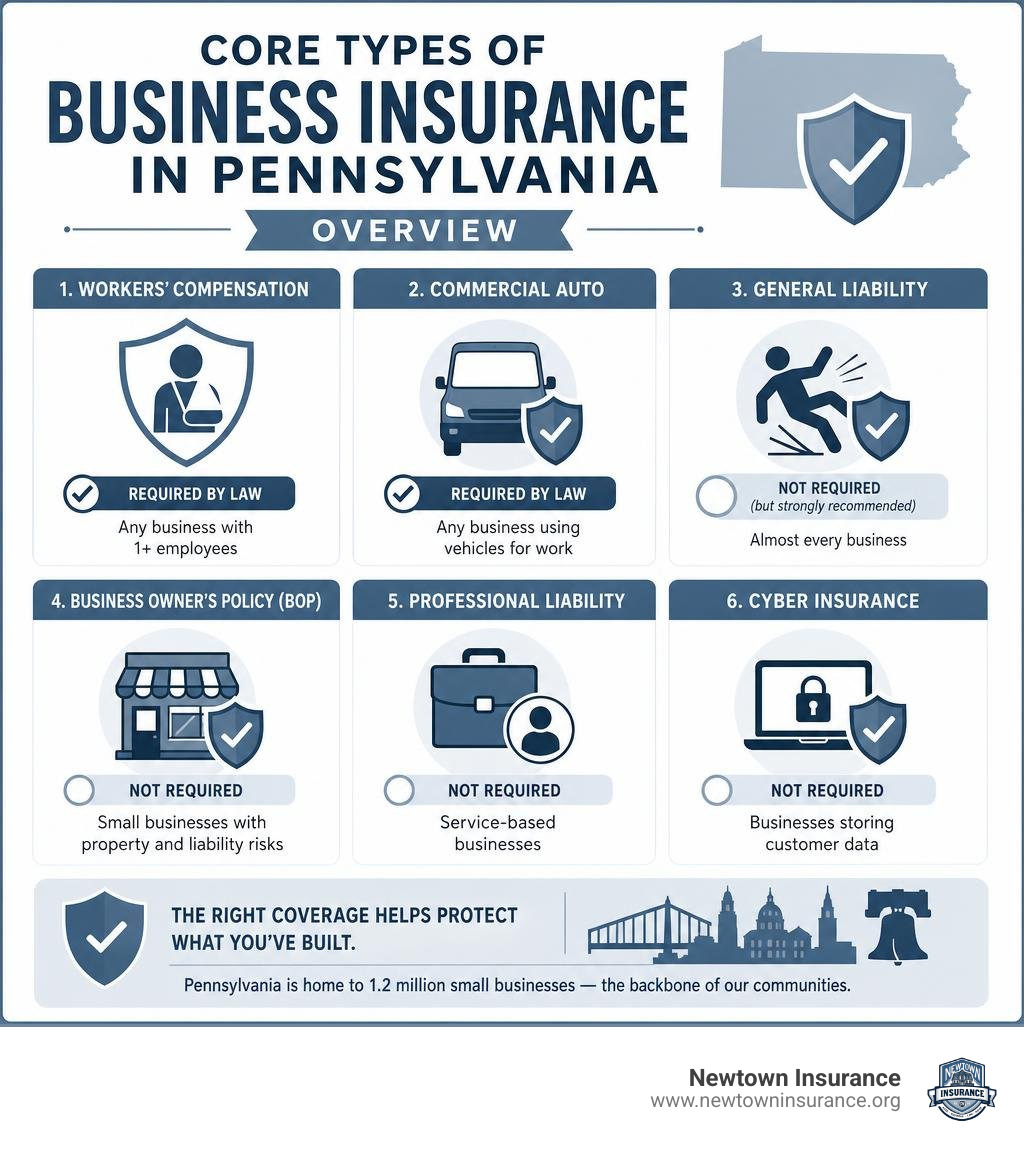
Here's a quick overview of what Pennsylvania businesses need to know:
| Coverage Type | Required by Law? | Who Needs It |
|---|---|---|
| Workers' Compensation | Yes | Any business with 1+ employees |
| Commercial Auto | Yes | Any business using vehicles for work |
| General Liability | No (but strongly recommended) | Almost every business |
| Business Owner's Policy (BOP) | No | Small businesses with property and liability risks |
| Professional Liability | No | Service-based businesses |
| Cyber Insurance | No | Businesses storing customer data |
Pennsylvania is home to 1.2 million small businesses — that's 99.6% of all companies in the state — employing 2.5 million people as of June 2026. From a Philadelphia bakery to a Pittsburgh contractor, the risks these businesses face every day are real. A customer slip, a vehicle accident, a workplace injury — any one of these can cost tens of thousands of dollars out of pocket without the right coverage.
That's exactly why getting the right protection matters, and why understanding your options is the first step.
I'm Shawn Beihl from Newtown Insurance, and with over 15 years of experience in commercial P&C and specialty insurance, I've helped countless Pennsylvania business owners cut through the confusion around business insurance in Pennsylvania to find coverage that actually fits their needs and budget. In this guide, I'll walk you through everything you need to know — from legal requirements to cost-saving strategies.
What Business Insurance is Required by Law in Pennsylvania?
When you start a business in the Keystone State, one of your very first questions should be: What do I legally have to carry?
While it is tempting to skip insurance to keep your startup costs low, Pennsylvania state mandates are strict. Failing to carry legally required coverage can result in severe financial penalties, lawsuits, and even the forced closure of your business.
Let's break down the two primary coverages that Pennsylvania law mandates for employers and vehicle operators.
Workers' Compensation Insurance Requirements
If you employ at least one person in Pennsylvania-whether they are full-time, part-time, or even seasonal-you are legally required to carry workers' compensation insurance. For official state guidance, the Pennsylvania Department of Labor & Industry provides a helpful overview of workers' compensation in Pennsylvania.
This mandate exists for a vital reason. In 2023, the Bureau of Labor Statistics reported 115,200 non-fatal workplace injuries and illnesses in Pennsylvania alone. Whether you run a bustling restaurant in Bucks County or a quiet professional office, accidents happen. Workers' comp protects both you and your team by covering:
- Medical bills resulting from work-related injuries or illnesses.
- Lost wages while the employee recovers.
- Legal fees if an injured worker decides to sue (though workers' comp generally prevents employees from suing for damages in exchange for these guaranteed benefits).
Are there exemptions? Yes, but they are narrow. Executive officers of a corporation can sometimes officially opt out of coverage under specific conditions, and certain domestic or agricultural workers may be exempt. However, for the vast majority of businesses, if you have payroll, you need workers' comp.
To learn more about how this applies to specific physical trades, take a look at our contractor insurance pennsylvania guide.
Commercial Auto Insurance Minimums
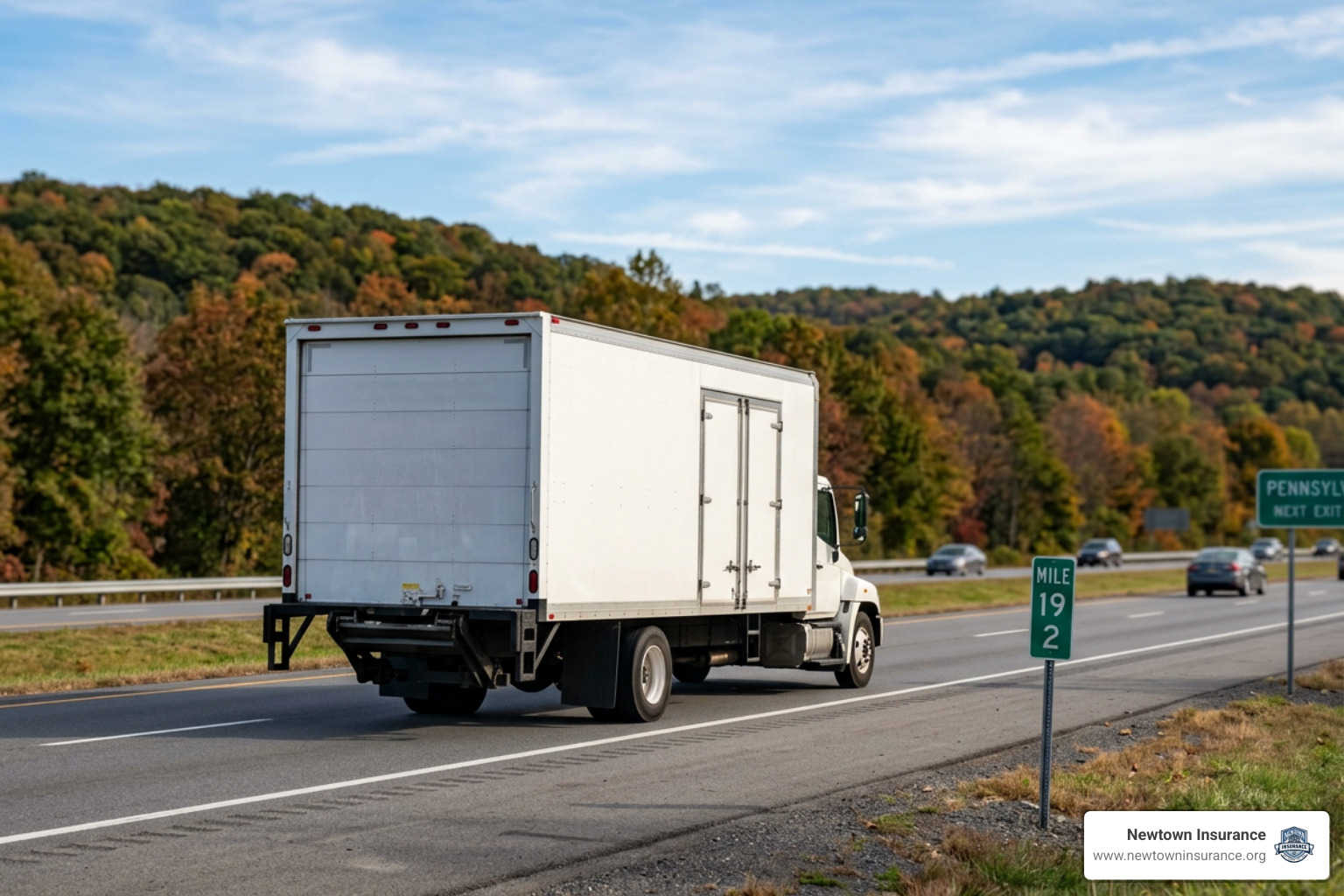
If your business owns vehicles, or if you or your employees drive personal vehicles for business-related tasks, you must comply with Pennsylvania's commercial auto insurance requirements.
Do not make the mistake of assuming your personal auto policy has you covered. If you are driving to a client meeting, delivering goods, or hauling tools, a personal auto policy will almost certainly deny any claim that occurs during business use.
To legally operate a commercial vehicle in Pennsylvania, your policy must meet or exceed the state's minimum liability requirements:
- Bodily Injury Liability: $15,000 per person / $30,000 per accident
- Property Damage Liability: $5,000 per accident
While these are the bare minimums required to get your vehicle registered, they are incredibly low. If your commercial truck rear-ends a luxury sedan or causes a multi-car pileup, $5,000 in property damage coverage will be gone in the blink of an eye, leaving your business liable for the remaining balance. We always recommend carrying significantly higher limits to keep your assets secure.
Recommended Business Insurance in Pennsylvania for Small Businesses
Beyond what is legally required, there is a suite of coverages that form the bedrock of any smart risk management strategy. These policies protect your physical assets, your intellectual property, and your financial stability against third-party lawsuits.
General Liability as Essential Business Insurance in Pennsylvania
If there is one policy that every single business owner should have from day one, it is general liability insurance. Often referred to as commercial general liability (CGL), this coverage protects your business from financial ruin if you are accused of causing bodily injury, property damage, or personal/advertising injury (like libel or copyright infringement).
Imagine a customer slips on a wet floor in your Newtown retail shop and breaks their wrist. Or suppose you are a painter, and you accidentally knock over an expensive antique vase while working in a client's home. General liability covers:
- The injured party's medical expenses.
- Repair or replacement costs for damaged property.
- Legal defense costs, court fees, and settlements if the case goes to court.
To dive deeper into how this coverage operates across the state, read our guide on liability insurance pa.
Business Owner's Policy (BOP)
For many small to medium-sized businesses, purchasing individual insurance policies can get expensive and disorganized. That is where a Business Owner’s Policy (BOP) comes in.
A BOP is a bundled insurance package designed specifically for smaller, low-to-moderate-risk businesses. It typically combines three essential coverages into one convenient, discounted policy:
- General Liability Insurance: Protects against third-party bodily injury and property damage.
- Commercial Property Insurance: Protects your physical building, equipment, inventory, and furniture from perils like fire, windstorms, theft, and vandalism.
- Business Interruption Insurance: If a covered disaster (like a fire) forces you to temporarily close your doors, this covers your lost income, rent, and payroll so you can survive the rebuild.
Bundling these coverages can save you 15% to 25% compared to buying them separately. For a detailed breakdown of what these packages look like, explore our resource on business insurance coverage.
Professional Liability and Cyber Insurance
As our economy becomes increasingly service-oriented and digital, physical risks are no longer the only threats to your bottom line.
- Professional Liability (Errors & Omissions): If your business provides advice, designs, or professional services (such as accountants, consultants, real estate agents, or IT specialists), you can be sued if a client claims your mistake or negligence caused them financial harm. Professional liability covers your legal defense and any damages awarded, even if the claim against you is completely groundless.
- Cyber Insurance: In June 2026, cyber threats are more sophisticated than ever. If your business stores sensitive customer data—such as credit card numbers, medical records, or social security numbers—you are a prime target for hackers. Cyber insurance helps cover the massive costs of data breach notifications, credit monitoring services, forensic investigations, and regulatory fines.
Understanding Pennsylvania Small Business Definitions and Health Care Tax Credits
Navigating state regulations regarding employee benefits can be a headache, but understanding how Pennsylvania defines a small business can open doors to valuable tax incentives.
Defining Small Business for Business Insurance in Pennsylvania
For health insurance and employee benefit purposes, Pennsylvania defines a small business as an entity with 50 or fewer full-time equivalent (FTE) employees.
If your business falls under this threshold, you are not legally mandated by the federal Affordable Care Act to provide health insurance to your employees. However, offering health benefits is one of the most effective ways to attract and retain top talent in a competitive job market.
To explore your options for setting up a group plan, check out our guide on pennsylvania small business health insurance.
Qualifying for the Small Business Health Care Tax Credit
To help small businesses afford the cost of providing health coverage, the federal government offers the Small Business Health Care Tax Credit. If you qualify, this credit can be worth up to 50 percent of your contribution toward your employees' premiums for two consecutive tax years.
To qualify for this tax credit in Pennsylvania, your business must meet the following criteria:
- Have fewer than 25 full-time equivalent employees.
- Pay an average annual salary of roughly $50,000 or less per employee.
- Offer health insurance coverage through the SHOP (Small Business Health Options Program) Marketplace.
- Pay at least 50 percent of the premium costs for your full-time employees.
This tax credit can make a massive difference in your annual overhead, turning what seemed like an impossible benefit expense into a highly manageable business write-off.
How Much Does Business Insurance Cost in Pennsylvania?
Now let's talk about the bottom line: What is this going to cost me?
While every business is unique, understanding average costs and the factors that influence your premiums can help you budget effectively and find affordable business insurance.
Average Cost of General Liability Insurance
Pennsylvania small business owners pay an average annual premium of $885 for general liability insurance—which breaks down to a highly affordable $74 a month.
Of course, this is just an average. On a national scale, median costs can range from $50 per month for a basic professional liability policy to $80 per month for a standard Business Owner's Policy (BOP). Your actual cost will depend heavily on your specific risk profile.
Key Factors Affecting Your Premium
Insurance companies determine your premium rates by calculating the likelihood that you will file a claim. The primary factors that influence your cost include:
- Your Industry & Risk Exposure: A tree removal service faces far greater physical risks than a graphic designer working from a home office in Newtown. High-risk industries pay higher premiums.
- Annual Revenue & Payroll: Higher revenue and payroll numbers generally indicate a larger volume of work and more employees, which increases the overall statistical risk of an accident occurring.
- Claims History: A clean track record with zero past claims will earn you preferred pricing. Conversely, a history of frequent claims will label your business as high-risk.
- Your Location: Operating in a high-traffic urban area like Philadelphia or Pittsburgh may result in slightly higher premiums than operating in a quieter suburban area like Newtown, due to localized risk variations.
Here is a general look at how risk levels correspond to estimated premium ranges:
| Risk Level | Typical Industries | Estimated Annual Premium Range (General Liability) |
|---|---|---|
| Low Risk | Consultants, IT Professionals, Photographers | $400 – $650 |
| Moderate Risk | Retail Stores, Hair Salons, Restaurants | $700 – $1,200 |
| High Risk | General Contractors, Landscapers, Roofers | $1,500 – $3,500+ |
Frequently Asked Questions About Business Insurance in Pennsylvania
We hear many of the same questions from local business owners navigating the insurance marketplace. Here are clear, straightforward answers to help you make informed decisions.
Is general liability insurance required in Pennsylvania?
No, Pennsylvania state law does not mandate general liability insurance for most businesses. However, in the real world, you will find that it is practically required to operate.
Commercial landlords will almost always require proof of general liability before letting you sign a lease. Similarly, corporate clients, government entities, and general contractors will require a Certificate of Insurance (COI) before allowing you to step foot on a job site or sign a service contract.
For a complete look at how different coverages interact across the state, read our insurance pennsylvania complete guide.
How can Pennsylvania business owners get a quote?
Getting a quote is simple, but it requires a bit of preparation. To get the most accurate pricing, follow these steps:
- Assess Your Needs: Determine what physical assets you need to protect and what risks your specific industry faces.
- Gather Your Information: Have your business address, estimated annual revenue, payroll details, employee count, and any claims history ready.
- Compare Quotes: Reach out to a licensed independent agent who can shop your information across multiple highly rated insurance companies pennsylvania to find the best rates.
If you are ready to see what customized coverage looks like for your business, you can connect directly with us at the Newtown Insurance contact page.
What is the difference between general liability and professional liability?
This is one of the most common points of confusion for new business owners. The simplest way to remember the difference is:
- General Liability covers physical incidents. Think of bodily injuries (slips and falls) or physical property damage (breaking a client's window).
- Professional Liability covers financial incidents. Think of errors, omissions, missed deadlines, or professional negligence that cause your client to lose money, even if no physical damage occurred.
Most service-based businesses require both policies to be fully protected.
Conclusion
Building a business in Pennsylvania takes immense dedication, hard work, and passion. But all of that effort can be wiped away in an instant by a single uncovered lawsuit or property disaster.
At Newtown Insurance, we believe that protecting your life's work shouldn't be confusing or break the bank. We are committed to providing Pennsylvania business owners with tailored protection, smart savings, and completely transparent pricing. Our customer-first support is designed to ensure you get the exact coverage you need, without ever overpaying for things you don't.
Let us handle the risk so you can focus on what you do best: growing your business.
Ready to secure your peace of mind? Get a Quote with Newtown Insurance Today and let's build a policy that protects your passion.