

Gap Insurance Pennsylvania Explained for New Car Owners
Why Gap Insurance in Pennsylvania Can Save You Thousands
Gap insurance Pennsylvania drivers need works like a financial safety net — and most new car owners don't know they need it until it's too late.
Here's the quick answer:
What is GAP insurance in Pennsylvania?
- GAP (Guaranteed Asset Protection) insurance covers the difference between what your car is worth and what you still owe on your loan or lease if your vehicle is totaled or stolen
- Standard auto insurance only pays the actual cash value of your car — not your remaining loan balance
- Cars can lose 10–20% of their value in the first year alone, meaning you can quickly owe more than the car is worth
- GAP insurance is not required by Pennsylvania law, but lenders and leasing companies often require it
- It is most affordable when added to an existing auto policy — as little as $20–$60 per year — versus $500–$700 through a dealership
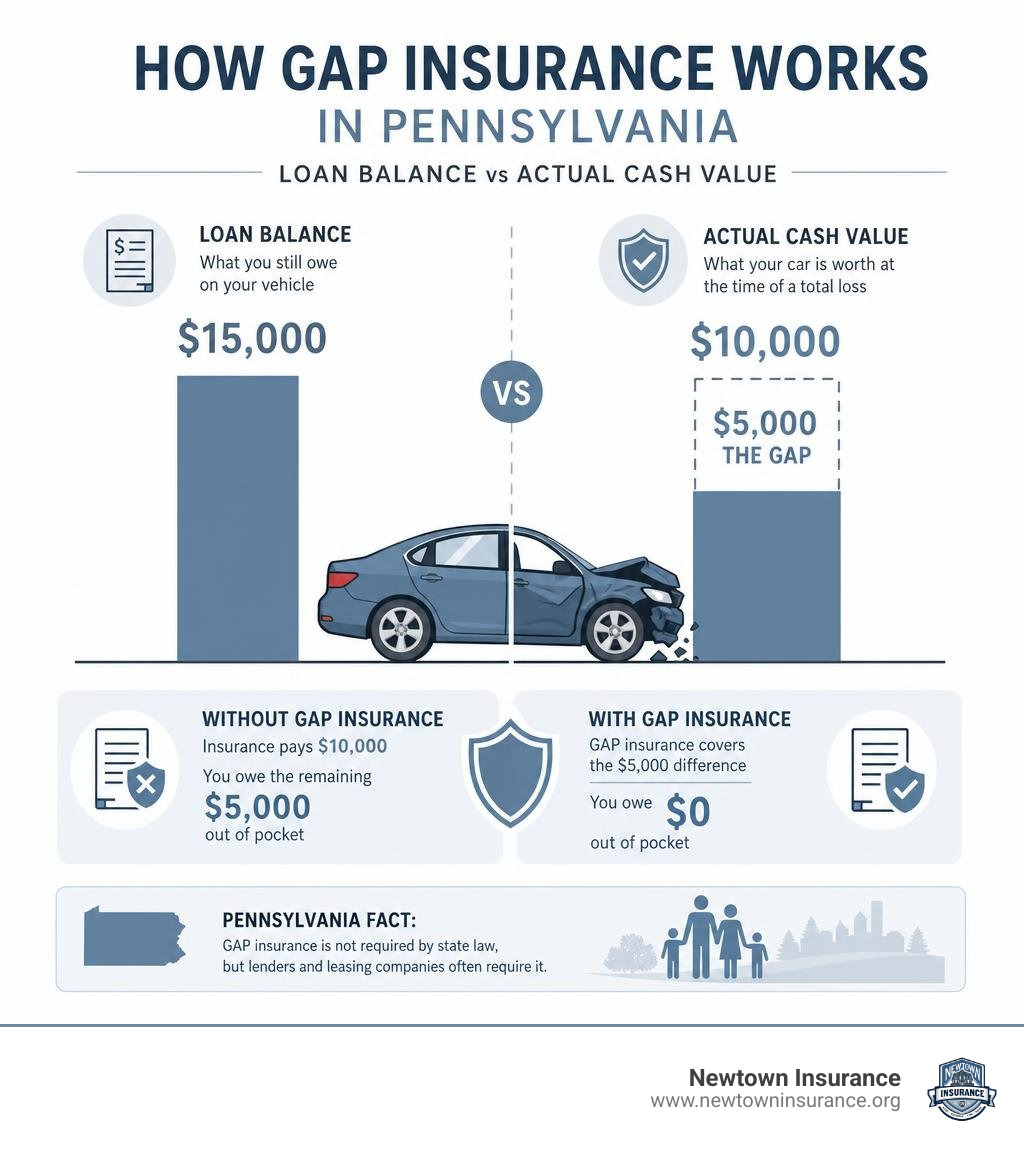
Here's a simple example of why this matters:
| Scenario | Amount |
|---|---|
| Your loan balance after one year | $15,000 |
| Your car's actual cash value | $10,000 |
| Standard insurance payout | $10,000 |
| Amount you still owe out of pocket | $5,000 |
| What GAP insurance covers | $5,000 |
That $5,000 shortfall is real — and without GAP coverage, it comes straight out of your pocket.
I'm Shawn Beihl from Newtown Insurance, and with over 15 years of specialty insurance experience, I've helped countless Pennsylvania drivers understand the risks of underinsurance — including the often-overlooked need for gap insurance in Pennsylvania. Let's walk through everything you need to know to make a smart, informed decision.
What is GAP Insurance and How Does It Work?
To understand Guaranteed Asset Protection (GAP) insurance, we first have to look at how standard auto insurance claims are paid. When you purchase a comprehensive and collision policy, your insurer is not agreeing to pay off your auto loan if your vehicle is destroyed. Instead, they agree to pay you the actual cash value (ACV) of the vehicle at the exact moment of the loss.
Actual cash value is the fair market value of your vehicle, taking into account its age, mileage, wear and tear, and local market conditions.
The problem is that car values depreciate rapidly, while loan balances decrease slowly. This difference between what you owe and what the car is worth is where the "gap" lives. If your vehicle is declared a total loss after an accident, or if it is a victim of vehicle theft and never recovered, standard insurance leaves you holding the bill for the remaining loan balance. GAP insurance step in to pay that remaining balance, ensuring you aren't paying for a "ghost car" that you can no longer drive.
Understanding the "Gap" Scenario
Let’s look at how the gap naturally occurs. This is primarily driven by two competing financial timelines: the vehicle’s depreciation rate and your loan amortization schedule.
When you buy a brand-new car, it depreciates the moment you drive it off the lot. On average, a new vehicle loses 10% of its value immediately and another 10% by the end of its first year. Some vehicles, particularly electric vehicles (EVs) or high-end luxury cars, can depreciate even faster.
Meanwhile, your loan amortization schedule is structured so that your early monthly payments go heavily toward interest rather than the principal balance. This means your loan balance decreases slowly while your car's value drops like a stone.
This intersection of rapid depreciation and slow amortization creates negative equity, often referred to as being "underwater" or "upside-down" on your loan. Your loan-to-value (LTV) ratio exceeds 100%, meaning you owe more than 100% of the car's current market value.
For a deeper dive into how car valuation and standard policies interact in our state, check out our comprehensive Pennsylvania Auto Insurance Guide 2026.
Who Needs Gap Insurance Pennsylvania?
Not every driver in the Keystone State needs to purchase gap insurance Pennsylvania policies. If you made a large down payment (20% or more), your loan balance is likely already lower than the vehicle's market value, meaning you are not underwater.
However, we highly recommend GAP insurance if you fall into any of the following categories:
- You are leasing the vehicle: Almost all lease agreements require GAP insurance because leasing inherently keeps you underwater for the duration of the lease.
- You made a low down payment: If you put down less than 20% (or nothing at all), you will immediately have negative equity.
- You signed a long-term loan: Financing terms of 60, 72, or 84 months mean you will be paying off the principal balance very slowly, extending the time you remain underwater.
- You rolled over negative equity: If you traded in a previous car and rolled what you still owed on it into your new loan, your starting loan balance is artificially high.
- You bought a vehicle that depreciates rapidly: Electric vehicles, luxury sedans, and certain SUVs depreciate much faster than compact cars or popular trucks.
- You drive high annual mileages: Putting miles on your car faster than average accelerates its depreciation, widening the gap.
If you are financing a vehicle, your lender will also require you to carry full coverage insurance. You can read more about these requirements in our guide to Auto Insurance Requirements in Pennsylvania.
How Much Does Gap Insurance Pennsylvania Cost?
The cost of gap insurance Pennsylvania drivers pay varies dramatically based on where and how you purchase the coverage.
If you buy GAP insurance from a car dealership or directly from your lender, it is typically charged as a flat fee ranging from $500 to $700. This fee is often rolled directly into your auto loan, meaning you will also pay interest on your GAP insurance policy over the life of the loan.
Conversely, if you add GAP insurance as an endorsement to your existing auto insurance policy, it is incredibly inexpensive. It typically costs only $20 to $60 per year (which breaks down to just a few dollars a month).
To give you an idea of the broader insurance landscape, the average cost of a full coverage policy in Pennsylvania in July 2026 is around $2,472 annually, with average rates varying by carrier and location. For example, Philadelphia drivers face the highest average rates at $3,961 per year due to dense traffic and higher claim rates, while Pittsburgh drivers enjoy lower average rates around $2,182 per year.
The table below outlines the cost differences between purchasing GAP insurance through different channels:
Gap Insurance Cost Comparison by Provider Type
| Provider Type | Average Annual Cost | Total Cost (Over 3 Years) | Payment Method |
|---|---|---|---|
| Auto Insurance Carrier (Add-on) | $20 – $60 | $60 – $180 | Added to monthly/annual premium |
| Credit Union / Lender | $100 – $200 | $300 – $600 | Flat fee or rolled into loan |
| Car Dealership | $160 – $230 | $500 – $700 | Rolled into loan (accrues interest) |
As you can see, buying coverage from your insurance company is by far the most cost-effective option. You can learn more about managing your overall insurance costs in our Car Insurance Rates Pennsylvania Guide 2026.
Where to Buy Gap Insurance Pennsylvania
When looking to secure this vital protection, Pennsylvania drivers have three main avenues:
- Auto Insurance Carriers: This is almost always the best option. Many major insurance companies offer "loan/lease gap coverage" as an add-on to your comprehensive and collision policy. However, keep in mind that some carriers place limits on their coverage. For example, some insurers cap their GAP payout at 25% of the vehicle’s actual cash value.
- Credit Unions and Banks: If your insurance company doesn’t offer GAP coverage, or if you prefer a standalone policy, credit unions often offer standalone GAP policies at much more reasonable rates than dealerships.
- Local Independent Insurance Agents: Working with local agents allows you to shop multiple carriers simultaneously to find the best deal. An independent agent can help you compare rates and find tailored coverage that fits your budget and needs.
Pennsylvania Laws and Insurance Requirements
Before diving into how GAP claims are processed, it's important to understand the regulatory environment in Pennsylvania.
Pennsylvania operates under a choice no-fault system (governed by 75 Pa.C.S. § 1705). This means that when you purchase auto insurance in the state, you must choose between two tort options:
- Limited Tort: This option limits your right to sue for pain and suffering unless your injuries meet the state's definition of "serious injury" (such as permanent disfigurement or death). Choosing limited tort saves you money on your monthly premiums.
- Full Tort: This option preserves your unrestricted right to sue negligent drivers for pain and suffering, regardless of the severity of the injury. It comes with higher premium costs.
Additionally, Pennsylvania requires all drivers to maintain minimum liability limits of 15/30/5:
- $15,000 for bodily injury per person
- $30,000 for bodily injury per accident
- $5,000 for property damage
Drivers must also carry at least $5,000 in first-party medical benefits. For a comprehensive breakdown of these state-mandated coverages, refer to our guide on Liability Insurance PA.
While traditional insurance is standard, some individuals or businesses with large fleets choose to self-insure. To understand how this works under state law, you can review the official Self-Insurance Package for an Individual from PennDOT, which outlines the strict collateral and reporting requirements required to qualify.
While Pennsylvania law strictly regulates liability and tort choices, GAP insurance is entirely optional under state law. The state does not require you to carry it, but your financial lender or leasing company almost certainly will as a condition of your financial agreement.
Is GAP Coverage Subject to Sales Tax in PA?
A common point of confusion for Pennsylvania car buyers is whether GAP insurance is subject to state sales tax. The answer depends entirely on how you are acquiring the vehicle:
- Vehicle Leases: If you purchase GAP insurance in conjunction with a vehicle lease, the GAP coverage is subject to PA sales tax. Under Pennsylvania tax code, the definition of a lease payment includes insurance charges rolled into the lease, making them taxable.
- Straight Sales (Financed Purchases): If you buy GAP insurance in conjunction with a straight purchase of a vehicle (financing a purchase), the GAP coverage is nontaxable.
For official verification of these tax guidelines, you can refer to the Pennsylvania Department of Revenue's page on Is GAP coverage subject to sales tax in PA? .
How to File a GAP Insurance Claim in Pennsylvania
Filing a GAP claim can feel overwhelming, especially right after your car has been totaled or stolen. However, the process is straightforward if you take it step-by-step.
Step-by-Step GAP Claim Process

- File Your Primary Claim: Immediately contact your primary auto insurance provider to report the accident or theft. They will assign an adjuster to evaluate the vehicle.
- Obtain the Total Loss Settlement: Once your primary insurer determines the vehicle is a total loss, they will calculate its Actual Cash Value (ACV) and issue a settlement offer.
- Notify Your GAP Provider: Do not wait for the primary claim to close before contacting your GAP insurer. Alert them as soon as it looks like the vehicle will be totaled.
- Gather Documentation: Collect all required paperwork from your lender, primary insurer, and the police.
- Submit the Claim Package: Send all documentation to your GAP provider.
- Lender Payoff: The GAP provider will review the documents and send a check directly to your lender to clear the remaining balance.
To help you get organized, here is the exact list of documents you will need to gather:
- The Police Report: Essential for verifying the details of the accident or theft.
- Primary Insurance Settlement Letter: Showing the exact ACV payout and your deductible amount.
- Insurance Valuation Report: The detailed breakdown showing how your primary insurer calculated your car's value.
- Original Loan/Lease Agreement: Showing the original amount financed, term length, and interest rate.
- Dealer Buyer's Order: The invoice showing the purchase price of the vehicle and any add-ons.
- Lender Payoff Statement: A document from your financial institution showing the exact balance remaining on the loan as of the date of the loss.
Navigating claims within Pennsylvania's unique choice no-fault legal system requires a clear understanding of state rules. For a complete walkthrough of the entire process, read our Insurance Pennsylvania Complete Guide.
Frequently Asked Questions about PA Gap Insurance
Is gap insurance required by law in Pennsylvania?
No, gap insurance Pennsylvania laws do not mandate this coverage. It is completely optional under state regulations. However, while the state doesn't require it, your lender or leasing company almost certainly will. They want to protect their financial asset, and requiring GAP insurance ensures their loan will be paid off even if the physical asset is destroyed.
Does gap insurance cover my deductible in PA?
In most cases, standard GAP insurance policies do not cover your comprehensive or collision deductible. If your deductible is $500, that amount is typically subtracted from your primary insurance settlement, and you may still owe that specific portion to your lender. However, some premium GAP policies purchased through dealerships or specialty insurers include a "deductible waiver" that will cover up to $500 or $1,000 of your deductible. Be sure to read your policy's fine print.
Can I get gap insurance on a used car?
Yes, you can get GAP insurance on a used car, but there are restrictions. Most insurance companies will only offer GAP coverage on used cars if the vehicle is less than a certain age (typically 5 to 6 years old) and has fewer than a specified number of miles (often 100,000 miles). Because used cars have already gone through their steepest depreciation curve, the "gap" between their market value and your loan balance is usually much smaller, making GAP insurance less critical than it is for brand-new cars.
Conclusion
Navigating auto financing and insurance can feel like trying to read a map upside down. But protecting yourself from negative equity doesn't have to be complicated.
At Newtown Insurance, we believe in providing our Pennsylvania neighbors with tailored protection, smart savings, and transparent pricing. We pride ourselves on our customer-first support, helping you find the exact coverages you need so you can avoid overpaying for unnecessary dealer markups.
If you've recently purchased or leased a vehicle in Pennsylvania, don't leave yourself exposed to a multi-thousand-dollar financial gap. Explore our comprehensive auto insurance services today, or reach out to our team in Newtown, Pennsylvania, to get a personalized quote that keeps your hard-earned money right where it belongs: in your pocket.