What Pennsylvania Drivers Need to Know About Auto Insurance
Pennsylvania auto insurance is required by law for every registered vehicle in the state — no exceptions.
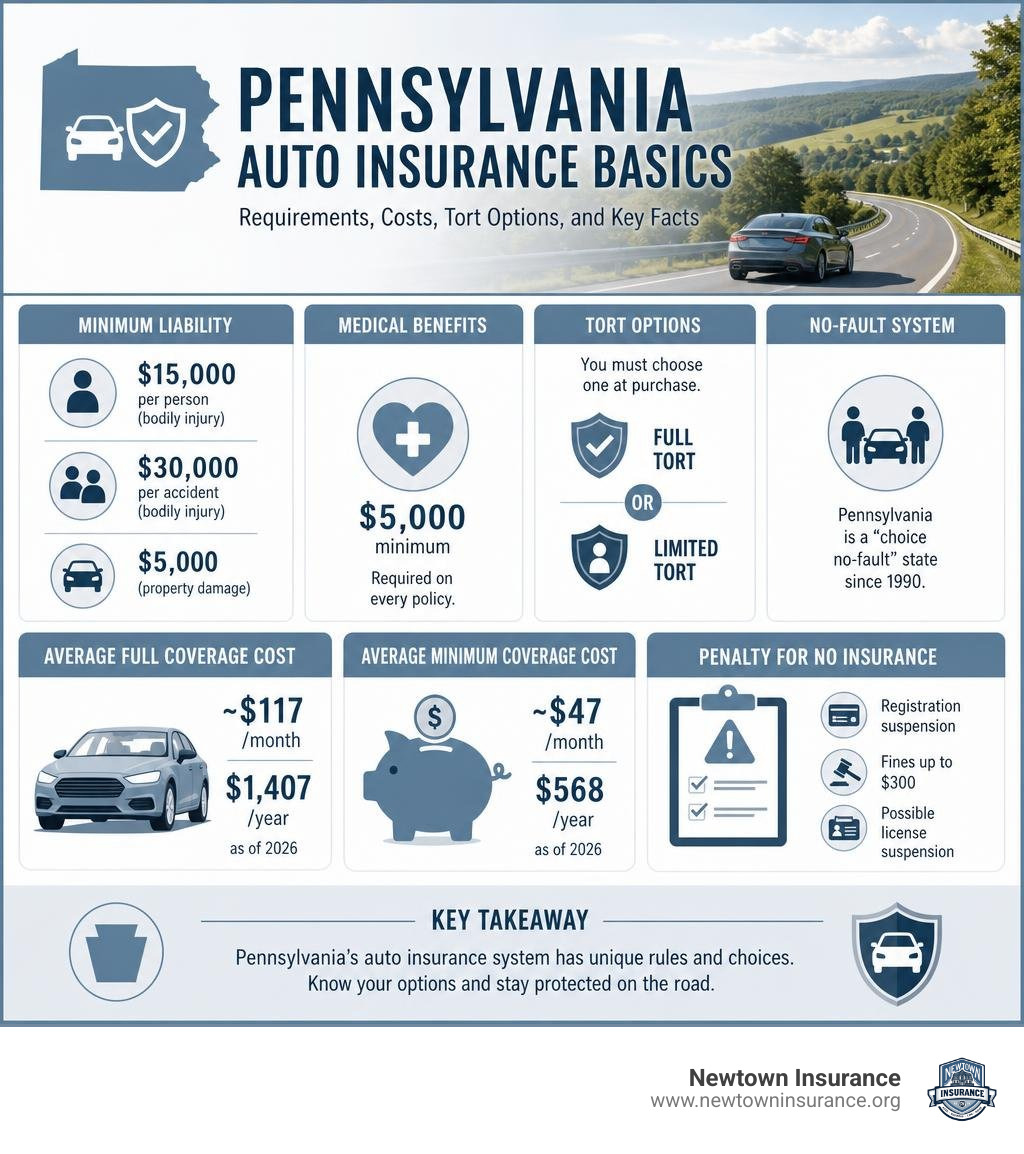
Here’s a quick snapshot of what the law requires and what it costs:
| Topic | Key Facts |
|---|---|
| Minimum liability | $15,000 per person / $30,000 per accident (bodily injury); $5,000 (property damage) |
| Medical benefits | $5,000 minimum (required on every policy) |
| Tort choice | Must choose full tort or limited tort at purchase |
| No-fault system | Pennsylvania is a “choice no-fault” state since 1990 |
| Average full coverage cost | ~$117/month ($1,407/year) as of 2026 |
| Average minimum coverage cost | ~$47/month ($568/year) as of 2026 |
| Penalty for no insurance | Registration suspension, fines up to $300, possible license suspension |
Pennsylvania’s system is more complex than most states. You’re choosing between tort options, deciding whether to stack coverage, and navigating a no-fault framework — all before you even compare prices.
That complexity is exactly why so many drivers end up overpaying for coverage that doesn’t fit their situation, or underinsured when they actually need it.
I’m Shawn Beihl of Newtown Insurance, and with over 15 years of specialty insurance experience — including helping Pennsylvania drivers find the right Pennsylvania auto insurance coverage at a fair price — I’ve seen how the wrong policy can cost you far more than the premium. This guide will walk you through everything clearly, so you can make a confident, informed decision.
Minimum Requirements for Pennsylvania Auto Insurance

To legally operate a motor vehicle on Pennsylvania roads, the Commonwealth requires you to maintain financial responsibility. This isn’t just a friendly suggestion from PennDOT; it is a strict legal mandate. According to the official Insurance Overview | Driver and Vehicle Services | Commonwealth of Pennsylvania, all registered motor vehicles—including cars, motorcycles, recreational vehicles, trucks, and buses—must carry continuous liability insurance.
Every time you hit the road, you must carry acceptable proof of insurance in your vehicle. This can be a physical insurance ID card, a policy declarations page, a valid binder, or even an electronic version on your smartphone. If you are caught driving without active coverage, the consequences are swift and expensive.
Mandatory Liability Limits in PA
When you buy a basic policy, you must meet the state’s minimum “15/30/5” liability limits, plus a mandatory first-party medical benefit. Let’s break down exactly what those numbers mean:
- Bodily Injury Liability ($15,000 per person / $30,000 per accident): If you cause an accident, this covers the medical bills and rehabilitation costs of other people injured in the crash. The policy will pay up to $15,000 for a single injured person, and a maximum of $30,000 total per accident, regardless of how many people are hurt.
- Property Damage Liability ($5,000 per accident): This pays to repair or replace another person’s property (like their car, mailbox, or fence) if you damage it in an accident.
- Medical Benefits ($5,000): Often referred to as Personal Injury Protection (PIP), this is a mandatory first-party benefit. It pays for your own medical bills (and those of your passengers) after an accident, regardless of who caused the crash.
While these are the legal minimums, they are incredibly low. If you cause a multi-car accident, a $5,000 property damage limit will barely cover a scratched bumper on a modern vehicle, let alone a totaled sedan. If your liability limits are exhausted, you are personally responsible for the remaining balance. That is why we almost always recommend carrying higher limits to protect your personal savings and assets.
| Coverage Type | PA State Minimum Limit | Recommended Protection Limit |
|---|---|---|
| Bodily Injury (Per Person) | $15,000 | $100,000 |
| Bodily Injury (Per Accident) | $30,000 | $300,000 |
| Property Damage (Per Accident) | $5,000 | $100,000 |
| Medical Benefits (PIP) | $5,000 | $10,000+ |
Penalties for Driving Without Pennsylvania Auto Insurance
Letting your Pennsylvania auto insurance lapse is a costly mistake. Insurers in Pennsylvania are legally required to report policy cancellations and terminations directly to PennDOT. If your insurance company notifies the state that your policy has ended, and you do not immediately provide proof of new coverage, PennDOT will initiate enforcement actions.
The penalties for a coverage lapse include:
- Registration Suspension: Your vehicle’s registration will be suspended for three months. During this time, the vehicle cannot legally be driven by anyone.
- Civil Penalty Option: If your lapse in coverage was 30 days or less, and you can prove the vehicle was not driven during that time, you may pay an optional $500 civil penalty plus a restoration fee to avoid the three-month registration suspension. You can only use this civil penalty option once every 12 months.
- Plate Surrender: If you do not pay the civil penalty or provide proof of continuous coverage, you must surrender your registration plate and card to PennDOT within 30 days of the cancellation notice to avoid further legal trouble.
- Restoration Fees: To get your vehicle back on the road after a suspension, you must pay PennDOT a registration restoration fee and provide official proof of active insurance.
Understanding PA’s Choice No-Fault System and Tort Options
Pennsylvania operates under a “choice no-fault” insurance system, which has been in place since 1990. “No-fault” does not mean that no one is blamed for causing an accident. Instead, it means that if you are injured in a car crash, your own insurance policy’s first-party medical benefits will pay for your medical treatment up to your policy limit, regardless of who caused the collision.
Under the state’s vehicle code, specifically Section 1705.0 – Title 75 – VEHICLES, drivers must make an important choice when they buy a policy: they must choose between Limited Tort and Full Tort coverage.
Limited Tort vs. Full Tort Coverage
Your choice of tort option has a massive impact on your legal rights if you are injured by a negligent driver. It is also one of the primary drivers of your insurance premium. For a deep dive into how this choice affects your policy, check out our Pennsylvania Auto Insurance Guide.
- Limited Tort Coverage: Selecting this option lowers your monthly insurance premium. However, in exchange for those savings, you limit your right to sue an at-fault driver for “noneconomic” damages, such as pain and suffering. If you have limited tort, you can still recover all out-of-pocket medical bills and lost wages, but you cannot seek compensation for pain and suffering unless your injuries meet the legal definition of a “serious injury” (typically defined as death, permanent serious disfigurement, or serious impairment of a body function).
- Full Tort Coverage: This option costs more in premium, but it preserves your unrestricted right to sue the at-fault driver for all damages, including pain and suffering, even for minor injuries like whiplash or deep bruising.
If you do not actively make a choice and return the signed tort election form to your insurer, Pennsylvania law automatically defaults your policy to the Full Tort option.
There are a few rare legal exceptions where a limited tort driver is automatically granted full tort status. These include being hit by a drunk driver who is subsequently convicted of a DUI, being struck by a vehicle registered in another state, or being injured as a pedestrian.
Optional Coverages and the Stacking Decision
Beyond the mandatory state minimums, there are several optional coverages that drivers should seriously consider to protect their financial well-being. According to the official Pennsylvania Insurance Department Auto Insurance Guide, there is no such thing as a single “full coverage” policy. Instead, a robust policy is built by adding specific optional protections:
- Collision Coverage: This pays to repair or replace your vehicle if it is damaged in a collision with another car or an object (like a tree or guardrail), regardless of fault.
- Comprehensive Coverage: This covers damage to your vehicle caused by events outside of your control. This includes theft, vandalism, animal strikes (very common with deer in Pennsylvania), windshield cracks, and weather damage from winter storms or hail.
- Uninsured Motorist (UM) Coverage: This protects you if you are injured by a driver who has no insurance. Since Pennsylvania’s uninsured driver rate sits at approximately 8.9%, this is a highly recommended addition.
- Underinsured Motorist (UIM) Coverage: This steps in if you are injured by a driver who has insurance, but their liability limits are too low to cover your medical expenses.
Stacked vs. Unstacked Uninsured Motorist Coverage
If you choose to purchase UM and UIM coverages, and you have multiple vehicles on your policy, you must decide whether to stack or unstack your coverage limits.
- Stacked Coverage: This allows you to combine the UM/UIM limits of all vehicles insured under your policy. For example, if you have two cars on your policy and carry $15,000/$30,000 in UIM coverage, choosing “stacked” coverage multiplies those limits by two, giving you a total of $30,000/$60,000 in protection. Stacking also applies across different policies in the same household.
- Unstacked Coverage: If you choose unstacked coverage, your limit remains at the single-vehicle level ($15,000/$30,000 in the example above), regardless of how many cars you own.
By law, Pennsylvania insurance policies are written with stacked coverage by default. To choose unstacked coverage and save a small percentage on your premium, you must sign a specific rejection form provided by your insurer.
What Determines the Cost of Car Insurance in PA?

When you request a quote, insurance companies look at a variety of rating factors to calculate your risk profile. Understanding these factors can help you find the Average Cost of Car Insurance in PA that matches your budget.
The primary factors that influence your premium include:
- Driving Record: A clean driving record is the best way to keep rates low. A single DUI conviction in Pennsylvania can increase your full coverage premium by 105%, adding an average of $113 per month to your bill.
- Credit Score: Pennsylvania law permits insurance companies to use credit-based insurance scores to determine rates. Drivers with poor credit pay an average of $217 per month for full coverage, compared to just $117 per month for those with good credit—a massive $100 monthly difference.
- Age and Experience: Teen drivers are statistically more likely to be involved in accidents. Adding a 16-year-old to a family policy in Pennsylvania costs an average of $336 per month, which is $228 more per month than a 40-year-old baseline driver paying $108.
- Vehicle Choice: The make, model, and safety features of your car play a major role. Insuring a high-end electric vehicle like a Tesla Model Y can cost significantly more per month than insuring a standard light-duty truck like a Ford F-150.
Regional Rate Differences: Philadelphia vs. Rural PA
Where you park your car at night has a massive impact on your insurance bill. High population density, frequent traffic congestion, and higher rates of vehicle theft and vandalism mean that urban drivers pay significantly more than their rural counterparts.
For example, the average full coverage premium in Philadelphia is $237 per month—which is $120 above the state average of $117. Meanwhile, drivers in quieter areas like York enjoy average rates of just $106 per month. Additionally, Pennsylvania’s frequent winter storms and deer populations in wooded regions lead to localized increases in comprehensive claims, which insurers factor into regional zip code pricing.
How to Save Money and Shop for Pennsylvania Auto Insurance
You do not have to settle for sky-high premiums. There are several active steps you can take to lower your bill. Adjusting your deductibles is one of the fastest ways to see immediate savings. By raising your comprehensive and collision deductibles from $250 to $500 or $1,000, you assume more out-of-pocket risk in an accident, which lowers your monthly premium.
To explore customized options for your budget, check out our guide on finding Low Cost Auto Insurance PA.
Smart Discounts for Pennsylvania Drivers
Almost every insurance carrier offers a suite of discounts that can chip away at your premium. When shopping for coverage, make sure to ask about:
- Mature Driver Discount: Under Pennsylvania law, drivers aged 55 and older who complete an approved defensive driving or driver improvement course are entitled to a mandatory premium discount of at least 5% (valid for three years).
- Bundling Discounts: One of the easiest ways to save up to 20% or more is by purchasing your home, renters, or condo insurance from the same company that insures your vehicle. Learn more about how this works in our guide on the Auto and Home Bundle.
- Safety and Anti-Theft Features: If your vehicle is equipped with factory-installed anti-lock brakes (ABS), passive alarms, or tracking devices, you qualify for lower rates. For more details, read about the Anti-Theft Discount Auto Insurance.
- Good Student Discount: Young drivers aged 16 to 24 who maintain a “B” average or better in school can save significantly on their premiums.
For a comprehensive list of savings opportunities, read our article on 6 Car Insurance Discounts You Should Ask About and explore general Moneysaving Car Insurance strategies.
How to Compare Pennsylvania Auto Insurance Quotes
The golden rule of insurance shopping is to compare apples to apples. When gathering quotes, make sure the liability limits, first-party medical benefits, tort selections, and deductibles are identical across all companies. Otherwise, you won’t get an accurate picture of who is offering the best value.
To make this process simple, we have put together a Compare Insurance Quotes Complete Guide. If you prefer to explore pricing without sharing your phone number or email with dozens of persistent telemarketers, you can also check out our Car Insurance Quote No Personal Info Guide to learn how to shop smart. Ready to start comparing? Head over to our Auto Insurance Quotes page to see your options.
Frequently Asked Questions About PA Auto Insurance
Is Pennsylvania a no-fault state?
Yes, Pennsylvania has been a “choice no-fault” state since 1990. This means that if you are injured in a car accident, your own insurance policy’s medical benefits (minimum $5,000) will pay for your medical treatments, regardless of who caused the crash. However, Pennsylvania is unique because it allows you to choose between “Limited Tort” and “Full Tort” when you buy your policy, which determines your right to sue an at-fault driver for pain and suffering.
What happens if my auto insurance lapses in PA?
If your insurance lapses, your insurance company will notify PennDOT. Unless you can prove the lapse was 30 days or less and the vehicle was not driven, your vehicle registration will be suspended for three months. To avoid the suspension, you may pay a $500 civil penalty plus restoration fees (allowed once every 12 months). Otherwise, you must surrender your license plate to PennDOT within 30 days of the cancellation notice.
How much does full coverage car insurance cost in Pennsylvania?
According to data from 2026, the average cost of full coverage car insurance in Pennsylvania is approximately $1,764 per year (about $117 to $147 per month, depending on the specific data pool and driver profile). This is roughly 6% below the national average. However, your actual rate will depend heavily on your driving record, credit score, age, vehicle type, and whether you live in a high-cost area like Philadelphia.
Conclusion
Navigating Pennsylvania auto insurance doesn’t have to be a headache. By understanding the state’s minimum requirements, making an informed choice between limited and full tort, and knowing how to leverage smart discounts, you can secure the protection you need without overpaying.
At Newtown Insurance, we believe in providing tailored protection, smart savings, and transparent pricing. As a local provider based in Newtown, Pennsylvania, we emphasize customer-first support to ensure you never pay for coverage you don’t need, while keeping you fully protected on the road.
Don’t leave your financial security to chance. Let us help you find the perfect policy for your vehicle and your budget. Get a Quote today and experience the Newtown Insurance difference.