

Everything You Need for a Personal Vehicle Insurance Quote Without the Headache
Why Getting a Personal Vehicle Insurance Quote the Right Way Saves You Money

Getting a personal vehicle insurance quote doesn't have to be confusing or time-consuming. Here's what you need to know upfront:
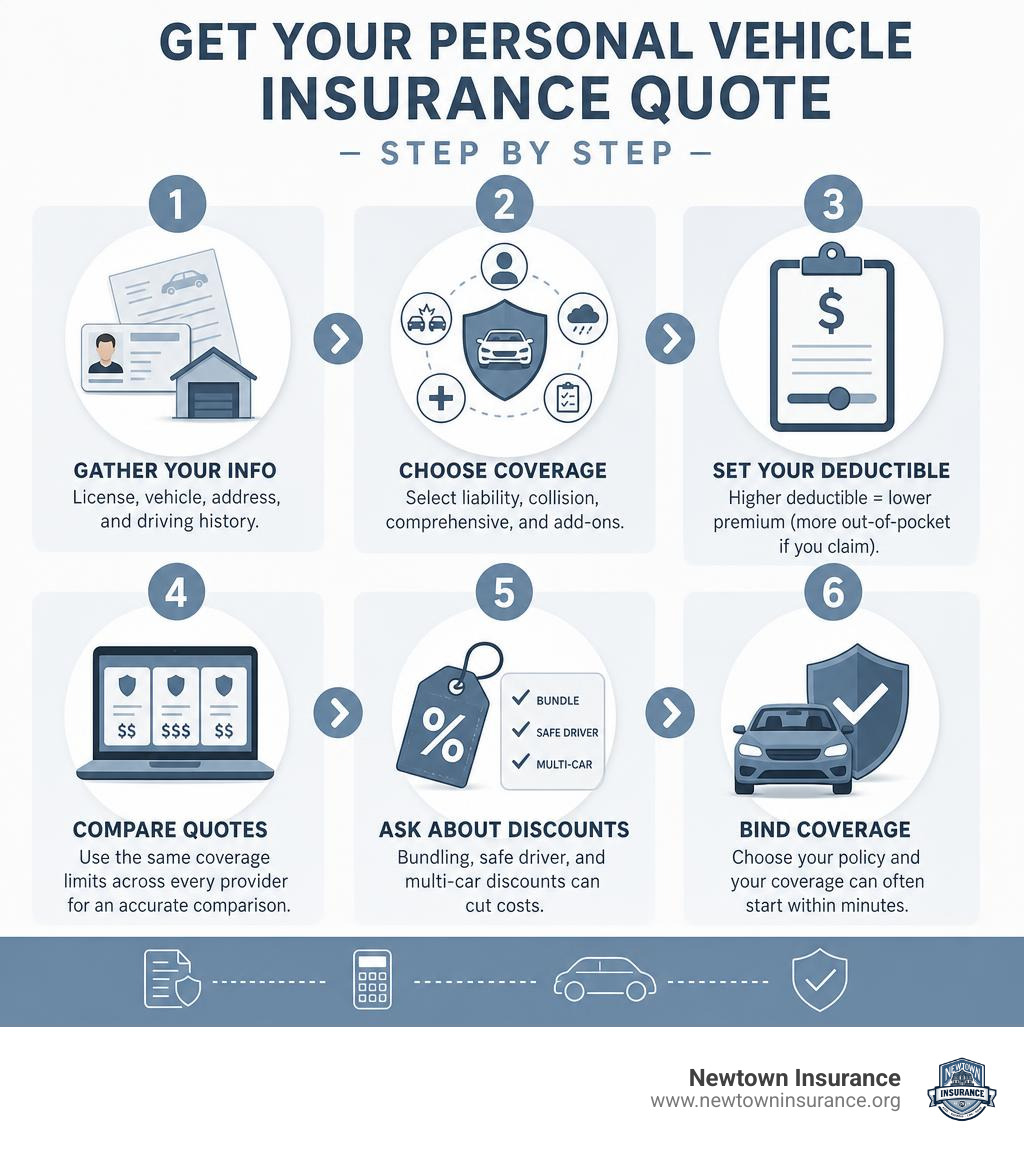
How to get a personal vehicle insurance quote — quick overview:
- Gather your info — driver's license, vehicle VIN, garaging address, and driving history
- Choose your coverage types — liability, collision, comprehensive, and any add-ons
- Set your deductible — higher deductible = lower premium (but more out-of-pocket if you claim)
- Compare quotes — use the same coverage limits across every provider for an accurate comparison
- Ask about discounts — bundling, safe driver, and multi-car discounts can cut costs significantly
- Bind coverage — once you choose a policy, coverage can often start within minutes
Most drivers in Pennsylvania overpay simply because they don't know what to compare — or they grab the first quote they see. Insurance companies don't always make it easy. Rates vary widely based on your location, driving record, vehicle type, and the coverage levels you choose.
The good news? A little preparation goes a long way. Knowing what information to have ready, what coverage you actually need, and where to look for savings can make the whole process fast and frustration-free.
I'm Shawn Beihl from Newtown Insurance, and with over 15 years of experience helping clients navigate complex insurance decisions — including finding the right personal vehicle insurance quote — I know exactly where people get stuck and how to avoid it. This guide will walk you through everything clearly, step by step.
What Information Do You Need for a Personal Vehicle Insurance Quote?
Before you sit down to request a quote, having your paperwork organized will save you from digging through drawers mid-process. To get an accurate, binding personal vehicle insurance quote, insurance companies need specific data points to calculate your risk level.
To start, you will need the basic personal details of every driver in your household. This includes full names, dates of birth, marital status, and employment details. Additionally, you will need to provide your exact physical address—specifically where the vehicle is stored overnight (known as the garaging address).
You should also have your current insurance policy's "declarations page" handy if you are already insured. This document lists your current coverage limits and deductibles, which makes it much easier to request Personalized Insurance Quotes that match or exceed your current protection levels.
Vehicle Details and Driving History
Your vehicle itself is one of the biggest factors in determining your premium. You will need to provide the year, make, model, and safety features of your car. However, using the 17-character Vehicle Identification Number (VIN) is the most accurate way to get a quote. The VIN tells the insurer exactly what safety features, engine type, and anti-theft devices are installed on your specific car.
You must also estimate your annual mileage and specify how you use the vehicle. Do you use it for a short daily commute to work, or is it strictly for weekend pleasure trips?
Equally important is your driving history. Insurers will look at the past three to five years of your record, checking for:
- Traffic violations (speeding tickets, reckless driving, etc.)
- At-fault or not-at-fault accidents
- Comprehensive claims (such as hitting an animal or windshield damage)
- Any lapses in your continuous auto insurance coverage
For a complete breakdown of how these details impact your policy, check out our Ultimate Auto Insurance Guide.
How Deductibles Affect Your Personal Vehicle Insurance Quote
A deductible is the amount of money you agree to pay out of pocket before your insurance coverage kicks in to pay for a claim. Deductibles typically apply to physical damage coverages, such as collision and comprehensive.
There is a direct, inverse relationship between your deductible and your premium:
- Lower Deductibles (e.g., $250 or $500): You pay less out of pocket during a claim, but your monthly or annual premium will be higher.
- Higher Deductibles (e.g., $1,000 or $2,000): Your premium will be significantly lower, but you must ensure you have enough cash set aside to cover that higher amount if you get into an accident.
Choosing the right deductible is all about balancing your monthly budget with your risk tolerance. If you want to lower your premium but are worried about a sudden out-of-pocket expense, look into flexible Auto Insurance Payment Plans to keep your overall expenses manageable.
Understanding Your Coverage Options: Liability, Collision, and Comprehensive
When looking at a personal vehicle insurance quote, you will see several different types of coverage listed. Understanding what each one does is crucial to ensuring you do not leave yourself financially exposed.
| Coverage Type | What It Covers | Is It Required in PA? |
|---|---|---|
| Bodily Injury Liability | Medical bills and legal defense for injuries you cause to others. | Yes (Minimum $15,000/$30,000) |
| Property Damage Liability | Damage you cause to another person's property (car, fence, building). | Yes (Minimum $5,000) |
| First-Party Medical Benefits | Medical expenses for you and your passengers, regardless of fault. | Yes (Minimum $5,000) |
| Collision Coverage | Damage to your own vehicle from a collision with another car or object. | No (Unless financing/leasing) |
| Comprehensive Coverage | Damage to your car from non-collision events (theft, fire, animal strikes, weather). | No (Unless financing/leasing) |
For official state details on these categories, you can review the Pennsylvania coverage options provided by the Pennsylvania Insurance Department.
Liability vs. Full Coverage
In Pennsylvania, you are legally required to carry liability insurance and medical benefits. However, "state minimums" only protect other people and your basic medical bills—they do not pay a single cent to repair or replace your own vehicle if you are at fault in an accident.
"Full coverage" is a term commonly used to describe a policy that includes liability, collision, and comprehensive coverages. While full coverage costs more, it provides true asset security. If your car is totaled in a storm or a collision, a full coverage policy ensures you aren't left stranded without a vehicle or stuck paying off a loan on a car you can no longer drive. When comparing Auto Insurance Quotes, we always recommend looking at limits well above the state minimums to protect your personal savings and assets from lawsuits.
Optional Add-ons to Consider
Beyond the standard coverages, there are several optional add-ons that can make your life much easier in an emergency:
- Roadside Assistance: Covers towing, flat tire changes, fuel delivery, and battery jump-starts.
- Gap Insurance: If your vehicle is totaled, gap insurance pays the difference between the actual cash value of the car and what you still owe on your auto loan or lease.
- Rental Reimbursement: Pays for a rental car while your vehicle is in the shop being repaired after a covered claim.
To make sure your policy aligns perfectly with Pennsylvania's unique legal framework, you can read the Pennsylvania car insurance guidelines managed by the DMV.
How to Compare and Save on Your Policy

Finding the right policy is not just about choosing the absolute cheapest number on a screen. True savings come from finding the highest level of protection for the most competitive rate.
Step-by-Step Guide to Comparing a Personal Vehicle Insurance Quote
To compare quotes effectively, you must perform an "apples-to-apples" comparison. If one quote uses a $500 deductible with $100,000 in liability limits, and another uses a $1,000 deductible with state minimum limits, you aren't comparing the same product.
- Step 1: Select your desired coverage limits and deductibles.
- Step 2: Input the exact same details into each quoting tool.
- Step 3: Compare the premiums, but also evaluate the insurer's reputation for customer service and claims handling.
- Step 4: If you are hesitant about sharing your personal details right away, check out our Car Insurance Quote No Personal Info Guide to learn how to explore rates safely.
For a deeper dive into this process, read our Compare Insurance Quotes Complete Guide and check out our tips on securing Moneysaving Car Insurance.
Common Discounts to Ask Your Provider About
Virtually every insurance provider offers discounts, but they don't always apply them automatically. You should proactively ask about:
- Bundling Policies: Combining your auto policy with home, renters, or condo insurance is the single most effective way to save. Across the industry, bundling can save policyholders an average of $646 to over $1,000 annually.
- Safe Driver Programs: Many modern policies offer telematics programs (using a mobile app to track driving habits). Drivers who demonstrate safe behaviors can save up to 30% or 40% on their premiums.
- Multi-Car Discount: Insuring more than one vehicle on the same policy often triggers significant savings.
- Good Student Discount: Young drivers with a B average (3.0 GPA) or higher can qualify for lower rates.
- Anti-Theft Devices: Installing active or passive alarm systems can lower your comprehensive premium.
Learn more about these opportunities by reading about 6 Car Insurance Discounts You Should Ask About, exploring the Anti-Theft Discount Auto Insurance criteria, and implementing our general Tips for Saving Money on Insurance.
Frequently Asked Questions About Vehicle Insurance
How quickly can I get active coverage after receiving a quote?
In most cases, you can get active coverage almost instantly. Once you complete your application, select your start date, and submit your initial payment, the insurance company will issue a "binder agreement." This binder serves as temporary, legal proof of insurance until your official policy documents are generated. You will receive digital proof of insurance immediately via email or the insurer's mobile app, allowing you to drive legally right away.
What are the minimum car insurance requirements in my state?
As of June 2026, Pennsylvania law requires all registered vehicle owners to maintain financial responsibility. The minimum liability limits are:
- $15,000 for bodily injury to one person in an accident.
- $30,000 for total bodily injury to multiple people in an accident.
- $5,000 for property damage liability.
- $5,000 for medical payments (First-Party Benefits), which covers medical bills for you and your passengers regardless of who caused the accident.
To understand how these state laws apply to your specific situation, you can review the official guidelines provided by the Pennsylvania Insurance Department or explore local PA DMV resources to see how regional requirements compare.
How does bundling auto and home insurance affect my rates?
Bundling auto and home insurance is one of the easiest ways to secure deep discounts. When you purchase multiple policies from the same provider, it streamlines their administrative costs, and they pass those savings on to you.
Beyond saving money—often ranging from 10% to 20% off your total premiums—bundling offers incredible convenience. You only have to deal with a single online portal, streamlined billing, and one customer support team. For more information on how multi-policy structures work, you can consult with an independent agent or review our guide on 6 Car Insurance Discounts You Should Ask About to see typical bundling advantages in Pennsylvania.
Conclusion
Navigating auto insurance doesn't have to feel like a second job. By gathering your information ahead of time, understanding your Pennsylvania coverage requirements, and actively seeking out bundling and safe-driving discounts, you can secure excellent protection without overpaying.
At Newtown Insurance, we are proud to serve our local community right here in Newtown, Pennsylvania. We believe in providing tailored protection, smart savings, and completely transparent pricing. We put our customers first, helping Pennsylvania drivers find the exact coverage they need while keeping hard-earned money in their pockets.
Ready to see how much you could save? Get a personalized quote today and let us do the heavy lifting for you!