

The Best Affordable Full Coverage Auto Insurance Options for 2026
What Is Affordable Auto Insurance Full Coverage - and How Can You Find It in 2026?

Finding affordable auto insurance full coverage doesn't have to mean settling for less protection. The key is understanding what full coverage includes, comparing more than one option, and adjusting your policy so you are not paying for coverage you do not need.
| Cost Benchmark | Average Monthly Cost | Average Annual Cost |
|---|---|---|
| National average full coverage estimate | $133 | $1,597 |
| Possible annual price difference for similar coverage | Up to $150 | Up to $1,800 |
Actual rates vary by driver, vehicle, location, coverage limits, deductibles, claims history, and other underwriting factors.
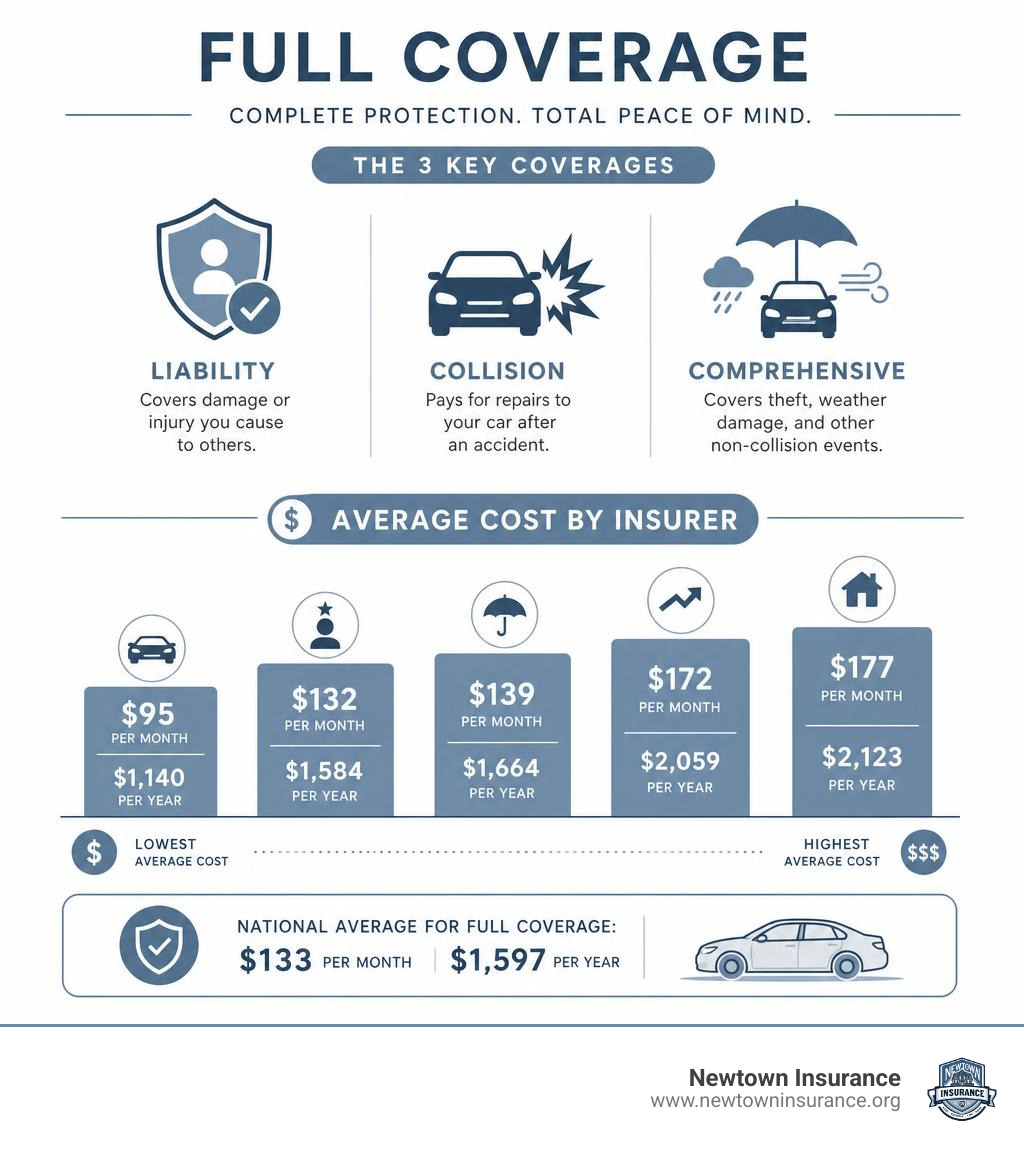
Full coverage typically combines three types of protection:
- Liability - covers damage or injury you cause to others
- Collision - pays for repairs to your car after an accident
- Comprehensive - covers theft, weather damage, and other non-collision events
The national average for full coverage is $133 per month (about $1,597 per year). But your actual rate depends heavily on your driving record, credit score, age, and where you live - which means many drivers can do significantly better than average.
For Pennsylvania drivers especially, overpaying for coverage is a real risk. Rates vary widely between policies and underwriting factors, and the difference between a more affordable option and a more expensive option for the same coverage can be as much as $1,800 per year.
I'm Shawn Beihl from Newtown Insurance, and over 15 years of working in specialty insurance I've helped countless clients cut through the noise to find affordable auto insurance full coverage that actually fits their lives and budgets. In this guide, I'll walk you through everything you need to know to make a confident, cost-smart decision in 2026.
Understanding Full Coverage Auto Insurance
When we talk about protecting your vehicle, the term "full coverage" gets thrown around a lot. However, it is important to understand that "full coverage" isn't a single specific policy you select from a dropdown menu. Instead, it is an industry term used to describe a robust combination of coverages designed to give you comprehensive protection and true financial security.
Without this complete safety net, a single unexpected event on the road could jeopardize your hard-earned savings. Furthermore, if you are currently financing or leasing your vehicle, your lender will almost certainly require you to carry full coverage to protect their financial investment until the vehicle is paid off in full.
What is Affordable Auto Insurance Full Coverage?
At its core, a standard full coverage policy consists of three essential pillars:
- Liability Coverage: This is the legal foundation of your policy. It pays for bodily injuries and property damage that you cause to other people in an at-fault accident. It does not cover your own injuries or vehicle repairs.
- Collision Coverage: This covers the cost of repairing or replacing your own vehicle if you are involved in an accident with another car, hit an object (like a guardrail or tree), or experience a rollover accident.
- Comprehensive Coverage: Often called "other-than-collision" coverage, this handles damage to your vehicle caused by events outside your control. This includes theft, vandalism, animal strikes (such as hitting a deer on a dark Pennsylvania road), windshield cracks, hail, fire, and falling objects.
Depending on your needs, you can also add optional protections such as roadside assistance, rental car reimbursement, and gap insurance. To dive deeper into how these coverages interact to shield your assets, check out our Ultimate Auto Insurance Guide.
Full Coverage vs. Minimum Liability
Opting for minimum liability coverage is certainly the cheapest way to legally get behind the wheel, but it leaves you highly vulnerable. If you cause a severe accident with only minimum liability, your insurance provider will pay up to your policy limits to cover the other driver’s damages. Once those limits are exhausted, you are personally on the hook for the remaining balance, which can lead to devastating out-of-pocket costs and the potential loss of your personal assets.
When you upgrade to affordable auto insurance full coverage, you are buying peace of mind. On average, switching from a bare-minimum liability policy to a full coverage policy with $500 deductibles raises a driver's rate by about $69 per month. For most drivers, that extra investment is well worth the protection.
| Feature | Minimum Liability Only | Full Coverage (Liability + Collision + Comp) |
|---|---|---|
| Meets Legal Requirements | Yes | Yes |
| Satisfies Lender Requirements | No | Yes |
| Covers Damage to Others | Yes (up to policy limits) | Yes (up to policy limits) |
| Covers Your Car in a Crash | No | Yes (minus deductible) |
| Covers Theft & Weather Damage | No | Yes (minus deductible) |
| Risk of High Out-of-Pocket Costs | Extremely High | Low |
How to Find Affordable Auto Insurance Full Coverage
Finding a policy that fits your budget requires more than just picking the first option you see. It takes strategic comparison shopping and deliberate policy customization. By working with an independent agency like us, you can compare multiple Auto Insurance Quotes simultaneously to find the sweet spot between low premiums and reliable protection.
Key Factors That Influence Affordable Auto Insurance Full Coverage Rates
Insurers don't hand out the same rate to everyone. Your premium is a highly personalized mathematical calculation based on several key risk metrics:
- Driving Record: A clean record is your golden ticket to the lowest rates. A single speeding ticket or at-fault accident can cause your rates to spike.
- Credit Score: In Pennsylvania, insurers use credit-based insurance scores to help predict risk. On average, drivers with poor credit pay 69% more per year for full coverage than those with excellent credit.
- Age and Experience: Younger drivers, particularly those under the age of 25, face significantly higher rates due to a statistical lack of experience. Rates tend to stabilize and decrease as you reach age 25, remaining lower until around age 70.
- Vehicle Type: The make, model, and year of your car dictate how much it costs to repair or replace. Practical, highly rated safety vehicles like a Subaru Outback are much cheaper to insure than high-performance sports cars or luxury electric vehicles.
To learn more about how to navigate these variables, read our Compare Insurance Quotes Complete Guide.
Average Costs and Regional Variations
Your geographic location plays a massive role in what you pay. Even within Pennsylvania, a driver in a quiet suburb of Newtown will likely pay different rates than a driver navigating the congested streets of downtown Philadelphia.

Nationally, the average cost of full coverage sits at $129 to $133 per month. However, state laws, weather patterns, repair costs, traffic density, claim frequency, and local litigation trends can all cause dramatic shifts. Pennsylvania drivers can also review consumer resources from the Pennsylvania Insurance Department to better understand state-specific insurance rules and coverage considerations.
Because pricing is so location-specific, the best way to find affordable full coverage is to compare options using the same coverage limits, deductibles, and driver information. That way, you are comparing true policy value rather than just chasing the lowest advertised premium.
Strategies to Lower Your Full Coverage Premiums
You don't have to accept a high premium as an unchangeable fact of life. There are several highly effective, proactive strategies you can employ today to secure a more Money Saving Car Insurance policy.
Smart Deductible Adjustments and Bundling
One of the fastest ways to lower your monthly payments is by raising your deductibles. Your deductible is the amount you agree to pay out-of-pocket before your insurance coverage kicks in. If you raise your collision and comprehensive deductibles from $250 to $1,000, your monthly premium will drop significantly. Just make sure you keep that deductible amount tucked away in an emergency savings account so you can easily cover it if you ever need to file a claim.
Another highly effective strategy is multi-policy bundling. By combining your auto coverage with your homeowner's or renter's insurance, you can unlock massive multi-policy discounts. To see how this works, take a look at our guide on the Auto and Home Bundle.
Maximizing Policy Discounts
Most insurance companies offer a long list of discounts that can dramatically lower your rates. Many of these are easy to qualify for but frequently overlooked:
- Safe Driver Discounts: If you maintain a clean record for three consecutive years, you could save up to 20% on your premiums.
- Good Student Discounts: High school and college students who maintain a "B" average or higher can save up to 7% or more.
- Paperless and Autopay: Opting for electronic statements and automatic monthly payments often triggers an immediate discount.
- Affiliation Discounts: Membership in certain professional groups, alumni associations, employers, or community organizations may qualify you for additional savings depending on the policy.
For a complete checklist of savings opportunities, read our articles on 6 Car Insurance Discounts You Should Ask About and our top Tips for Saving Money on Insurance to ensure you aren't leaving money on the table.
Is Full Coverage Worth It for Your Vehicle?

As your vehicle ages, its depreciation naturally reduces its overall market value. At a certain point, maintaining a full coverage policy might no longer make financial sense.
To determine if you should transition to a liability-only policy, we recommend using the 10 percent rule. If the annual cost of your comprehensive and collision premiums exceeds 10% of your vehicle's actual cash value (minus your deductible), it may be time to drop the physical damage coverage.
For example, if your car is worth $3,000 and your deductible is $1,000, the maximum payout you could receive in a total loss is $2,000. If you are paying $400 a year for collision and comprehensive coverages, you are paying 20% of the maximum potential payout every single year. In this scenario, saving that premium money in a personal repair fund is often the smarter financial move. For local advice on balancing this equation, read about finding Low Cost Auto Insurance PA.
Frequently Asked Questions About Full Coverage Insurance
Navigating the nuances of auto insurance can raise plenty of questions. Here are clear answers to some of the most common inquiries we receive:
What is typically excluded from a standard full coverage policy?
A standard full coverage policy does not cover everything. It typically excludes routine maintenance (like oil changes, brake replacements, and tire wear), mechanical breakdowns, and general wear and tear. It also won't cover custom aftermarket equipment unless you purchase a specific custom parts endorsement. Additionally, standard full coverage does not pay off your auto loan if your car is totaled and you owe more than the car is worth; for that, you need to add gap insurance.
How much does a DUI or poor credit affect full coverage rates?
High-risk behaviors and poor credit scores carry heavy financial penalties. A single DUI conviction in Pennsylvania can raise your annual full coverage premium by an average of $1,294, pushing rates up to around $244 per month. Similarly, having poor credit can increase your rates by 69% compared to having good credit, resulting in an average annual penalty of over $1,300. Maintaining a clean driving record and working to improve your credit score are two of the most powerful tools you have for keeping insurance affordable.
Does full coverage insurance cover rental cars?
Yes, in most cases, your primary auto insurance policy's liability, collision, and comprehensive coverages will transfer over to a temporary rental vehicle within the United States. However, this is subject to the same limits and deductibles as your personal policy. It is also important to note that standard policies do not cover "loss of use" fees charged by rental car companies while a damaged rental vehicle is in the shop. If you want coverage for that specific risk, you may want to consider using a travel credit card that offers primary rental car protection or purchasing the rental company's collision damage waiver.
Conclusion
Securing affordable auto insurance full coverage in 2026 doesn't have to be a stressful or confusing process. By understanding the core pillars of coverage, strategically adjusting your deductibles, and taking full advantage of available discounts, you can build a policy that offers robust protection without breaking the bank.
At Newtown Insurance, we specialize in helping Pennsylvania drivers navigate these choices with ease. We are proud to offer personalized protection, smart savings, and transparent pricing designed to keep you safe on the road while ensuring you never overpay.
Ready to see how much you could save? Explore our guide on Personalized Insurance Quotes or Get a tailored quote today to start building your perfect policy.