The Smarter Way to Shop: Home Insurance Quotes Without the Spam

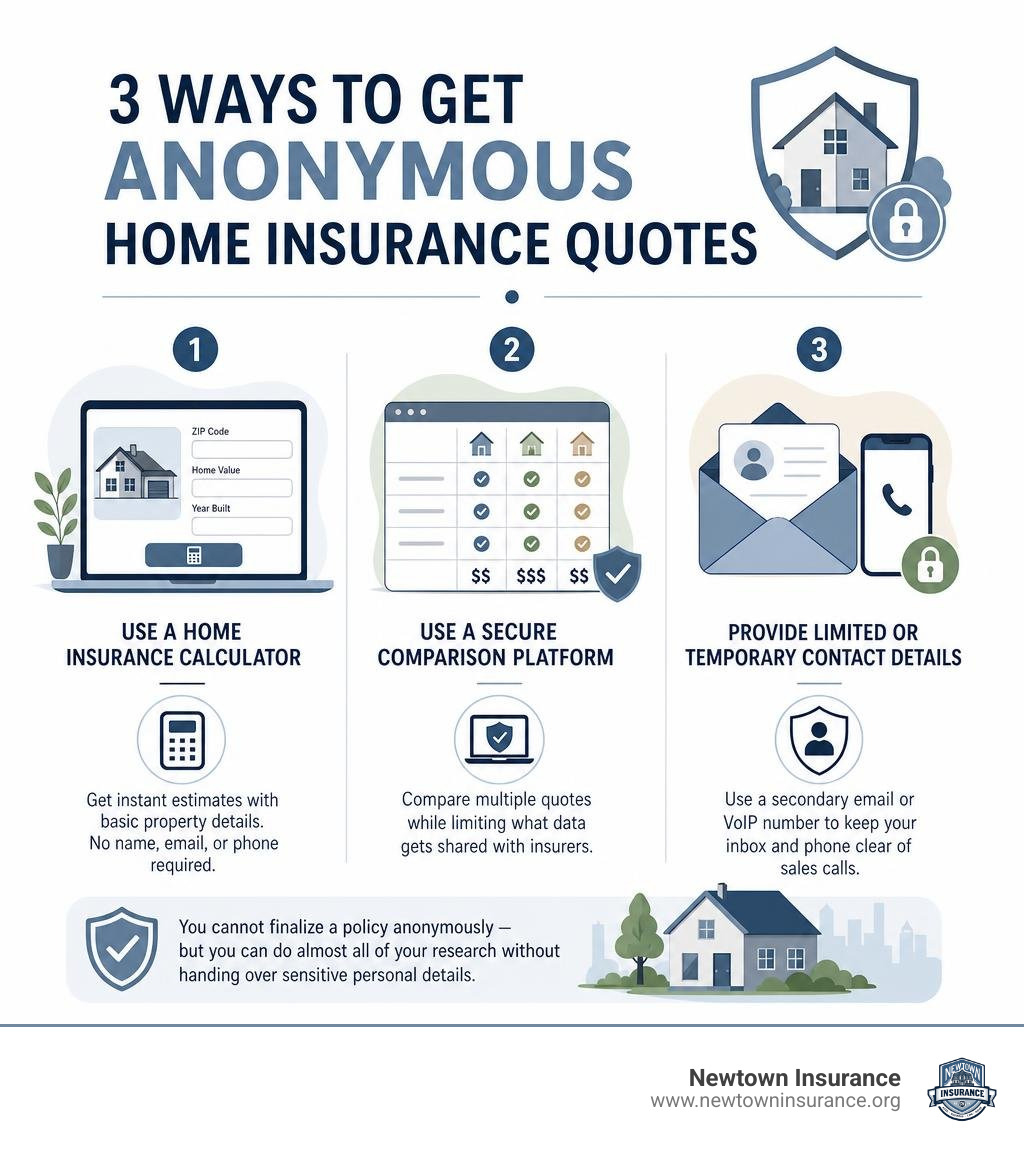
If you’ve been wondering how to get home insurance quotes without personal information, here’s the short answer:
- Use a home insurance calculator — enter basic property details like ZIP code, home value, and year built. No name, email, or phone required.
- Use a secure comparison platform — reputable sites let you compare multiple quotes while limiting what data gets shared with insurers.
- Provide limited or temporary contact details — a secondary email or VoIP number keeps your inbox and phone clear of sales calls until you’re ready to buy.
You cannot finalize a policy anonymously — but you can do almost all of your research without handing over sensitive personal details.
Most people shopping for homeowners insurance hit the same wall: you want a ballpark number, but every quote form wants your name, birthday, address, and phone number before showing you anything. And once you submit? Your inbox fills up. Your phone rings. A lot.
It’s a real problem. Many “free quote” websites are actually lead marketplaces — they collect your information and sell it to multiple brokers at once. That’s why getting a single quote can feel like opening a floodgate.
Here’s the good news: you don’t have to play that game. There are legitimate ways to estimate your homeowners insurance costs — and even compare real rates — while keeping your personal data close to your chest.
Homeowners insurance already costs more than $2,000 per year on average, so shopping around matters. You just shouldn’t have to sacrifice your privacy to do it.
I’m Shawn Beihl of Newtown Insurance, and with over 15 years in specialty insurance — including property and casualty coverage — I’ve helped countless Pennsylvania homeowners navigate exactly how to get home insurance quotes without personal information while still ending up with the right coverage. In this guide, I’ll walk you through the tools, steps, and tradeoffs so you can shop smart and stay protected.
Why Do Insurers Ask for Your Life Story?
When you open up a standard online quote form, it often feels less like an insurance application and more like an interrogation. You might wonder why an insurance company needs to know your exact date of birth, your marital status, and even your current employer just to tell you what it costs to cover a pile of bricks and wood in Newtown, Pennsylvania.
The reason comes down to underwriting and risk assessment. Insurance companies are in the business of predicting the future—specifically, how likely your home is to experience a loss, and how much that loss will cost to repair. To do this, they use massive historical datasets and complex algorithms.
Every piece of information they request is a variable in their pricing equation. If they don’t have these variables, they can’t run the math. This process of data collection allows them to calculate a highly specific premium tailored to your exact risk profile.
Standard Information Required for Home Insurance
To understand how to bypass the traditional data-heavy quoting process, it helps to know what a standard insurer typically looks for. When you request a formal quote, carriers generally gather data across several categories to establish your Home Insurance Information:
- The Property Address: This is crucial. Insurers don’t just look at your town; they look at your exact geographic coordinates. Is your home close to a local fire hydrant? Is it located in a low-lying area prone to local flooding?
- Home Age and Construction Materials: A home built in the 1950s has different wiring, plumbing, and structural risks than a brand-new build in Bucks County. Standard homes represent about 75% of properties, while 20% are semi-custom and 5% are fully custom. Additionally, the age of your roof is a massive factor—roofs older than 20 years can increase your premium by 40% or more.
- Claims History: Insurers query a database called the Comprehensive Loss Underwriting Exchange (CLUE) report. This report tracks property insurance claims for the past seven years. If a property has a history of water damage or fire claims, insurers view it as a higher risk. For example, a single previous fire claim can increase premium costs by 20%, while a second claim can spike costs by 44%.
- Credit-Based Insurance Score: In Pennsylvania, insurers are legally permitted to use your credit history to help determine your home insurance rate. Statistics show that homeowners with poor credit can pay up to 127% more for the exact same coverage compared to those with excellent credit.
Why True Anonymity Limits Quote Accuracy
While it is entirely possible to get a ballpark estimate without sharing your life story, you must accept a trade-off: true anonymity limits quote accuracy.
Without your exact address, an insurer cannot assess highly localized regional hazards. They won’t know if your home is nestled in a heavily wooded area prone to brush fires or if it sits right next to a professional fire station. Furthermore, without running a soft credit check or pulling your CLUE report, the system must rely on default assumptions.
This means an anonymous quote is essentially a “best-guess” estimate. According to industry data, anonymous estimates are generally within 10% to 25% of your final premium. They are incredibly useful for budgeting and comparison shopping, but they cannot be used to bind a policy.
To learn more about how to navigate these trade-offs, check out this Hassle-Free Quotes Guide for a deeper look at balancing privacy with quote accuracy.
How to Get Home Insurance Quotes Without Personal Information
If you want to shop for coverage without triggering a barrage of sales calls, you need to change your approach. You can get realistic, highly usable rate estimates by using online tools designed for data minimization. Here is our step-by-step method to get the numbers you need while keeping your privacy intact.
Step 1: Use an Online Home Insurance Calculator
The absolute easiest way to start your search is with an online home insurance calculator. These tools are designed to provide rapid premium estimates without asking for a single piece of identifying personal information.
Instead of asking who you are, a calculator asks what your home is. You will typically need to provide:
- Your ZIP Code: This allows the calculator to apply regional base rates for Pennsylvania.
- Approximate Square Footage: To estimate the size of the structure.
- Year Built & Home Style: To gauge construction standards and potential aging risks.
- Estimated Rebuild Cost (Replacement Cost): It is vital to remember that replacement cost is different from market value. Market value includes the price of the land and local real estate demand. Your insurance only covers the cost of labor and materials to rebuild the structure from the ground up.
By adjusting these basic inputs, you can watch your estimated premium change in real time. For more tips on using these tools safely, refer to our Insurance Quotes No Personal Info Guide.
Step 2: Leverage Secure Comparison Platforms
Once you have a general estimate from a calculator, you can take things a step further by using a secure comparison platform. These platforms act as a protective barrier between you and individual insurance carriers.
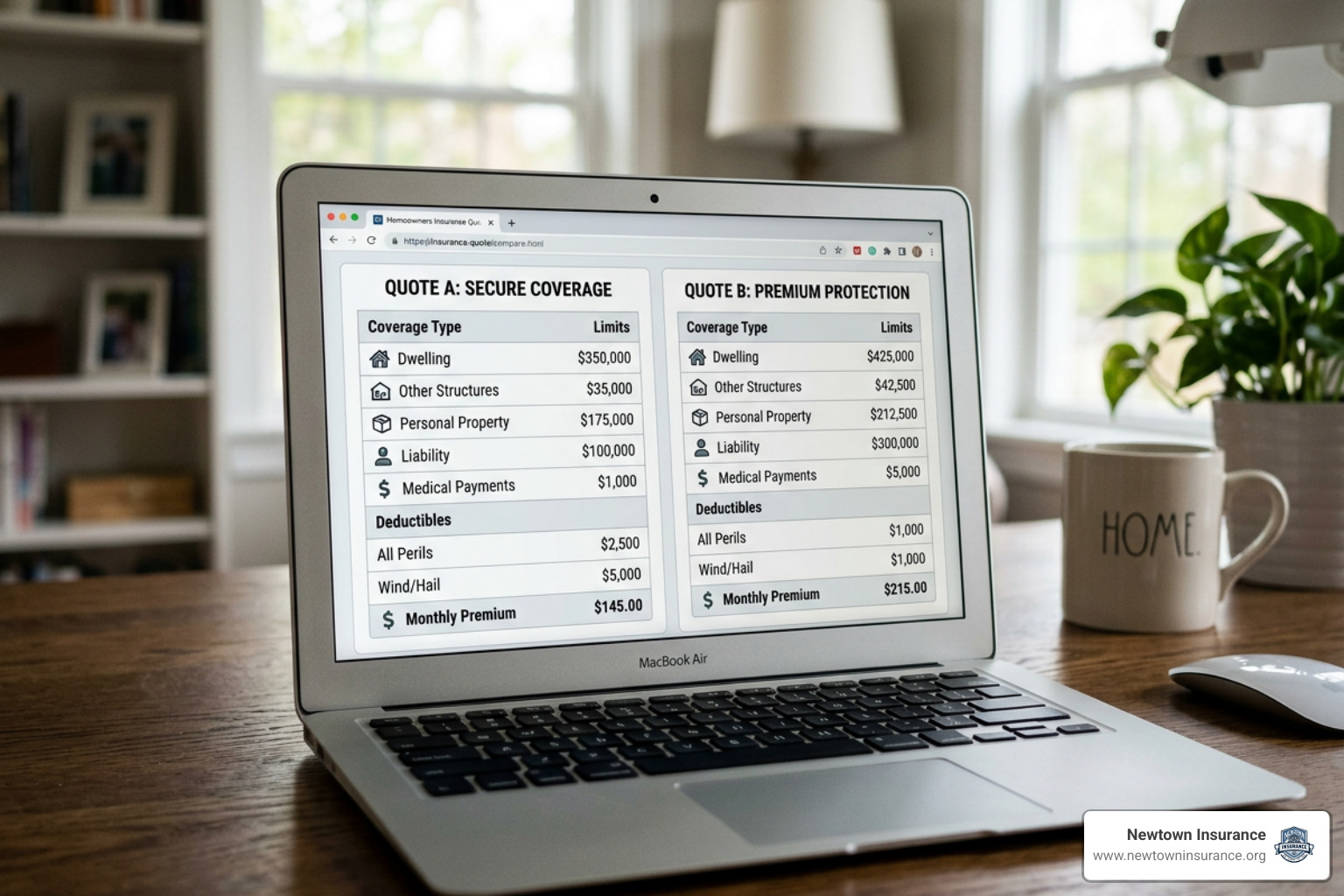
When you use a high-quality comparison site, you enter your property details once. The platform queries multiple carriers on your behalf to generate side-by-side quotes. Many of these platforms use soft credit inquiries, which do not affect your credit score but allow for much more accurate estimates.
By using a secure intermediary, you prevent your contact details from being distributed to dozens of different sales agents. To find the safest options for this step, read our guide on the Best Website to Compare Home Insurance Quotes.
Step 3: Provide Limited or Temporary Contact Details
If a comparison site or carrier website requires contact information before displaying your quotes, you don’t have to use your primary personal details. You can easily protect your main inbox and phone line by using temporary alternatives:
- Create a Secondary Email Address: Set up a free, dedicated email account (e.g., through Gmail or Outlook) specifically for insurance shopping. You can review all your quotes in one place, and if the spam becomes overwhelming, you can simply close the inbox.
- Use a VoIP Phone Number: Use a free service like Google Voice to create a temporary phone number. This allows you to receive automated text verifications or quote updates without giving out your actual mobile number.
- Use a Generic Name: If a form requires a first and last name just to show an initial estimate, using a generic placeholder (like “Newtown Resident”) is a simple way to keep your search private until you decide to move forward.
For more strategies on keeping your data secure while gathering rates, check out this guide on Free Home Insurance Quotes Without Personal Info.
Pros and Cons of Anonymous Home Insurance Estimates
Shopping anonymously is a fantastic way to protect your peace of mind, but it does come with specific limitations. To help you decide if this is the right path for your current search, we have compiled a quick comparison of how anonymous estimates stack up against traditional, personalized quotes.
| Feature | Anonymous Estimates | Traditional Personalized Quotes |
|---|---|---|
| Spam Prevention | Excellent. No phone calls, text messages, or persistent emails. | Poor. Often results in immediate follow-up calls and marketing campaigns. |
| Data Security | High. Your sensitive data (SSN, DOB, claims history) remains private. | Moderate. Your personal data is stored in carrier databases and shared. |
| Rate Accuracy | Moderate (80% – 90%). Based on regional averages and public property records. | High (95% – 100%). Based on your exact credit score and CLUE claims report. |
| Time Commitment | Very Fast. Estimates are typically generated in under 30 seconds. | Slow. Forms can take 15 to 30 minutes to fill out completely. |
| Binding Coverage | Impossible. Cannot be used to purchase or finalize a legal policy. | Yes. Ready to be signed, paid for, and bound immediately. |
As you can see, anonymous estimates are the perfect tool for the initial research phase. They allow you to compare prices across the market without any sales pressure. However, when you are ready to actually purchase a policy, you will need to transition to a personalized quote.
To explore how to manage this transition smoothly, read our Compare Insurance Quotes Complete Guide.
How to Protect Your Privacy While Shopping for Coverage
If you do decide to shop online, it is important to understand that the internet is filled with data brokers looking to package and sell your search history. Fortunately, taking a few simple security precautions can dramatically reduce your digital footprint.
Use Secure and Reputable Websites
Before entering any details about your home—even generic ones—ensure that the website you are using is secure.
Always look for the padlock icon in your browser’s address bar, which indicates an active SSL (Secure Sockets Layer) encryption connection. A secure connection ensures that the data you send to the website cannot be intercepted by third parties.
Furthermore, take a moment to look at the site’s privacy policy. Reputable sites will explicitly state that they do not sell your information to third-party advertisers. You can also adjust your browser’s cookie settings to block tracking cookies, preventing ad networks from following you around the web with home insurance advertisements after you leave the site.
To learn more about how we handle data security and protect our clients, check out our resource on Personalized Insurance Quotes.
Understand how to get home insurance quotes without personal information safely
To protect your privacy safely, you should understand how insurance sites gather data. Many modern digital platforms use public property records to pre-fill information about your home. When you enter an address, the system automatically pulls your home’s square footage, year built, and construction type from municipal databases.
While this makes the quoting process faster, it also means your property data is actively being queried. To keep this process secure:
- Use reputable platforms that do not require an upfront phone number to unlock this public data.
- Utilize your browser’s private or “Incognito” mode to prevent search history tracking.
- Once you finish your research, you can submit opt-out requests to major data brokers to remove your public records from their immediate search tools.
If you are also shopping for other types of coverage and want to keep your personal details secure across the board, check out our Car Insurance Quote No Personal Info Guide.
Transitioning from an Anonymous Estimate to a Bound Policy
Once you have used anonymous tools to find a rate and coverage structure that fits your budget, the time will come to finalize your coverage. You cannot legally bind an insurance policy anonymously.

When you are ready to transition from an estimate to a bound policy, you will need to provide your full legal name, date of birth, and Social Security number. This allows the underwriter to:
- Verify Your Identity: To prevent insurance fraud and comply with federal regulations.
- Run a Formal Credit and Claims Check: To finalize your exact premium.
- Coordinate with Your Mortgage Lender: If you have a mortgage, your lender will require proof of active coverage (often paid directly through an escrow account) before your closing date.
By keeping your search anonymous until this final step, you ensure that you only share your personal details with the one insurance provider you have actually chosen to do business with.
Frequently Asked Questions About Anonymous Quoting
Shopping for insurance can raise a lot of questions, especially when it comes to protecting your personal data. Here are some of the most common questions we hear from Pennsylvania homeowners.
Can I buy a policy using how to get home insurance quotes without personal information?
No, you cannot purchase or bind a home insurance policy anonymously. Insurance policies are legal contracts that require a verified legal identity.
Insurers must confirm exactly who they are insuring to prevent fraud and to ensure that payouts are made to the correct property owner in the event of a claim. For a broader look at how identity and anonymity work in other areas of insurance, you can read our article: Can You Get Health Insurance Quote Without Giving Personal Information.
How accurate are home insurance quotes with no personal info?
They are highly accurate for general budgeting—typically within 10% to 25% of the final cost—but they are not exact.
Because anonymous quotes rely on regional averages rather than your personal credit score, claims history, or the exact age of your roof, your final premium may vary once a formal underwriting check is completed. However, they are incredibly useful for identifying which insurance carriers offer the most competitive base rates in your area.
Will getting an anonymous quote affect my credit score?
No. Simply using an online calculator or entering basic details on a comparison site will never affect your credit score.
Even when you transition to a formal quote and the carrier runs a credit-based insurance check, they perform what is known as a “soft pull.” Unlike a “hard pull” (which occurs when you apply for a credit card or a mortgage), a soft inquiry has zero impact on your credit score.
Conclusion
Shopping for home insurance in Pennsylvania doesn’t have to mean giving up your privacy or dealing with endless sales calls. By utilizing online calculators, secure comparison platforms, and temporary contact details, you can take complete control of your shopping experience. You get to decide when you are ready to have a conversation—not the other way around.
At Newtown Insurance, we believe in smart savings, tailored protection, and completely transparent pricing. We want to help you find the best possible coverage for your home without the hassle, the pressure, or the spam.
When you are ready to take the next step and secure a highly accurate, personalized quote for your property, we are here to help. Explore Our Tailored Protection Services today, or read through our Home Insurance Pennsylvania Complete Guide to learn more about protecting your biggest investment.